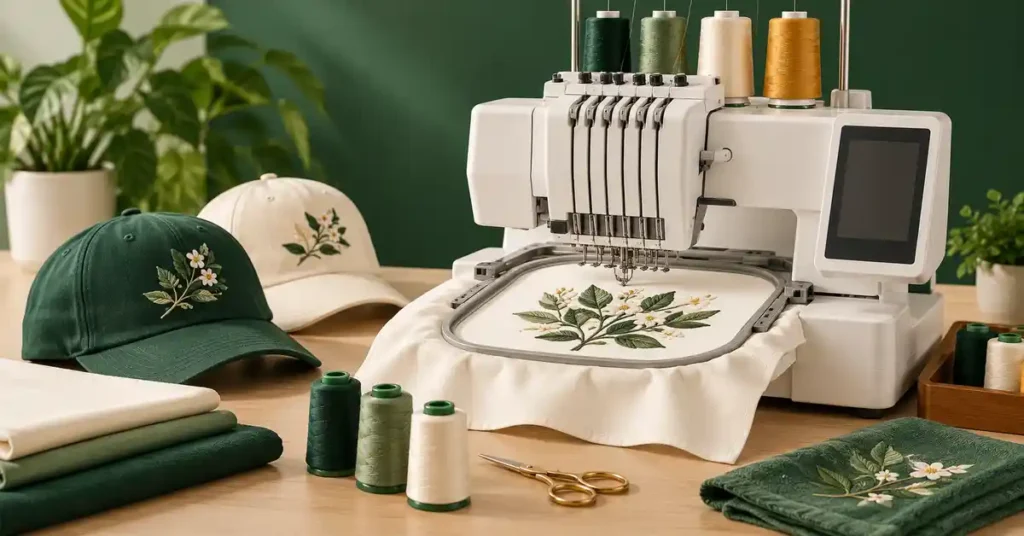
Ricoma embroidery machine reviews should identify the exact machine revision, included equipment, and support arrangement before comparing production claims. A single-head multi-needle system can reduce some manual color changes, but it does not create guaranteed orders or effortless output. This guide evaluates the EM-1010 buying proposition, explains cap and garment checks, and connects the purchase to thread organization and repeatable job records so you can assess a complete working setup.
As an Amazon Associate, Practical Textile earns from qualifying purchases. Product links may earn us a commission.
Quick Answer
Compare an exact US EM-1010 quote as a ten-needle, single-head workflow, with controller revision, stand, cap equipment, software, and instruction identified separately. Published packages differ. The Amazon cards show a different-brand multi-needle comparison and a different-category home option; they are not Ricoma listings.
This guide compares published specifications and project fit; it does not report hands-on testing.
Smartstitch S-1001

Check exact equipment, support, and revision before comparing cost.
Brother PE900

Consider only when modest flat work and manual color changes fit.
The Quote Is Part of the Machine Review
| Quote item | What to establish |
|---|---|
| Machine identity | Revision, controller, electrical configuration |
| Workstation | Stand, delivery, assembly, installation |
| Product equipment | Exact flat hoops and cap system |
| Software | Capabilities, license, term, transfer rights |
| Support | Training, service route, coverage, freight responsibility |
EM-1010: Understand the Single-Head Multi-Needle Role
The EM-1010 has ten needle positions on one head. Prepared colors can reduce manual rethreading during a suitable design, but the head stitches one item at a time. Needle count should not be multiplied into a claim about simultaneous garment output.
Ricoma’s published materials show controller and package differences across offers and regions. An older official page and a newer regional bundle should not be merged into one assumed US specification. Ask the seller to document the actual controller and equipment in your order.
That identification is also important for training and parts. A general EM-series demonstration may explain a broad concept without establishing the exact operating sequence or accessory compatibility for the unit you receive.
A Useful Demonstration Uses Your Products
Bring the actual file and blank. Ask to load the design, map colors to needles, select the proper frame, position and trace the field, stitch, unload, trim, and inspect. A preselected showroom logo does not answer whether your small lettering or dense border works on the intended material.
Test a cap separately from a flat garment. Curved finished caps have different design and access requirements, and a flat field measurement does not establish the cap field. Confirm the driver, frames, loading equipment, and instruction supplied.
Time the entire cycle rather than only active stitching. Hooping, color preparation, interruptions, bobbin work, trimming, and inspection affect usable output. Those observations are more practical than converting maximum advertised speed directly into finished orders per hour.
Calculate Ownership Without an Income Promise
Include digitizing, blanks, thread, backing, needles, frames, maintenance, training, and spoiled samples. If financing is considered, compare total repayment and fees separately from the machine price. A monthly payment is not evidence of customer demand or profitable capacity.
Transfer software, lettering, editing, and digitizing are different tools. Have the seller perform your required operation using the actual included license. A trial or subscription promotion should not be treated as a permanent full digitizer.
Five Potential Benefits and Two Commitments
- Prepared colors reduce some manual changes.
- A dedicated workstation can organize repeat embroidery.
- Compatible cap and garment equipment broadens the workflow.
- Structured training can establish correct setup habits.
- Documented job settings support repeat orders.
Two commitments remain: one head still requires item-by-item handling, and service, accessories, training, and consumables add to the initial purchase. Neither machine ownership nor a package testimonial guarantees income.
Compare Different Equipment Honestly


The S-1001 is another single-head multi-needle comparison with its own support and accessories. PE900 is a smaller home embroidery category, not an equivalent tubular cap system. Compare the workflow you actually need rather than treating every embroidery machine as the same purchase.
Read our commercial guide, Smartstitch review, and multi-needle comparison. The cap guide and PE900 review clarify the category boundaries.
Project Preparation and a Repeatable Sewing Setup
Thread identity and job records are part of an organized Ricoma workstation. The following checks distinguish hand and machine supplies, preserve color information, and support repeatable sampling instead of treating the machine as the only quality variable.
Separate hand and machine embroidery thread
Stranded hand floss, pearl cotton, and machine embroidery thread have different structures and uses. A skein that works well in hand stitches should not automatically be put into a machine’s needle path. Check the product’s intended application and the machine’s supported thread arrangement before treating visually similar colors as substitutes.
For hand embroidery, choose the working thickness and needle around the stitch and fabric. If using stranded floss, record the intended strand count. A large decorative flower and small lettering can need different choices. Color alone does not determine whether the thread will pass through the fabric and sit as intended.
For machine embroidery, check the upper and bobbin setup, needle, design requirements, and material support. Do not assume that the same thread belongs in both positions unless the method specifies it. A good thread choice works with the whole setup rather than replacing correct threading and a suitable design.
Define quality through the project requirements
Useful checks include identifiable product information, consistent feeding or handling in the intended method, appropriate color and care behavior, and a sound sample. Price or a large spool count does not establish that a collection is suitable for your work. An inexpensive but incompatible assortment can be less useful than a smaller clearly labeled set.
Inspect the actual material for damage, contamination, or handling problems. If thread frays in use, check the needle, threading path, tension, fabric resistance, and spool feed as well as the thread. Do not declare one brand defective from a sample sewn with an unsuitable needle or an incorrectly threaded machine.
Keep the label and purchase details for a successful product. If a problem appears later, knowing the product and color code helps you investigate or reorder. A loose spool labeled only white may be difficult to distinguish from several other threads that have different thickness, fiber, or intended use.
Compare thread products without confusing numbering systems
Thread thickness can be described through different numbering systems, and those numbers should not be transferred blindly between ranges. Read the manufacturer’s explanation and intended use. A larger printed number does not provide one universal instruction about thickness across every kind of thread.
Compare spool size and quantity on consistent terms. A set containing many small colors is a different purchase from a few larger spools of frequently used shades. Check actual length or quantity, the relevant range, and whether replacements can be identified. The number of items in a photograph does not establish the amount of usable thread.
Choose the first collection around defined projects. If a design uses a short list of colors, buying those identified colors may be more practical than an enormous assortment whose labels are unclear. Expand through actual use so the storage plan grows with materials you can recognize and replace.
Distinguish screen color, print, and actual thread
A screen displays light, a printed page uses inks, and a thread reflects light from its own surface. Their appearance can differ with display settings, lighting, gloss, and the surrounding material. An online chart is useful for planning but should not be treated as a guarantee of an exact visual match on your finished fabric.
For an important match, compare the actual thread with the fabric under the intended lighting where possible. A shade that looks correct beside white paper may appear different on a dark or patterned garment. Keep a stitched sample when the thread surface and density affect the result.
A DMC-to-another-brand conversion is an approximation unless the relevant makers establish otherwise for the exact products. Similar numbers from different brands are not inherently matching colors. Label the substitute and sample it rather than quietly treating it as the same identified material in repeat orders.
Organize machine spools and hand floss separately
Choose storage that protects the material and keeps the identification visible. A rack, drawer, box, or binder can each work when it suits the products and room. Check dust, light, moisture, heat, and tangling risks. Decorative display is useful only if the thread remains identifiable and in suitable condition.
If winding hand floss onto cards, transfer the full relevant code and range before discarding any original band. Keep partial project lengths labeled too. For machine spools, secure loose ends without damaging the material or hiding the label. A tidy-looking drawer is less useful if several similar white products become indistinguishable.
Store bobbins by machine compatibility and thread information. Similar-looking bobbins can differ in specification. Do not mix them in one container simply because their colors match. Keep a record of the bobbin arrangement used in embroidery separately from ordinary sewing where the setups differ.
Sample specialty thread as its own setup
Use the thread maker’s current needle and operating recommendations together with the machine manual and the actual fabric and design. Do not copy a universal needle size or speed from an unrelated specialty thread. A small sample helps identify feeding, abrasion, coverage, and the way the thread interacts with other colors.
Inspect both surfaces after the full stitch-out and appropriate finishing. Evaluate the effect after the required light exposure and care where relevant. Record the product, design, needle, support, and settings. If the sample fails, change one factor deliberately rather than adjusting several controls while continuing on the final garment.
Build a project record that can be repeated
For each design, retain the original color list, actual products used, substitutions, thread positions, and care information. Add a small stitched sample where matching matters. This record is especially helpful when a hand-embroidery design and a machine design use related colors but different thread products.
As a practical example, a floral motif might use DMC hand floss for a sampler and a separate machine-thread range for clothing. Keep both lists rather than translating one number directly onto the other brand. If adding glow detail to the machine version, identify it as another material change and sample the design again.
Reassess old or unlabelled thread
There is no single age limit in this guide that proves every spool is usable or unusable. Product, storage, visible condition, and actual behavior matter. Inspect a questionable thread and test it before using it in an important seam or design. Do not hide unexplained breakage by continually increasing tension or sewing slower without diagnosing the setup.
If identification is lost, describe the material honestly and avoid relying on it for an exact repeat color or an unverified machine application. Keeping an anonymous remnant for an appropriate low-risk practice sample is different from promising it as a matched product in a customer order.
Make a thread inventory that preserves identity
List the brand, range, identifying shade code, product or thickness information, and approximate remaining quantity in a practical format. Keep hand floss, machine thread, bobbin setups, and specialty products distinguishable. An inventory that records only a general color can make an exact repeat order difficult even when the collection looks organized.
For a substitution, retain both the original specified product and the actual replacement used. Add a stitched sample when appearance matters. A printed conversion reference can help shortlist colors, but it should not quietly erase the difference between products from two ranges.
For glow thread, add the maker’s current setup and care information and keep its decorative role clear. Record the conditions of any sample photograph rather than presenting it as a brightness test. Changing the fabric color or design coverage can alter appearance without changing the thread product.
Review the inventory through real projects. Reorder identified materials you use regularly, and avoid buying a large anonymous assortment merely to increase the color count. A smaller collection that can be matched, stored appropriately, and repeated is often easier to use than one whose labels and origins are lost.
Frequently Asked Questions
Does ten needles mean ten garments at once?
No. Ten positions prepare different threads on one head. The machine still stitches one item at that head, and loading and finishing remain part of production.
Are all EM-1010 packages the same?
No assumption of identical offers is justified. Request the exact US revision, controller, stand, frames, cap equipment, software, and written support terms.
Can it stitch my logo without digitizing?
A compatible stitch file is required. An ordinary picture is not automatically suitable. Confirm whether the included software or service actually prepares the intended design.
How should I judge support?
Identify who diagnoses faults, where service occurs, when instruction is available, and who pays travel or freight. Clear responsibilities matter more than a broad support slogan.
Is it a profitable first business machine?
Profit depends on demand, pricing, labor, digitizing, consumables, quality, and support. Use measured full-cycle samples and realistic costs rather than a brand-based revenue promise.
Final Recommendation
Evaluate Ricoma through an exact EM-1010 package and your real product samples. Confirm revision, equipment, software, and support, then calculate the full workflow. Buy demonstrated capacity and usable instruction rather than an advertised output or income forecast.