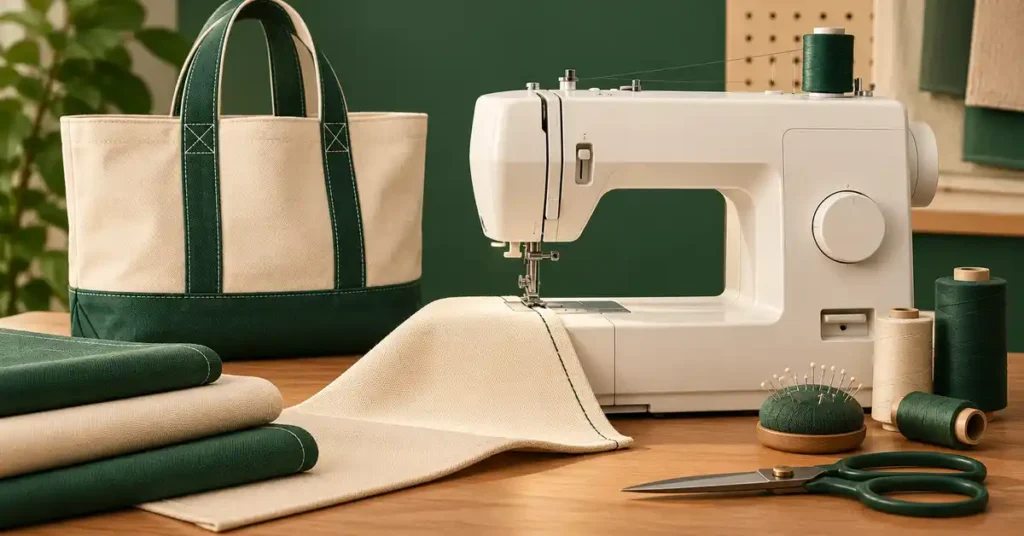
The best sewing machine for canvas depends on the material's density, coating, folded seams, and intended use. A lightweight tote and a reinforced outdoor cover can require very different equipment. This guide compares household options for suitable canvas projects, explains where their limits matter, and shows how to assess needles, thread, feeding, and workspace before choosing a machine that must handle more than a flat fabric sample during actual construction.
As an Amazon Associate, Practical Textile earns from qualifying purchases. Product links may earn us a commission.
Quick Answer
Compare the Singer 4423 for mechanical sewing with pressure adjustment, the Brother ST371HD for mixed household utility work, and the Brother PQ1600S for an appropriate straight-stitch workflow. These are domestic options for compatible projects, not universal recommendations for marine canvas, stiff coated covers, or heavily reinforced production work. Test the thickest complete seam before buying.
This guide compares published specifications and project fit; it does not report hands-on testing.
Singer Heavy Duty 4423
Evaluate pressure adjustment and the actual folded canvas construction.
Brother ST371HD

Compare useful utility stitches and handling on a representative project sample.
Brother PQ1600S

Consider only when straight stitching suits the material and construction.
First Decide What Kind of Canvas Work You Mean
Canvas describes a broad fabric category, not a machine-capacity standard. A supple cotton canvas used for an everyday tote behaves differently from dense coated fabric folded around binding and webbing. Even two materials with a similar stated weight can differ in stiffness, friction, and resistance to needle penetration. The finished seam matters more than the category name.
This shortlist focuses on domestic sewing options for suitable projects. If you regularly construct stiff outdoor covers, reinforced equipment bags, or thick layered assemblies, begin by assessing whether a purpose-built industrial or portable walking-foot setup is required. Choosing a household machine first and redesigning every difficult seam around its limitations can become an expensive compromise.
Make a construction sample that includes every layer likely to meet at the hardest intersection. Include lining, reinforcement, seam allowances, and webbing where applicable. A machine that stitches two flat layers comfortably has not thereby demonstrated that it can manage a boxed corner or a folded handle attachment made from the same fabric.
| Option | Reason to compare | Reason to pause |
|---|---|---|
| Singer 4423 | Mechanical utility sewing with foot-pressure adjustment | Domestic limits still apply at bulky intersections |
| Brother ST371HD | General household canvas and mixed-material projects | Do not assume adjustable pressure or industrial feed |
| Brother PQ1600S | Dedicated straight-stitch workflow | No zigzag, buttonhole, or compound walking-foot system |
Singer 4423: Compare It for Manageable Household Canvas
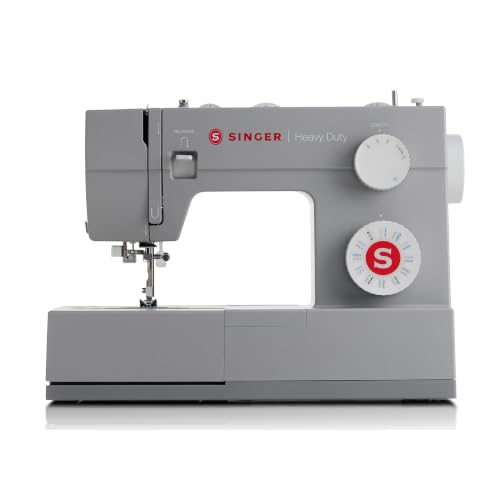
The Singer 4423 is worth evaluating when you want mechanical controls and expect to sew canvas alongside ordinary household fabrics. Adjustable presser-foot pressure gives you a way to assess the feeding setup on compatible materials. The adjustment should be tested methodically rather than treated as permission to place an increasingly thick stack under the foot.
The machine offers straight stitching and utility options that can be useful when a project includes linings, closures, or other non-canvas components. Its one-step buttonhole may matter for general sewing, but it is not a reason to select it for a dense canvas application. Prioritize a satisfactory seam sample and comfortable slow-speed operation over unrelated features.
Examine the start and end of each sample, not just the smooth middle section. The machine must begin feeding without pulling from behind and should move across an appropriate intersection without visible needle deflection or repeated failed stitches. If you need to force the material or help the motor overcome the stack, the sample has exposed a suitability problem.
Our Singer 4423 review provides the broader model context. You can also read the Singer 4432 comparison when considering stitch selection. A larger stitch menu should not be mistaken for a higher material-capacity rating.
Brother ST371HD: Utility Sewing Across a Mixed Project


The Brother ST371HD is a mechanical household machine positioned for varied sewing and mending. It is relevant when your canvas project also involves ordinary woven lining, a zipper, or smaller utility operations. Brother has published a canvas-tote project using this model, which establishes a more specific intended application than an unlimited claim about every outdoor fabric.
Its supplied accessory selection includes a nonstick foot, useful to evaluate on compatible surfaces that resist smooth movement. That foot does not add a powered upper feed or make every coated fabric appropriate. Check the material maker’s sewing advice and the machine instructions before deciding whether the surface, needle holes, and seam design suit the intended use.
The ST371HD should not be selected on the assumption that it has adjustable presser-foot pressure. Nor does its heavy-duty branding make it an industrial walking-foot machine. The useful question is whether a complete sample feeds and stitches consistently within the manufacturer’s guidance. A realistic tote sample tells you more than forcing a large number of loose fabric scraps into a demonstration.
Use our Brother machine guide to compare its role with other household options. If you later add a compatible walking-foot attachment, confirm exact fit; our Brother walking-foot guide explains why accessory compatibility must be checked by model.
Brother PQ1600S: A Straight-Stitch Role With Clear Boundaries

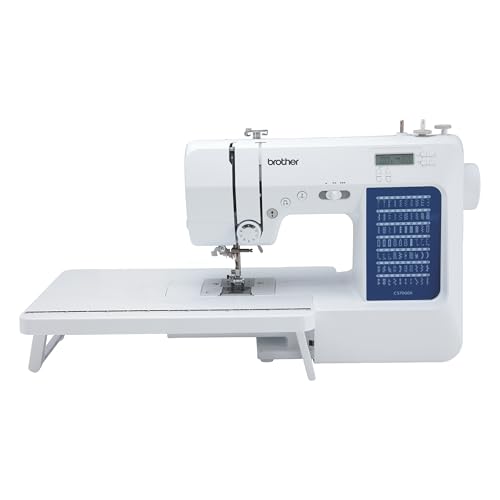
The Brother PQ1600S is worth considering when suitable canvas construction forms part of a repeated straight-stitch workload. Its table and operating features can help organize longer seams and larger panels. However, its primary distinction is being a straight-stitch specialist, not being an all-purpose solution for anything labeled heavy fabric.
Its pin-feed feature should not be confused with compound walking-foot feed. These mechanisms are different. A description of one cannot establish the performance of the other on thick, slippery, or uneven assemblies. Assess the complete project, the compatible feeding settings, and the machine’s intended use before treating this model as an alternative to specialized upholstery or marine equipment.
The PQ1600S also cannot supply zigzag or a conventional buttonhole. If your canvas work needs those operations, plan another suitable machine or reconsider the workflow. A specialist makes sense when it solves a recurring, defined job. It makes less sense when most projects immediately require a second machine that was not included in the budget.
Useful Reasons to Compare This Shortlist
- It separates general household sewing from straight-stitch specialization.
- Each option has a clear role to evaluate with real fabric samples.
- Mechanical utility choices remain useful for linings and closures.
- The Singer offers an adjustable-pressure setup to assess.
- The specialist can support an organized straight-seam workflow.
Important Limits
- None should be assumed suitable for every canvas weight, coating, or reinforcement stack.
- A domestic attachment or pin-feed feature does not establish industrial compound-feed capability.
Build a Sample That Represents the Hardest Part
Cut enough material to reproduce a meaningful section of the project. For a bag, that might include a seam allowance turned across another seam and the point where a handle joins the body. For a cover, include binding and any reinforcement patch. A short, unrealistic sample can hide both feeding problems and the difficulty of maneuvering the finished shape.
Mark a straight reference line and sew at a controlled pace. Inspect stitch consistency, top and underside tension, and any tendency for one layer to move ahead of the other. Then examine the reverse and restart areas. Do not accept a clean-looking top surface without checking whether the underside has loops or whether the seam weakens when gently handled.
Record the sample setup so you can repeat it. Include the exact fabric, layers, needle, thread, foot, and settings. A shop demonstration on a different canvas is useful for learning the controls, but it does not establish suitability for your material. Ask whether you can bring the actual construction sample before arranging a demonstration.
Match Needle and Thread to the Machine and Fabric
Begin with the needle system specified by the machine. Within that system, select a point and size suitable for the fabric and permitted thread. Dense canvas often makes needle condition especially noticeable, so replace a damaged or worn needle rather than continuing until stitches fail. If penetration or feeding is unreliable, stop and investigate the complete setup.
Do not assume that very thick bonded thread belongs in every domestic machine. Thread must pass through the needle and tension system and form a balanced stitch within the machine’s design. A visually impressive thread size is not evidence of suitability. Consult the exact model instructions and material requirements instead of copying the settings from an unrelated industrial machine.
For Brother models, our needle-size guide provides background. Use it alongside the manual for the particular machine. Do not resolve every skipped stitch by moving to a larger needle, because needle point, thread compatibility, threading, and machine condition can all affect the result.
Understand Fabric Feeding Before Buying Accessories
Canvas layers can shift when one surface meets more resistance than another. Supporting the project, managing seam allowances, and selecting an appropriate foot may help within the machine’s limits. A compatible walking-foot attachment can be useful for some layer-control problems, but it has its own operating restrictions and should not be described as an industrial feed conversion.
Check compatibility with the precise machine model, including shank, attachment instructions, and stitch-clearance restrictions. A foot advertised for a brand may not fit every model in that brand. Turn through the clearance checks required by the instructions before powered sewing, and keep the needle path clear of attachment parts.
A nonstick foot addresses a different concern: friction against a surface that does not slide readily. It does not necessarily move the top and bottom layers in a synchronized manner. Choose accessories according to the problem observed in the sample rather than accumulating tools whose names sound related to heavy sewing.
Construction Choices Can Reduce Unnecessary Bulk
Review the pattern before cutting. Some designs place several folded allowances and reinforcement pieces at one point even when another seam layout would meet the same non-safety-critical purpose with less bulk. A thoughtful construction sequence can make a compatible project easier to sew and press without asking the machine to penetrate an avoidable stack.
That does not mean removing reinforcement from a load-bearing application without a sound design basis. Structural straps, attachment points, and protective equipment require appropriate engineering and testing. A neat line of stitches is not proof that a seam is strong enough for a particular load or exposure. Select suitable professional equipment and expertise where the application requires it.
For ordinary household projects, consider how seams will be finished and accessed. A boxed corner may become difficult after the bag is assembled, while an open panel is easy to support. Planning when to attach a pocket or zipper can prevent an awkward final operation that no additional stitch pattern will make comfortable.
Give Large Panels a Stable Path Through the Machine
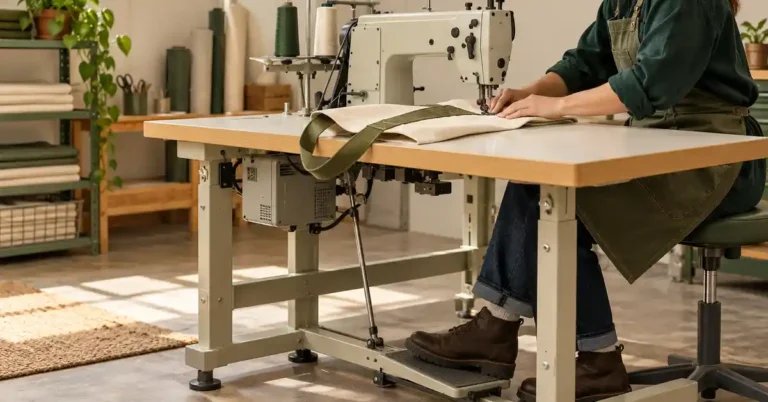
The weight of a canvas panel can pull against the feed system if most of it hangs off the table. Support the material in front, behind, and beside the needle as appropriate. Keep the pathway clear so the panel does not catch on a table corner or another object. The operator should guide the seam rather than carry the full project weight through the machine.
Consider the room needed to turn the project, not only its flat dimensions. A partly assembled bag or cover may become stiff and awkward to rotate. A machine with a useful table still needs enough surrounding space. Test your working posture and visibility while managing a similarly sized sample before deciding that a compact station will be sufficient.
If seams become inconsistent, work through one variable at a time. Recheck threading and the needle, then assess feeding and suitable settings. Our Brother tension guide offers a systematic starting point for applicable machines. Avoid repeated tension changes that attempt to compensate for unsupported fabric weight or an unsuitable stack.
Frequently Asked Questions
Can a regular sewing machine sew canvas?
Some domestic machines can sew suitable canvas projects with appropriate materials and settings. The actual density, coating, folded seam, thread, and required use determine suitability. The word canvas alone does not establish whether a machine will handle the construction.
Is the Singer 4423 suitable for every canvas bag?
No. It is a domestic option to evaluate for compatible projects. Reinforced handle attachments, dense material, and multiple folded intersections can exceed a suitable household workflow. Test the complete hardest seam rather than relying on the model’s heavy-duty label.
Does a walking-foot attachment make a domestic machine industrial?
No. A compatible attachment can help with particular feeding problems, but it does not replace the machine’s underlying drive, feed system, needle system, or operating limits. Choose purpose-built equipment when the construction requires it.
Should I use the thickest thread I can find?
No. Use thread that suits both the application and the machine’s permitted setup. Very thick thread can be incompatible with a domestic needle or tension system. A balanced, appropriate seam matters more than the visual thickness of the thread.
Which option should I compare first?
Compare the 4423 and ST371HD for mixed household work, then consider the PQ1600S if a defined straight-stitch role fits your projects. For stiff reinforced outdoor work, assess specialized equipment before assuming any of these is the right starting point.
Final Recommendation
Buy according to the complete canvas construction, including its hardest intersection and intended use. The three options here serve different domestic workflows and should earn a place through a representative sample. When the sample exposes inadequate feeding, strain, or unreliable stitching, choose a more suitable equipment class instead of forcing a machine to perform beyond an appropriate role.