
Singer Heavy Duty 4432 Review: What the Extra Stitches Add
A Singer Heavy Duty 4432 review should answer whether its extra stitches improve the projects you actually sew. This mechanical machine sits among.

This guide has Amazon links. If you buy through them we may earn a small commission, at no extra cost to you.
A Singer Heavy Duty 4432 review should answer whether its extra stitches improve the projects you actually sew. This mechanical machine sits among several similar-looking Singer models, making feature counts and bundle photographs easy to confuse. The guide below explains its practical role, compares it with the 4423 and 4452, and shows how to evaluate buttonholes, fabric handling, accessories, and buying terms before choosing a machine for your sewing table.
As an Amazon Associate, Practical Textile earns from qualifying purchases. We may receive a commission through product links.
What’s in this article11 sections
Quick Answer: Should You Choose the Singer 4432?
Consider the 4432 if you want mechanical home sewing and will use its additional stretch or decorative selections compared with the 4423. Do not choose it expecting the stitch count to provide greater industrial capability. Compare the exact 4452 bundle if accessories interest you, and investigate a computerized option if a separate speed limiter is a priority.
This is a specification-based review. We have not conducted hands-on fabric tests or measured reliability, speed, noise, or motor performance.
Singer Heavy Duty 4432

Compare it when the stitch chart contains options your projects need.
Singer Heavy Duty 4423
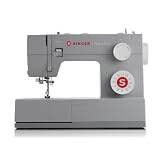
Compare the current offer if basic construction functions are sufficient.
Singer Heavy Duty 4432: What the Machine Offers
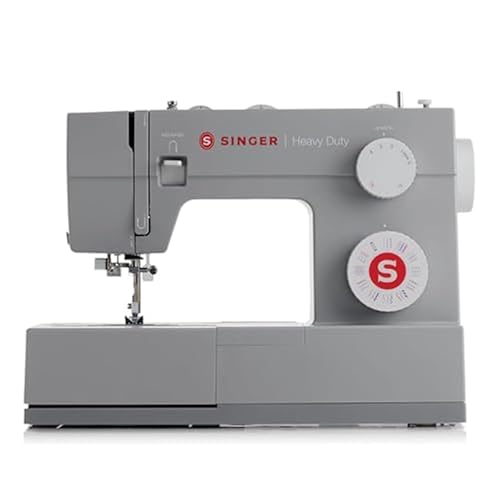
Singer describes the 4432 as a mechanical domestic machine with 32 built-in stitches, a one-step buttonhole, top-loading bobbin, needle threader, and adjustable presser-foot pressure. These are useful distinctions when you compare a specific sewing routine. None establishes how a particular dense seam stack will behave without a relevant sample.
The machine belongs on a home-sewing shortlist for varied utility work, not on an industrial-equipment shortlist merely because of the Heavy Duty name. Its interior metal frame and stainless steel bedplate describe construction features. They do not mean every part is metal, every accessory is suitable for heavy materials, or every fabric can be sewn at the advertised maximum speed.
Think about the operations you perform every week. If you repair garments, make straightforward clothing, and occasionally add stretch or decorative details, the feature set may be relevant. If you mostly sew long straight seams, compare whether those extra selections add value. If you need automatic embroidery, you are shopping in the wrong category.
32 Built-In Stitches Is Different from 110 Stitch Applications
The 4432’s 110 applications describe techniques possible with the available stitches. The number is not a count of 110 independently selected stitch patterns. A straight stitch, for example, can participate in multiple construction operations without becoming a different built-in stitch each time.
When comparing machines, place their actual stitch charts beside your project list. Identify the straight, zigzag, stretch, buttonhole, and decorative patterns you will use. That is a fairer comparison than placing one brand’s applications total against another brand’s count of built-in selections.
Extra patterns can be useful when they perform a task you would otherwise struggle to complete. A decorative border that suits a household project may be worthwhile; an unused group of stitches contributes little to repairing trousers. Neither preference is wrong. The purchase should reflect the sewing you want to do rather than the longest available feature list.
Also consider adjustment and control. A pattern you can select is not automatically the right stitch for a fabric, and using the wrong foot or width can cause problems. Learn the recommended combinations from the manual and test the complete seam before treating a new stitch as ready for a finished garment.
Singer 4432 Versus 4423 and 4452
| Model | Built-in stitches | Main comparison point | What not to assume |
|---|---|---|---|
| 4423 | 23 | Whether its utility range already covers your work | Fewer stitches do not automatically mean inferior seam quality. |
| 4432 | 32 | Whether the extra selections will be used | A larger stitch menu does not create industrial feeding. |
| 4452 | 32 | The exact current accessory bundle and offer | Every seller package may not include identical extras. |
This table does not establish identical internal components or measured performance across models. It highlights the most practical first comparison for a home sewist: stitch needs and supplied accessories. Read the current model descriptions and inspect the relevant control details before concluding that two similar-looking machines are interchangeable.
Our Singer 4423 review considers the simpler stitch-menu option. Our Singer 4452 review examines the accessory question. Compare the total cost of the machine and the compatible accessories you need rather than treating a model-number increase as an automatic upgrade.
Clothing, Repairs, and Buttonholes
Ordinary construction is the strongest starting use
For woven clothing, evaluate how comfortably you can maintain the seam allowance, guide a curve, insert a zipper, and handle the garment around the needle. Those actions will influence the experience more often than an occasional decorative stitch. Keep the work supported so its weight does not pull against the feed.
A free-arm arrangement can help with accessible tubes, but it does not fit every cuff or sleeve. Plan the construction sequence around the garment. Small openings may be easier to sew before closing another seam, or from a different accessible position, rather than forcing them over the machine’s arm.
A one-step buttonhole still needs a proper sample
Test through the same fabric, interfacing, and number of layers used in the finished garment. Position the button and required controls according to the manual, then inspect the complete result before cutting it open. Check the actual button through the sample; appearance alone does not establish a comfortable fit.
Bulk near the buttonhole can affect how the foot rests and travels. Leave room around seam intersections when the pattern permits, and confirm that the fabric can move through the whole sequence without obstruction. Automatic sequencing reduces manual stages, but it does not correct inaccurate marking or unsupported fabric.
Denim, Canvas, Knits, and Leather: Use a Project-Based Check
Denim and canvas
A flat seam in garment denim is different from a folded hem crossing a thick side seam. Likewise, a lightweight canvas tote panel differs from a dense bag corner containing webbing and several folded allowances. Test the actual construction, not just a single piece of the fabric.
Choose suitable needles and thread, follow the manual’s permitted combinations, and reduce unnecessary bulk where the design allows. If the foot becomes severely tilted, an appropriate leveling method may help the feed approach the crossing more evenly. It does not increase the machine’s underlying capacity.
Stop if the needle meets resistance, the machine labors, or the fabric cannot move normally. More pedal pressure is not an appropriate diagnostic tool. For frequent dense assemblies, investigate specialized equipment and request a demonstration using your own seam stack.
Knits and lightweight material
A stretch-stitch option is only one part of sewing a knit. Needle choice, seam construction, stabilization where appropriate, and fabric handling all contribute. Test the seam’s ability to stretch in use; a seam that looks smooth on the table may still break when pulled over a shoulder or around a cuff.
Adjustable foot pressure gives you another setting to investigate when feeding is unsuitable. Change one variable at a time, record the result, and consult the manual. Do not assume a single pressure or tension setting is correct for every knit, sheer, or layered fabric.
Leather and coated materials
Assess the specific material, its density, surface behavior, and intended thread. Garment-weight leather is a different task from a thick belt or structured bag assembly. A material fitting under the presser foot is not sufficient proof that the machine can stitch it appropriately.
Coated surfaces may also require a compatible foot and careful handling. Verify the accessory against the exact model and test on an offcut. Avoid making a product recommendation around broad leather-capability language without understanding the construction the buyer plans to sew.
Control, Setup, and First-Project Troubleshooting
Understand the speed-control arrangement
The standard mechanical 4432 does not provide the same separate maximum-speed slider found on some computerized home machines. Consider that distinction if gentle pedal control is difficult for you or if you primarily sew small, precise details. Trying the controller yourself is more useful than assuming every fast machine feels equally controllable.
Compare a computerized workflow if that is the issue you want to solve. Our Brother buying guide explains models serving different home-sewing roles. A different control arrangement may be more meaningful than another group of decorative selections.
Establish a reliable baseline
Begin on stable woven scraps with a fresh appropriate needle. Thread the machine and bobbin exactly as instructed, select a basic stitch, and inspect both sides of the sample. Once the baseline works, move to the actual project fabric and layer arrangement.
If loose loops or skipped stitches appear, recheck the thread path, bobbin insertion, needle condition, and installation before making repeated tension changes. A setup error can resemble a tension fault. Changing several settings simultaneously makes it difficult to identify what actually solved the problem.
Maintain the correct boundaries
Disconnect power before clearing trapped fabric or working near the needle mechanism. Follow the specified cleaning and maintenance process, and do not apply oil to places the instructions do not identify. A cover helps with storage, but it does not replace cleaning lint from the areas the manual tells you to maintain.
When a problem repeats despite correct basic setup, use qualified service rather than improvising internal adjustments. Keep a note of the fabric, needle, thread, selected settings, and symptoms. A clear description can make troubleshooting more useful than simply reporting that the machine will not sew.
Singer 4432 Pros and Limitations
Reasons to consider it
- A mechanical interface suits sewists who prefer direct selection.
- The stitch range offers more patterns than the 4423.
- A one-step buttonhole supports a common garment operation.
- Adjustable foot pressure provides another feeding adjustment.
- The feature set covers many ordinary home-sewing tasks.
Reasons to compare other machines
- No independent speed-limit slider on the standard model.
- The Heavy Duty name and applications count can encourage unrealistic expectations.
Buying Checklist: Compare the Exact Offer
- Model and edition: confirm 4432 and distinguish standard, special-edition, and newer model names.
- Included equipment: verify feet, controller, power cable, bobbins, cover, and tools.
- Accessory compatibility: confirm that any planned walking or nonstick foot fits this exact machine.
- Condition: compare new, refurbished, and used offers on their actual terms.
- US suitability: check electrical labeling and applicable warranty coverage.
- Service and returns: clarify the process before relying on a low headline price.
For a used purchase, ask for a sample including the operations you need rather than a video showing only that the motor runs. A clean straight stitch does not verify every buttonhole or decorative function. For an accessory-heavy bundle, compare whether the extras solve a real project need.
If you are evaluating mechanical categories across brands, our Janome sewing comparison offers another reference point. If you want automatic logos or names, our embroidery machine review explains a separate process that the 4432 does not provide.
Frequently Asked Questions
How many stitches does the Singer 4432 have?
Singer lists 32 built-in stitches and 110 stitch applications. Applications describe techniques using the stitches, not 110 separate selectable patterns. Compare the actual chart with your projects before using the largest number to judge value.
Is the Singer 4432 better than the 4423?
It offers additional stitch choices, but better depends on whether you use them and on the specific offer. The larger menu alone does not prove better stitch quality or heavier material capacity. Compare controls, condition, bundle, and total cost.
Can the Singer 4432 sew thick denim hems?
Test the exact seam construction with suitable needles and thread. A folded intersection is more demanding than a flat denim sample. Stop if the machine struggles and consider a different construction or equipment for repeated dense seams.
Does the Singer 4432 do embroidery?
It provides ordinary and decorative sewing stitches, not computerized hoop embroidery. Imported logos and automatic hoop designs require a machine intended for that process. A decorative stitch should not be confused with embroidery-file capability.
Should I buy the 4432 or a 4452 bundle?
Compare the current included accessories, compatible replacements, seller terms, and price. Both are listed with 32 built-in stitches, so the useful difference may be the particular package. Do not assume every seller includes the same bonus equipment.
Final Recommendation
The Singer 4432 is worth considering when you want mechanical household sewing and its additional stitch choices have a clear purpose. Check the 4423 if a smaller menu is sufficient and examine the exact 4452 package if accessories are the main attraction.
Choose the machine around the work, controller feel, and support you need. Neither the Heavy Duty name nor a large applications count substitutes for a relevant sample and a clear understanding of the machine’s limits.