BCOOSS and Poolin sewing machine reviews need exact product identification before any recommendation makes sense. Small mechanical packages, computerized household machines, and dedicated embroidery models are different purchases, even when their listings use similar beginner language. This guide compares BCOOSS’s advertised portable package with Poolin’s EOC sewing range, explains unclear stitch counts and useful controls, and shows how to judge value without assuming a low price guarantees an economical start.
As an Amazon Associate, Practical Textile earns from qualifying purchases. Product links may earn us a commission.
Quick Answer
Compare the BCOOSS portable package only after clarifying its exact stitch selection, manual, and support. Compare Poolin EOC02RE when electronic speed control and a fuller household interface matter. Neither brand’s sewing range should be confused with its embroidery products. The Amazon boxes below are clearly named alternatives from other brands; they are not verified BCOOSS or Poolin sewing listings.
This guide compares published specifications and project fit; it does not report hands-on testing.
Brother GX37
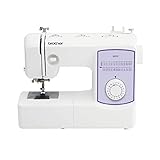
A separately identified model for a basic household shortlist.
Brother CS5055
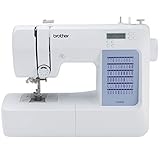
Compare its actual controls, not a generic computerized label.
Singer Heavy Duty 4423
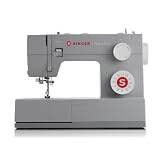
Test its handling and calculate the complete offer.
Compare the Product Categories First
| Product | What the listing establishes | What to clarify |
|---|---|---|
| BCOOSS portable 38-advertised package | Dial selection and four-step buttonhole | Stitch selections versus applications; exact manual and package |
| Poolin EOC01RE | Marketed as a computerized sewing machine with 107 applications | Exact selectable patterns and operating controls |
| Poolin EOC02RE | 200 advertised stitches, speed slider, start/stop, table | Exact revision, accessories, support, and sample performance |
| Poolin EOC06 | Dedicated embroidery category | Not a replacement for an ordinary seam-making machine |
The practical comparison begins with the work, not the brand. A buyer making woven pillow covers needs a different setup from someone importing embroidery designs. A small portable sewing machine and a larger computerized household machine also represent different compromises. Their prices should not be compared as if the only difference were the logo on the casing.
BCOOSS Sewing Machine Review: Clarify the Advertised Package
The BCOOSS portable page uses 38 built-in stitches in its title while describing 38 stitch applications in its feature text. Those are not necessarily the same counting method. Treat that as a question for the seller rather than silently choosing the larger interpretation. Ask for the stitch chart and manual that correspond to the actual machine being supplied.
The page identifies dial selection and a four-step buttonhole. A four-step sequence means the user participates in completing the stages. That may be acceptable for occasional clothing or crafts, but it is worth practicing before buying for repeated buttonholes. A short video showing only straight sewing does not demonstrate the entire garment-making workflow.
The advertised package includes an extension table and a collection of sewing accessories. Evaluate the useful essentials rather than the total number of pieces. Several bobbins do not compensate for uncertain bobbin compatibility, and a bundle of needles is useful only when the type and sizes suit the machine and work.
An extension table can improve outside support, but it does not enlarge the working space inside the machine or establish heavy-material capacity. A lightweight portable machine may be appealing for storage, yet the actual sewing surface should remain stable. Test the setup on the table you intend to use instead of assuming the package photograph represents a comfortable station.
Five potential reasons to consider the package:
- Direct dial selection may suit basic learning.
- The advertised four-step buttonhole provides a garment function.
- A listed table offers work support beside the needle.
- A compact package may fit limited storage.
- Included essentials may reduce separate purchases when correctly specified.
Two important reservations:
- The title and feature text use inconsistent stitch-count terminology.
- Long-term value depends on the exact manual, parts, support, and return terms rather than accessory quantity.
Poolin Sewing Machine Review: EOC01RE and EOC02RE Are Not Interchangeable
Poolin’s sewing collection identifies EOC01RE, EOC02, and EOC02RE models. The names are close enough that buyers should verify every suffix. A feature from an EOC02RE listing should not be assigned automatically to an older EOC02 or another Poolin machine. Ask for the model label and matching instruction manual before comparing controls.
The EOC01RE page advertises 107 stitch applications. That is not enough by itself to establish 107 independently selectable patterns or a particular set of electronic conveniences. If speed limiting, needle positioning, or automatic cutting is essential, require an explicit model-specific answer and demonstration. The word computerized does not establish every one of those features.
The EOC02RE page advertises 200 built-in stitches, seven feet, an LCD, a needle threader, a speed slider, a start/stop button, and a wide table. Those features give it a different comparison profile from a basic small dial-operated package. Their value depends on whether you use them and can obtain clear instruction for the exact revision.
Speed limiting is useful to investigate for controlled starts and detailed work. Start/stop operation can provide another way to run the machine, but fabric guidance remains the operator’s task. A wide table adds support without demonstrating large-quilt capacity. Treat each feature as a tool for a specific operation rather than a promise of effortless results.
Five EOC02RE features worth comparing:
- The speed slider offers an electronic pace control.
- Start/stop provides another operating option.
- The LCD displays selected settings.
- The advertised table supports work outside the bed.
- The stitch and foot package can support varied household tasks when correctly matched.
Two reservations:
- Similar EOC model names and revisions require careful identification.
- Published features do not establish durability, local service, or results on your particular fabric stack.
Do Not Buy an Embroidery Machine for Ordinary Seams by Mistake
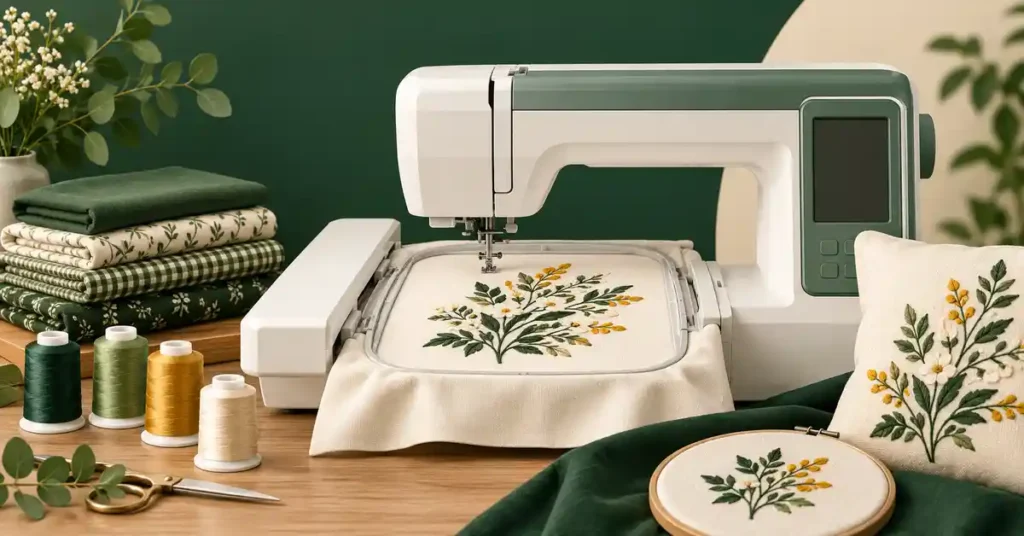
Poolin’s embroidery machines are a separate category. The EOC06, for example, is a dedicated embroidery model rather than a general sewing machine. It moves a hooped item through a design. That is different from joining garment pieces with an ordinary guided seam. A brand’s success in one category does not make every product interchangeable.
Our Poolin embroidery comparison explains that distinction. Also see Poolin embroidery buying considerations if automatic designs are the real goal. Confirm the exact sewing capability of any combination product rather than inferring it from a nearby model’s name.
Test the Sewing You Intend to Do
Start with a plain woven seam. Mark a line and test slow starts, stopping near a point, reverse stitching, and edge guidance. This is useful for judging control and visibility. A seller’s high-speed demonstration may show that a machine runs without showing whether the operator can manage a short repair comfortably.
Next test a buttonhole in the intended fabric and interfacing. The BCOOSS four-step process should be demonstrated in full. For a Poolin model, confirm the exact buttonhole operation in its manual rather than assuming a function from the computerized label. Compare the finished, opened buttonholes after several repetitions.
If you expect to sew knits, use the actual material and check the seam after gentle stretching. A seam that looks neat while flat may break or distort during wear. Needle suitability, stitch choice, and fabric handling all matter. Our garment sewing machine guide helps define the operations before choosing equipment.
For thicker work, bring the real seam crossing rather than a stack of unrelated scraps. Do not pull material through to make a demonstration appear successful. If feeding or penetration becomes inconsistent, stop and reassess whether the task fits the machine. Portable, beginner, and heavy-duty labels do not establish universal material capacity.
Brother GX37: A Separate Mechanical Benchmark
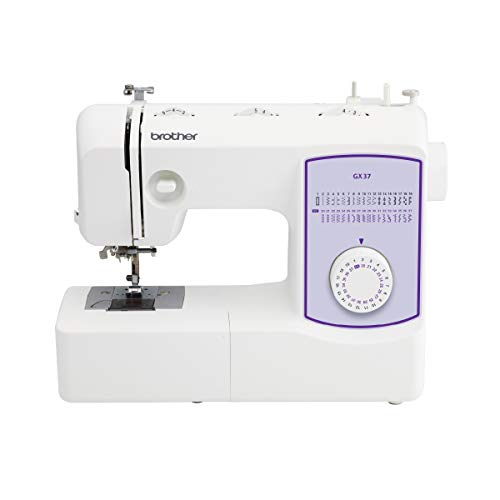

The GX37 offers a clearly identified mechanical household comparison. It can help you judge whether the appeal of a smaller budget package is its price, its size, or its interface. Compare the controller, stitch adjustments, buttonhole operation, and complete accessory list using the same materials.
Our Brother GX37 review explains the model’s ordinary sewing role. A familiar brand does not remove the need to check the seller and condition, but a clear model identity and accessible documentation make it easier to compare what the offer actually contains.
Brother CS5055: Check Electronic Features Individually
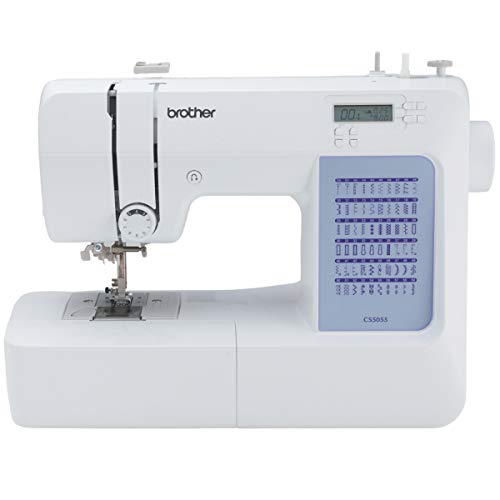
The CS5055 provides electronic stitch selection and a display, but it does not provide every convenience associated with computerized machines. It should not be bought expecting a speed slider, automatic thread cutter, start/stop button, or memorized needle-stop key. This makes it a useful example of why category labels are insufficient.
Compare it with the EOC02RE only after deciding which controls matter. If you need a speed limit, verify that function on every shortlisted machine. If clear stitch selection is the priority, test the display and buttons. Our operating-style comparison provides context.
Singer 4423: A Different Mechanical Purchase
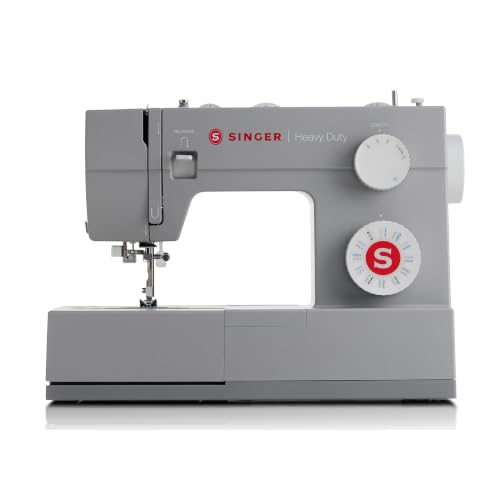
The Singer 4423 adds another mechanical option with a one-step buttonhole and adjustable foot pressure. It is not a guarantee of superior results on every fabric or an industrial replacement. Compare its handling, useful accessories, and current delivered cost with the exact BCOOSS or Poolin offer being considered.
Read our Singer 4423 review and Brother range guide when deciding whether a different package solves a named problem. Avoid expanding the shortlist indefinitely without identifying the sewing function you are trying to improve.
Support and Acceptance Checks Decide Budget Value
Ask for the correct manual, US electrical specification, replacement controller information, compatible bobbins, and a practical service route. A seller should be able to explain how an unresolved fault is handled. A general contact form is not the same as a local technician, and a long warranty headline does not describe every exclusion or shipping cost.
Compare returns, condition, and the complete carton inventory. Keep screenshots or an order record identifying the exact model and bundle. During the return period, thread the machine yourself and finish a small project using the controls that justified the purchase. Do not leave the first meaningful test until the seller’s acceptance window has closed.
Record the settings of a successful sample. If stitching changes, rethread and check needle and bobbin suitability before changing several adjustments. A low-cost machine should still produce acceptable results for its intended tasks, but those tasks need to be defined realistically. A purchase is economical when it becomes a usable sewing setup, not simply when its initial price is small.
A Project Check Before You Commit
For a budget purchase, save the exact product page and order description that identify the model and included accessories. If the carton arrives with a different suffix or package, resolve that before relying on the reviewed specifications. Similar product photographs do not establish identical controls.
Set aside matching fabric for a first-week test. Wind a bobbin, thread the machine yourself, and complete the stitches required by a simple project. Compare the result with the documented instructions. A machine that only ran briefly on its factory-threaded scrap has not yet demonstrated a usable personal sewing setup.
Frequently Asked Questions
Does the BCOOSS package have 38 separate stitches?
The reviewed page uses both built-in stitches and stitch applications. Ask for the exact stitch chart and manual rather than assuming those terms identify the same count. This review does not resolve the inconsistency by inventing a specification.
Is Poolin EOC06 a general sewing machine?
No. EOC06 is a dedicated embroidery model. Poolin’s ordinary sewing machines are listed separately. Check the exact model and whether a combination capability is explicitly documented before buying for garment construction.
Does computerized mean the machine has a speed slider?
No. Electronic stitch selection does not establish every control. The EOC02RE page lists a speed slider, but the function should still be confirmed for the exact model and revision being supplied.
Is a large accessory bundle better value?
Only when the items are compatible and useful. Count the essentials you need, check their identities, and compare the complete cost. Duplicated bobbins or unspecified needles should not outweigh unclear support or an unsuitable machine.
Which brand is the better choice?
Compare the specific offers and sample results. BCOOSS’s portable package and Poolin’s computerized models involve different controls and compromises. Choose only after the model, manual, support, and actual project fit are clear.
Final Recommendation
Buy neither brand on a beginner label alone. Clarify the BCOOSS stitch terminology and package; identify the exact Poolin EOC model and controls. Then compare the complete supported setup with clearly identified alternatives. A modest machine that performs your real work reliably is more useful than an impressive listing that leaves essential questions unanswered.