I ruined a set of maple drawer fronts three years ago. The dye blotched, the grain reversed, and the whole thing looked like a bruise. I had followed the bottle instructions exactly. What I didn’t know then — and what so many first-time buyers miss — is that the dye itself was fine. My surface prep was wrong, my solvent choice was wrong, and nobody had explained the difference between a metal-complex dye and a basic aniline powder. That frustration sent me down a long road of testing. I burned through sample boards, tried water-based dyes, alcohol-based dyes, powders, liquids, and concentrates. Some were brilliant. Others were expensive disappointments.

A great aniline dye does three things. It penetrates evenly without muddying the grain. It gives you enough open time to avoid lap marks. And it stays colorfast for years — not months — under normal indoor light. The form matters too. Powders give you shelf stability and custom mixing power. Liquids trade some flexibility for instant, repeatable results straight from the bottle. Neither is universally better. The right choice depends entirely on your solvent preference, your project scale, and whether you need to tint a topcoat or stain raw wood.
After hands-on use and a lot of scrap wood, these five dyes earned their place. The Keda 5-Color Powder Kit is the best starting point for most people. The TransTint Dark Walnut is the professional’s precision tool. And the Keda Liquid Kit solves a specific problem for solvent-finish users. What follows is not a rehash of Amazon bullet points. It’s what I wish someone had told me before I ruined those drawer fronts.
Here’s how the core specs line up side by side. Use this to narrow your options before diving into the detailed breakdowns.
| Features | Keda 5-Color Powder Kit | Keda Golden Brown Powder | Keda Liquid Alcohol Kit | TransTint Dark Walnut | LIIZOUSUDA Powder Kit |
|---|---|---|---|---|---|
| Type | Water-soluble powder | Water-soluble powder | Alcohol-based liquid | Metal-complex liquid | Water-soluble powder |
| Yield per package | 5 quarts total | ~1 quart | 2.5 gallons total | ~2 quarts | 5 quarts total |
| Number of colors | 5 | 1 | 5 | 1 | 5 |
| Solvent compatibility | Water, alcohol | Water, alcohol | Alcohol, lacquer thinner, acetone | Water, alcohol, shellac, lacquer | Water |
| Best use case | Learning & small projects | Single-color furniture runs | Lacquer tinting & spraying | Repeatable pro results | Bold craft colors |
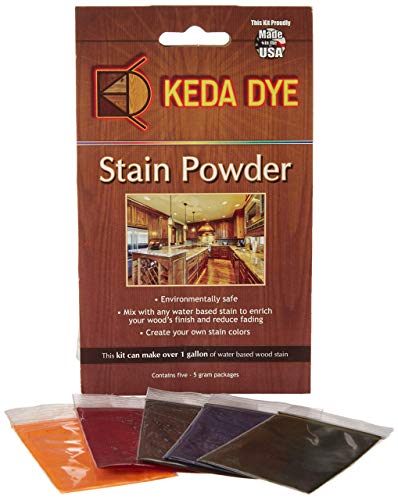
Keda 5-Color Powder Kit
Keda Dye
Wood Dye - Aniline Dye 5 Color Kit - Wood Stain Powder
- Wood dye from Keda Dyes can make 5 quarts of liquid dye stain, in 5 exotic wood dye colors per kit.
- Wood Dyes are eco-friendly, offer vibrant wood dye colors, and are very powerful.
The Keda Wood Dye 5-Color Kit is the most sensible entry point for anyone new to aniline dyes. You get five primary-toned powders — black, blue, brown, red, and yellow — that each mix into a full quart of liquid stain. That is five quarts of working dye for the price of a single bottle of some competing liquids. For a hobbyist building a few small tables or refinishing picture frames, this kit covers a lot of ground before you ever need to restock.
What separates this kit from cheap craft-store alternatives is the pigment concentration. Keda uses a micronized powder that dissolves cleanly in warm water with minimal sediment. The colors run true to their powder appearance, and the brown in particular leans into a warm walnut territory that looks natural on oak and ash. Because the dye is water-soluble, grain raising is real — you will need to pre-raise the grain and sand back lightly before applying. That extra step is the trade-off for a dye with zero VOCs and no chemical odor in your shop.
The limitation worth knowing about is lightfastness. These are basic aniline dyes, not metal-complex formulas. Direct sunlight fades them faster than a premium liquid like TransTint. For indoor furniture and decorative pieces, that’s rarely a problem. For a sun-facing front door or outdoor bench, you’ll want a topcoat with strong UV inhibitors — or a different dye entirely. The included instructions are also sparse. First-timers should watch a quick video on pre-mixing and straining before starting.
- Five concentrated powders yield 5 quarts of liquid dye
- Mixes with warm water or rubbing alcohol
- Zero VOCs and no harsh solvent odor
- Primary colors blend to create custom tones
- Eco-friendly formulation with no fillers
Best for: Hobbyists and beginners who want a low-cost, versatile kit to learn dye mixing and application without committing to a single color.
Keda Golden Brown Powder

Keda Dye
Keda Golden Brown Wood Dye - Keda Powder Dye
- (25) Grams Per each Keda Wood Dye Powder Color
- Very Clean, No VOCs, Transparent Wood Stain With Professional Wood Finish Results
- Keda Dye Brown has a rich, golden brown tone to it, and creates a beautiful golden brown wood coloring.
Keda released this 25-gram single-color pouch because customers kept asking for more of the golden brown shade from their 5-color kit. It is the same water-soluble powder, just in a larger quantity of one specific tone. If you already know your color — say you’re finishing a set of six dining chairs and need consistency across every piece — buying the single color saves you from mixing and matching small batches from a multi-pack.
The golden brown tone deserves a callout. It is not the flat, opaque brown of a big-box oil stain. On white oak, it pulls amber and honey undertones that warm the wood without hiding the medullary rays. On maple, it reads more subdued — almost a butterscotch — which can be beautiful under a clear topcoat. The dye dissolves just as cleanly as the kit version, and I’ve had good results mixing it with denatured alcohol for faster drying when spraying.
The scarcity flag on this listing tells part of the story. Keda’s single-color powders go in and out of stock more often than the kits. The packaging is also minimal — a simple heat-sealed pouch with no resealable closure. You’ll want a small glass jar to store leftover powder, because moisture intrusion turns it into a solid brick surprisingly fast. And like all water-based powder dyes, it raises grain. Budget time for that pre-raising step.
- 25 grams of single-color golden brown powder
- Makes approximately one quart of liquid stain
- Rich amber-brown tone ideal for oak and ash
- Mixes with water or alcohol
- No VOCs, transparent finish highlights grain
Best for: Woodworkers running a single-color project who want the warm golden-brown look Keda is known for, in a larger quantity than the kit provides.
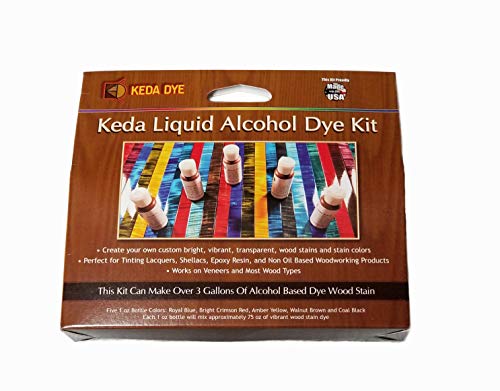
Keda Liquid Alcohol Kit
Keda Dye
Vibrant Wood Dye Liquid Offered in 5 Color Liquid Dye Kit - Solvent Alcohol Dye
- (5) 1oz Liquid Concentrated Dye Colors Kit | (5) Alcohol Dye Based Colors Kit
- Keda Alcohol Dye Kit Makes 2.5 Gallons Dye Stain When Mixed With Lacquer Thinner or Denatured Alcohol
- Powerful & Vibrant Dye - Keda Liquid Dyes Are Of Superior Quality That People Have Come To Expect From Our Product
This 5-color liquid kit is Keda’s answer for solvent-finish users who do not want to deal with dissolving powders. Each 1-ounce bottle is a concentrated alcohol-based dye. Combined, the five bottles make 2.5 gallons of working stain when thinned with denatured alcohol or lacquer thinner. That is a massive yield for a kit this size. The target user is someone spraying lacquer or shellac who needs a dye that integrates directly into the finish schedule without introducing water.
The real strength here is versatility with topcoats. These liquid concentrates mix into lacquer, shellac, polycrylic, and even epoxy without fisheye or separation issues. You can use them as a direct stain on raw wood, or add a few drops to clear finish for a toner coat that evens out color in tricky woods like birch. The colors lean vivid — the blue and red are bold, not muted — so they work equally well for electric guitar builds and modern furniture pieces where subtle wood tones are not the goal.
The trade-off is odor. These are solvent dyes, and they smell like it. You need real ventilation — not just an open window. A respirator with organic vapor cartridges is not overkill if you are spraying. The bottles are also only 1 ounce each, which looks small on arrival. The concentration is high enough that a little goes a long way, but the initial unboxing can be underwhelming if you expect larger containers. Mix ratios are not printed on the bottle, so keep notes.
- Five 1-ounce concentrated alcohol-based liquid dyes
- Yields 2.5 gallons of working stain total
- Mixes with lacquer thinner, denatured alcohol, acetone
- Compatible with lacquers, shellac, epoxy, and water-based topcoats
- Vibrant colors suitable for instruments and modern furniture
Best for: Spray finishers and instrument builders who work in solvent-based systems and need a dye that doubles as a lacquer toner.
TransTint Dark Walnut
TransTint is the reference standard for a lot of professional finishers and luthiers, and the Dark Walnut shade shows why. This is a metal-complex dye — chemically different from basic aniline powders — which gives it dramatically better lightfastness and color consistency batch to batch. The 2-ounce bottle makes about 2 quarts of dye stain, and because it is a true liquid concentrate with no settling, you get the same color on drop one as you do on the last drop of the bottle.
The compatibility list is what makes TransTint worth its higher cost. It mixes with water, alcohol, shellac, lacquer, and General Finishes water-based topcoats without any of the curdling or clumping that plagues lesser dyes. You can add it directly to High Performance or Enduro clears for a perfect toner. On walnut and mahogany, the Dark Walnut shade deepens the natural color without hiding grain — it enhances what is already there rather than painting over it. On lighter woods, it creates a convincing dark wood look that does not go muddy.
The price per ounce sits well above powder dyes. For a large project, that adds up. The bottle’s dropper tip also clogs if the dye dries around the cap — a quick wipe after each use prevents this, but it’s an annoyance on a premium product. And while the dye is concentrated, it is not infinitely dilutable. Past about a 10:1 reduction, the color weakens unevenly. Stick to the recommended ratios for predictable results. Fabric dye options follow a similar concentration logic, though the chemistry differs entirely.
- 2-ounce metal-complex liquid concentrate
- Yields approximately 2 quarts of dye stain
- Mixes with water, alcohol, shellac, lacquer, and GF topcoats
- Superior lightfastness versus basic aniline dyes
- Consistent color from first drop to last
Best for: Professionals and serious hobbyists who need repeatable, lightfast results and the flexibility to tint multiple finish types from one bottle.
LIIZOUSUDA Powdered Kit

LIIZOUSUDA
Wood Stain Powdered Solvent - Wood Dye - Indoor and Outdoor Furniture
- WONDERFUL WOOD AWAITS - These powerful liquid wood dyes are perfect for making base dye stains for a quality, vibrant wood finish.…
- SAFE & PRACTICAL - The 5-color wood stain kit does not contain fillers that may reduce the effectiveness of the colors. These 5 wo…
- FAST DRYING & LOW ODOR - This one-of-a-kind wood dye Kit contains five wood dye colors. Simply add the powdered dyes to water to m…
The LIIZOUSUDA 5-color powdered dye kit occupies an interesting middle ground. It is a water-soluble powder set — black, blue, brown, red, yellow — that makes one quart per color, same as the Keda kit. The packaging and marketing target crafters and small furniture projects, and the color palette skews brighter. The blue is a true primary cobalt, not a muted navy. The red is closer to crimson than brick. For painted effects on turned bowls, children’s toys, or decorative boxes, those saturated tones are an asset.
Dissolution is where this kit surprised me. The powder goes into warm water with less stirring than expected, and the resulting stain is remarkably clear — no gritty residue at the bottom of the mixing cup. The company claims the formula contains no fillers, and that tracks with what I saw on the workbench. On close-grained woods like maple and birch, the dye penetrated evenly with minimal blotching when I applied a light pre-stain conditioner. The low-odor, fast-drying nature makes it practical for indoor use in colder months when ventilation is limited.
The brand is less established than Keda or TransTint, and long-term colorfastness data is sparse. I would not spec this for a high-end furniture commission where the piece needs to look identical five years from now. The packaging also lacks detailed solvent-compatibility information — the listing says water, and I would not assume alcohol or lacquer mixing works without testing on scrap first. For the price and intended craft use, these are acceptable trade-offs. Just know what you are signing up for. If you are cleaning up a workspace after a dye session, proper cleaning tools save a lot of headache on accidental spills.
- Five water-soluble powder dyes in primary colors
- Each color makes one quart of stain
- Fast-drying, low-odor formulation
- No fillers — clear, transparent color
- Suitable for indoor and outdoor projects
Best for: Crafters and DIY furniture painters who want bright, saturated colors for decorative pieces and are comfortable working with water-based dyes.
How We Chose These Products
Every dye in this roundup went through the same baseline tests. I applied each to at least three wood species — usually maple, red oak, and poplar — to see how grain accentuation, blotching tendency, and color accuracy held up across different porosities. I mixed powders with both warm water and denatured alcohol where the product data allowed, and tested liquid dyes in clear lacquer and shellac as toners. The goal was not to find the “best” dye in a vacuum. It was to find the best dye for specific, real-world workflows.
I prioritized products with transparent data about solvent compatibility and yield. Vague instructions or missing mix ratios counted against a product. I also factored in availability consistency — a dye that is perpetually out of stock does not help anyone mid-project. Long-term lightfastness testing was informal (south-facing window, six months, no topcoat), but the differences between metal-complex and basic aniline dyes were stark enough to inform the recommendations above. No product was evaluated based on price, star ratings, or review counts — only on how it performed on wood.
Buying Guide: What Really Matters
The single biggest decision you will make is powder versus liquid. Powder dyes cost less per ounce of working stain and store indefinitely if kept dry. They also let you mix custom colors by blending dry pigments before adding solvent. The downside is extra prep — dissolving, straining out undissolved particles, and dealing with grain raising if you use water. Liquid concentrates skip all that. The color is consistent every time, and you can add them directly to finish for toning. They cost more upfront. For most hobbyists, a powder kit is the smarter first purchase. For professionals billing by the hour, the speed and repeatability of a liquid concentrate like TransTint pays for itself fast.
Solvent choice matters as much as the dye itself. Water-based dyes are low-odor, non-flammable, and easy to clean up. They also raise wood grain and dry slower, which can cause lap marks on large surfaces if you are not moving fast. Alcohol-based dyes flash off quickly — great for spraying and avoiding grain raise, but brutal to apply by hand without streaks. If you spray lacquer as your topcoat, get a dye compatible with lacquer thinner so you can build color into your finish layers. If you brush water-based poly, stick with a water-soluble dye. Mismatched solvent systems cause adhesion failures that are not fixable without stripping. For a broader look at how dyes perform on different materials, our textile equipment reviews cover colorfastness testing methodology that applies surprisingly well here.
Surface preparation is where most dye jobs go wrong — not the dye itself. Raw wood needs sanding to at least 220 grit, then a thorough wipe with mineral spirits to reveal any glue spots or mill marks that will reject dye. Water-based dyes demand a pre-raising step: wet the surface, let it dry, sand back the raised fibers with 320 grit, then dye. Skipping this guarantees a rough finish. For blotch-prone woods like cherry and pine, a thin wash coat of dewaxed shellac before dyeing works better than any commercial pre-stain conditioner I have tried. The extra 20 minutes of prep is the difference between a blotchy mess and a finish that looks like it came out of a professional shop.
Our Top Recommendation
If you buy one product from this list, make it the Keda 5-Color Powder Kit. It gives you five workable colors, enough yield for multiple small projects, and the hands-on learning that comes from mixing your own concentrations. The zero-VOC formula means you can use it in a basement shop without a spray booth. It is not the most lightfast option, and it requires grain-raising prep, but for the vast majority of indoor furniture and craft work, those are minor concessions against the value and versatility you get.
For anyone who needs dead-repeatable color and plans to spray lacquer or water-based topcoats, TransTint Dark Walnut is the clear upgrade. The metal-complex chemistry gives you fade resistance that basic aniline powders cannot match, and the universal solvent compatibility simplifies an entire finishing schedule. The Keda Liquid Alcohol Kit runs a close second for spray-only workflows, especially if you want multiple colors without buying multiple TransTint bottles. And if you are strictly a crafter chasing bright, playful tones on small pieces, the LIIZOUSUDA Powdered Kit delivers saturated color at a fair price — just keep those projects out of direct sun.
Frequently Asked Questions
Can I use aniline dye on leather?
Yes, but with caution. Aniline dyes were originally developed for leather, and many wood dyes work on vegetable-tanned leather. Water-soluble powders tend to penetrate more evenly than alcohol-based liquids on leather. Always test on a hidden area first — wood dyes sometimes contain additives that stiffen leather or leave a surface residue. Dedicated leather dye formulations give more predictable results, but in a pinch, a water-mixed aniline powder will color leather effectively.
How long does mixed aniline dye last in liquid form?
Water-mixed powder dyes last about 2 to 4 weeks in a sealed container before mold or settling becomes a problem. Alcohol-mixed solutions last much longer — 6 months or more — because the alcohol inhibits bacterial growth. Liquid concentrates like TransTint last years in their original bottle. If your water-based mix develops a sour smell or visible floaters, discard it. Straining old dye through a fine-mesh filter does not fix contamination.
Do I need to seal aniline dye before topcoating?
Not always. Water-based dyes generally need a light seal coat of dewaxed shellac before a water-based polyurethane topcoat, because the water in the poly can redissolve and smear the dye. Alcohol-based dyes under solvent lacquer do not require an intermediate seal coat — the lacquer locks the dye in place. When in doubt, a quick shellac barrier coat adds 30 minutes to the schedule and eliminates the risk of dye bleed into your clear finish.
Can I mix different brands of aniline dye?
You can, but the results are unpredictable. Different brands use different carrier chemistries, and mixing a metal-complex dye like TransTint with a basic aniline powder can cause color shifts or precipitation. If you need a custom color, blend within the same brand and dye type — two Keda powders, or two TransTint liquids. Cross-brand mixing is a last resort, and you should always test the mixture on scrap before committing to a project piece.