The best heavy-duty sewing machine for heavy fabric must suit the actual seam, not simply carry a tough-looking name. Dense cloth, slippery coatings, folded webbing, and thick upholstery require different feeding and stitching capabilities. This guide compares household options for appropriate projects, explains when a specialized machine makes more sense, and provides a sample-based buying process so you can match equipment to recurring work without relying on broad marketing claims.
As an Amazon Associate, Practical Textile earns from qualifying purchases. Product links may earn us a commission.
Quick Answer
Compare the Singer 4423 for mechanical household sewing with adjustable pressure, the Brother ST371HD for varied compatible utility projects, and the Brother PQ1600S for a defined straight-stitch workload. For repeated dense, thick, or difficult assemblies, assess an appropriate industrial equipment class before buying a domestic model. A heavy-duty label is not a universal material rating.
This guide compares published specifications and project fit; it does not report hands-on testing.
Singer Heavy Duty 4423
Evaluate the complete seam and low-speed control, with pressure adjustment where appropriate.
Brother ST371HD

Compare a utility-sewing role on realistic heavy-fabric samples.
Brother PQ1600S

A specialist to assess when straight stitching matches the recurring task.
What Heavy-Duty Should Mean in a Buying Decision
Heavy-duty is used across domestic machines with very different capabilities. It can describe a product range, a frame, a motor claim, or the kind of projects promoted by a seller. None of those uses establishes an unlimited ability to sew dense material. A useful buying decision begins with the seam you need to produce and the frequency with which you need to produce it.
Heavy fabric and thick fabric are also different ideas. A dense woven cloth can resist needle penetration despite being relatively thin. A lofty fabric can compress substantially under the foot. A coated material may introduce friction or visible needle holes. Several folded layers create another problem. There is no single fabric label that predicts all of these demands.
The household options below are worth comparing for compatible projects, but this is not a claim that they replace an industrial upholstery, leather, or canvas setup. If your work repeatedly exceeds what a domestic machine can feed and stitch normally, a different machine class is the relevant comparison. A more decorative domestic model will not necessarily solve that limitation.
| Option | Role worth evaluating | Boundary to understand |
|---|---|---|
| Singer 4423 | Mechanical household work with adjustable pressure | Marketing language does not establish unlimited seam thickness |
| Brother ST371HD | Mixed household utility sewing | Not an industrial compound-feed machine |
| Brother PQ1600S | Repeated suitable straight stitching | No zigzag or buttonholes; pin feed is not compound walking-foot feed |
| Specialized industrial equipment | A recurring seam requiring the appropriate feed and needle system | Requires model-specific selection, space, and operating knowledge |
Singer Heavy Duty 4423: Evaluate the Actual Household Task
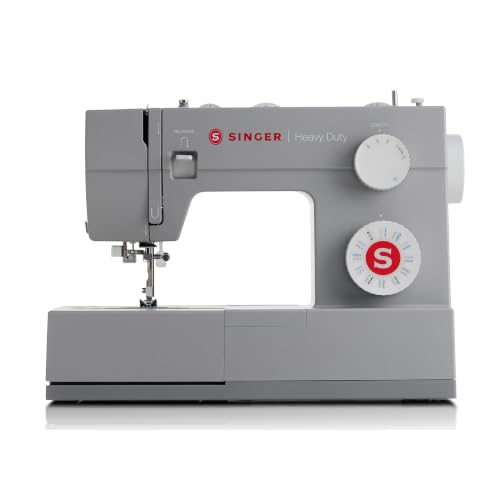
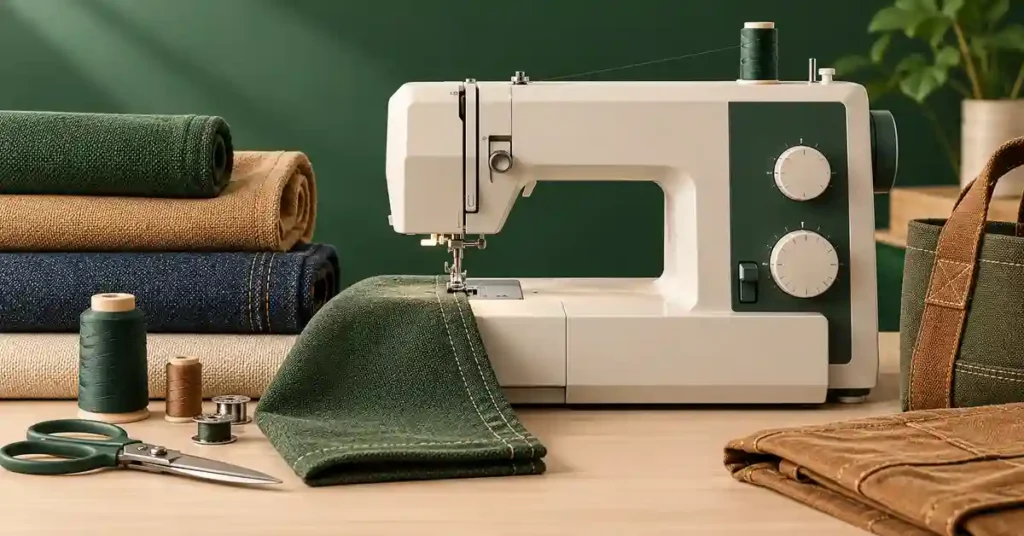
The Singer 4423 belongs on a household comparison list because it provides ordinary sewing utility with mechanical controls and adjustable presser-foot pressure. For appropriate materials, pressure adjustment is something you can evaluate while checking how the layers move. It is not a substitute for the right needle, thread, foot, and construction method.
Its stitch selection includes straight and zigzag operations, making it more broadly useful than a straight-only specialist when your projects also involve linings, closures, and ordinary repairs. Those additional operations can matter if this will be your only machine. Conversely, decorative stitch quantity contributes little to whether a dense folded seam is suitable.
Try the controller at the pace required by the difficult part of your sample. There is no separate computerized speed slider on the 4423. An advertised high maximum speed does not tell you how comfortably you will start at a thick intersection or stop near a corner. The actual low-speed experience deserves a demonstration.
Read our Singer 4423 review for the overall model role. Our Singer 4432 review is another comparison if stitch selection matters. Do not infer a material-capacity improvement from the stitch count alone.
Brother ST371HD: General Utility With Clear Limits


The Brother ST371HD is relevant when heavier household projects are mixed with ordinary sewing and mending. A machine that can handle an appropriate canvas tote sample and also perform common utility operations may be more useful in a small home workspace than a specialist selected for one occasional job.
Its included nonstick foot provides an accessory to evaluate on suitable surfaces that resist smooth sliding. That does not establish compatibility with every vinyl, coating, or leather. Material requirements, the exact needle setup, and seam appearance must still be assessed. Some materials retain every needle hole, making trial and correction on the final piece especially undesirable.
Do not assume this model includes adjustable presser-foot pressure or a powered upper-feed mechanism. Look at the exact model rather than generalizing from the words strong, tough, or heavy-duty. Your sample should show the start, middle, crossing, and end of the seam without pulling the fabric through by hand.
Our Brother sewing machine comparison can help separate its ordinary utility role from computerized and specialist models. Consider the ST371HD when that household role matches your workload, not as an automatic answer to every demanding material.
Brother PQ1600S: Choose It for Straight Stitching, Not a Label

The Brother PQ1600S is a straight-stitch specialist with operating features useful to assess for repeat straight-seam work. A larger support arrangement, a thread cutter, and a knee lifter can contribute to an efficient sewing station. They do not establish that any heavy material will be suitable or that the machine has every industrial feeding characteristic.
Its pin-feed system is not the same as compound walking-foot feed. Treat those terms as different mechanisms rather than interchangeable descriptions of improved feeding. If your material requires a particular feed arrangement, compare machines that actually provide it and request a demonstration on the intended construction.
The PQ1600S cannot replace zigzag or buttonhole operations. It is most relevant when you can clearly describe the straight-stitch job it will perform and how other operations will be handled. For a single-machine household doing varied repairs, those missing operations may outweigh the benefit of specialization.
What the Shortlist Helps You Compare
- A general mechanical role versus straight-stitch specialization.
- Useful household operations alongside heavier compatible projects.
- Adjustable pressure where the exact model provides it.
- Different operating controls and workspace needs.
- A practical route to deciding whether domestic equipment is sufficient.
What It Does Not Establish
- Universal suitability for every dense, coated, or reinforced material.
- Industrial feed capability simply because a domestic model is marketed as heavy-duty.
Make a Seam Map Before Shopping
Write down the difficult operations in the project rather than only the fabric names. Examples include a folded hem crossing a side seam, binding around an edge, a zipper end, a reinforced pocket corner, or a handle attachment. Each location can create a different layer stack and a different access problem.
Record which operations occur regularly. An awkward seam on one occasional project may be handled by a qualified service or a different design, while a seam repeated hundreds of times calls for a more deliberate equipment decision. The recurring job should influence the purchase more than a theoretical project you may never attempt.
Bring this seam map and physical samples to a knowledgeable seller. Ask about the machine’s intended needle system, thread range, feed system, maintenance, and continuous-work expectations for the actual application. A meaningful answer should connect the model to your work rather than repeat a broad promise about sewing anything.
A Demonstration That Reveals Useful Information
Prepare the thickest complete stack from the real project. Include the lining, reinforcement, binding, and webbing that meet there. Begin with the normal section, then cross the difficult intersection and finish the seam. Check whether the machine starts and stops reliably without forcing the material or helping the motor through the stack.
Inspect both faces for balanced stitches and consistent feeding. Look for visible damage around needle holes, skipped stitches, layer movement, and material marking. If the application needs a particular seam appearance, evaluate that directly. A machine’s ability to puncture the fabric once is not equivalent to producing an acceptable seam through the whole construction.
Ask to repeat the sample yourself after the demonstrator explains the setup. This reveals whether the controls, pedal, visibility, and handling suit you. Record the exact needle, thread, foot, and settings used. The result is evidence about that sample and setup, not a blanket rating for every fabric of similar weight.
Understand Feed Systems and Attachments
Standard bottom feeding, accessory walking feet, pin feed, needle feed, and compound-feed systems should not be collapsed into one category. They interact with fabric differently and belong to specific machine designs. If synchronized handling of difficult layers is central to the job, learn which mechanism is actually present before comparing prices.
A compatible walking-foot attachment may help with certain household layer-shifting problems. It does not change the underlying needle system, drive, frame, or permitted use of the machine. Check exact model compatibility and operating restrictions. Our Brother walking-foot guide provides context for that accessory decision.
Do not buy a foot first and assume it will fix a machine that already strains or cannot accommodate the construction normally. Accessories can refine a suitable setup; they do not make every unsuitable seam appropriate. The sample should identify whether the problem is ordinary handling or a fundamental mismatch of equipment and work.
Needle and Thread Are Part of the Equipment Choice
Use the needle system specified for the exact machine. A needle that looks similar may have the wrong dimensions or installation requirements. Within the permitted system, choose an appropriate point and size for the material and thread. Replace damaged needles promptly and stop if the needle visibly deflects or repeatedly fails to form stitches.
Very thick thread is not automatically compatible with a domestic machine. The thread must pass properly through the needle and the machine’s thread path and form a balanced stitch. An industrial thread recommendation may rely on a different needle system and tension arrangement. Ask about compatibility rather than using thickness as a visual measure of seam strength.
For relevant Brother models, our needle-size guide gives useful background. Use it with the exact manual. If a seam remains unreliable, troubleshoot the whole setup rather than repeatedly increasing needle size or upper tension.
When a Different Machine Class Is the Better Starting Point
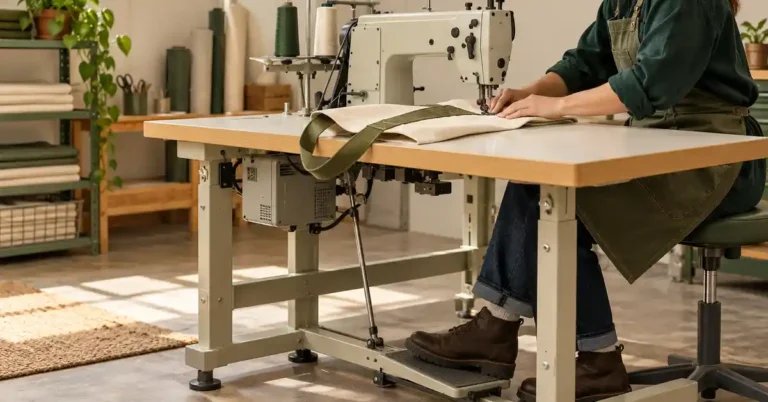
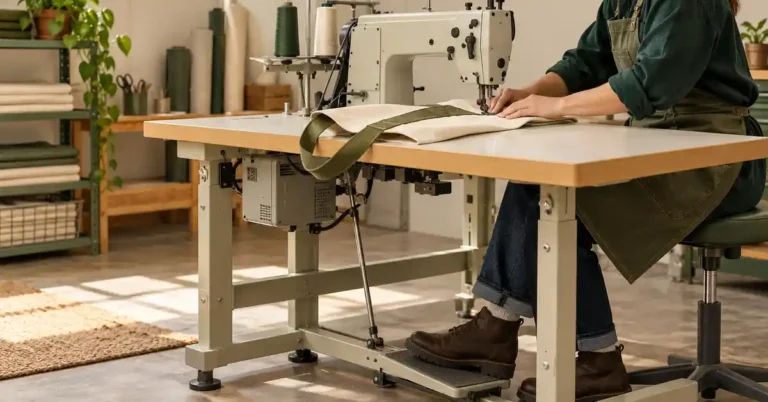
Consider specialized equipment when your recurring work depends on a feed system, thread range, needle system, or access shape that the domestic options do not provide. Cylindrical items and three-dimensional assemblies can introduce access problems independent of material thickness. A flat-bed machine that sews the sample before assembly may still be unsuitable for reaching the finished seam.
Industrial does not mean every machine handles every heavy material. Some industrial machines are designed for relatively light garment production. Others address upholstery, leather, or specialized assemblies. The model and its configured role matter. Ask a qualified dealer to match the seam requirements rather than treating the industrial category as a universal guarantee.
Account for the table, motor arrangement, power requirements, installation, maintenance, and training. A higher-capacity setup can be the appropriate purchase for sustained work, but it also changes the workspace. Compare the full working station and support plan, not only the machine head pictured in a listing.
Heavy Projects Need Support and a Sensible Sequence
Support the material so its weight cannot pull against the needle and feed dogs. Plan room for the project to move before beginning. Large covers and stiff bags can become difficult to turn even when the flat sample sews correctly. Consider whether the partly assembled shape can pass through the available working area.
Review construction order to avoid unnecessary bulk and awkward access. Attach suitable components while the work is flat when the design permits. However, do not remove reinforcement from structural or load-bearing applications merely to fit a smaller machine. An acceptable-looking seam is not proof of strength or suitability for a safety-critical use.
For ordinary household sewing, maintain a sample and settings log. Note what worked and where a setup reached its limits. If a stitch problem appears, follow a systematic process such as our Brother tension troubleshooting guide for relevant models. Do not keep sewing through repeated failure.
Consider Service and the Whole Ownership Cost
Ask how the exact machine is serviced, whether parts and compatible consumables are accessible, and which warranty terms apply to the seller and intended use. Do not assume that a warranty supports every kind of production work. Confirm the relevant terms before purchasing if the machine will be used commercially.
Include suitable needles, thread, feet, lighting, fabric support, and any required furniture in the budget. A domestic option that needs repeated outsourcing of its main intended task may not be economical. Equally, a specialized station can be unnecessary for a household that only occasionally sews an appropriate medium-weight project.
The best value comes from a realistic match between equipment and recurring work. Compare the cost of the whole workflow, including setup and support, rather than ranking machines solely by their current advertised price. Read our control-system comparison if interface preference is still part of the decision.
Frequently Asked Questions
Does heavy-duty mean a sewing machine can sew leather?
No. Leather type, thickness, seam stack, thread, needle, and feed requirements determine suitability. A heavy-duty label does not establish compatibility with every leather project or replace a demonstration of the intended seam.
Is a metal frame enough to choose a heavy-fabric machine?
No. Frame construction is one characteristic. Feeding, needle and thread compatibility, working access, control, and the complete seam sample are also important. A metal frame alone does not establish a machine’s usable material range.
Is the PQ1600S a walking-foot upholstery machine?
No. It is a straight-stitch specialist with a pin-feed feature, which should not be confused with compound walking-foot feed. Assess the actual mechanism and intended application before considering it for a demanding upholstery workflow.
How many layers should a heavy-duty machine sew?
A universal layer count is misleading because thickness, density, coating, thread, and folded construction vary. Test the complete project stack and judge normal feeding, stitch quality, and appropriate operation rather than an unspecified number of scraps.
When should I stop testing a difficult seam?
Stop when the motor strains, the needle deflects, material cannot advance normally, or stitches repeatedly fail. Forcing the stack is not a successful capacity test. Reassess the setup and seek more suitable equipment when necessary.
Final Recommendation
For appropriate household work, compare the 4423, ST371HD, and PQ1600S according to the operations you actually need. For recurring demanding assemblies, begin with the relevant specialized equipment class. The strongest buying evidence is a reliable seam made from your real construction under normal operation, supported by a clear service plan and realistic understanding of the machine’s limits.