

Choose a bernette sewing machine by function and control preference rather than treating the range as one product. The 35 is mechanical sewing, the 38 is computerized sewing, and the 70 DECO is embroidery-only. A true sewing-and-embroidery combination is a separate category to verify. Choose a purchase that fits your actual project and support needs. Its purpose is to support an informed comparison of suitable equipment, not promise universal results.
How this guide helps you choose
A category and interface guide preventing confusion among closely related bernette names.
Options organized by use
| Option | Reason to compare | Practical selection note |
|---|---|---|
| bernette 35 | Mechanical household sewing | The documented 23-stitch model uses physical controls and a one-step buttonhole. |
| bernette 38 | Computerized household sewing | Compare the electronic interface, cutting and actual stitch menu with your projects. |
| bernette 70 DECO | Embroidery-only comparison | Relevant only when decoration is required; it does not construct ordinary seams. |

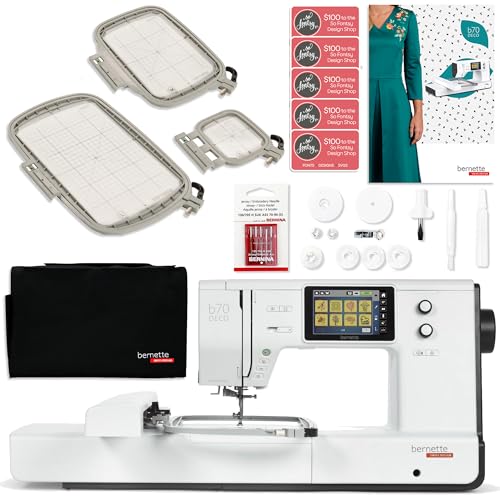
Amazon boxes cover only the specifically verified listings above. Manufacturer and dealer options without a verified ASIN are discussed separately. Bundle contents, condition and availability need checking in the current offer.
Begin with the function the machine must perform
A sewing machine and an embroidery machine can appear in the same brand range while serving different tasks. Confirm ordinary sewing capability, imported-design embroidery and any required unit before comparing models.
If your plan is garment construction, the sewing models are the relevant first comparison. If it is a digitized motif, the embroidery category matters. A broad brand search should not make an embroidery-only machine look like a substitute for the household seams, zippers and openings you need.
Compare the relevant equipment categories using the sewing machine buying guide.
35 versus 38 is mainly a control and workflow comparison
The mechanical and computerized models should be tried on the same fabric operations. Select a stitch yourself, sew a curve, stop at a mark, and make a buttonhole sample. Compare how easily you understand and control each machine.
The computerized model’s total includes varied stitch functions. A large count is useful only when the menu contains operations you need. The mechanical model may be attractive when direct physical controls suit you. Neither category should be ranked universally without a relevant hands-on comparison.
For related sewing preparation and problem-solving, see the sewing techniques and troubleshooting.
Thread cutting, pressure and memory have specific roles
Convenience features should be tied to repeated work. A cutter can affect cleanup at the end of a seam, pressure adjustment can be relevant to feeding, and memory can support a suitable pattern sequence. Confirm the exact model’s function and demonstrate it rather than assuming every bernette provides the same feature.
For fine clothing, test your lightest fabric as well as the thickest join. For quilting, compare a measured piecing seam and a layered sample. The better purchase is the one that handles the project comfortably, not the one that accumulates the most unrelated feature points.
Explore accessory categories in our sewing machine parts and accessories; use the exact manufacturer manual for compatibility and maintenance.
Compare the supplied feet and service arrangement
Check the exact package against your project list. If a useful foot is supplied, it may reduce a separate purchase. If an accessory is missing or incompatible, the total cost can change. Physical resemblance is not proof of compatibility.
Ask the dealer about instruction, service and the correct manual. If buying through a marketplace, confirm model, voltage, condition and seller terms. A dealer-supplied unit and an overseas or refurbished listing should not be assumed equivalent simply because their titles share a model number.
Keep the embroidery comparison separate
The 70 DECO is a dedicated embroidery machine and belongs in the comparison only when imported designs are part of the plan. Its field, frames and file support require a separate evaluation from the sewing controls of the 35 or 38.
If a combination model is desired, obtain its own current specification and demonstrate both modes. Do not add sewing capability to an embroidery-only machine in a review, or infer logo-file support from a computerized sewing model’s lettering stitches.
Five advantages and two limitations
Advantages
- Distinct control styles support personal workflow comparisons.
- Exact model identification prevents sewing/embroidery confusion.
- A documented foot package makes setup costs clearer.
- Dealer instruction can make complex features easier to assess.
- Model-specific support routes improve accessory checking.
Limitations
- The brand range includes different functions that are not interchangeable.
- A large stitch count does not establish superior fabric handling.
Check the exact listing and documentation
bernette 35: Check bernette 35 listing
bernette 38: No products found.
bernette 70 DECO: Check bernette 70 DECO listing
Frequently asked questions
Is bernette 35 computerized?
No. The manufacturer identifies it as mechanical sewing.
Does bernette 38 load embroidery designs?
It is a computerized sewing model; do not infer hoop embroidery from its electronic interface or sewing alphabets.
Does 70 DECO sew ordinary seams?
No. It is embroidery-only.
Should I buy the model with the most stitches?
Compare needed operations, controls, accessories and support. Unused stitches add little practical value.
What should I check in an Amazon offer?
The exact model, package, voltage, condition and seller terms. A cached listing identity is not a live stock or price check.
Related Practical Textile guides
Explore sewing, embroidery, dyeing, printing and other fabric topics at Practical Textile.
Sources and research method
Manufacturer pages, product documentation and exact listing identities were checked on 2026-10-13. Feature-based recommendations are editorial judgments; they are not measured performance results. Availability, software requirements, packages and lifecycle can change.

