Juki Sewing Machine Reviews: F300, F600 or TL-2010Q?
Juki sewing machine reviews should begin with the operation, because a computerized household model and a straight-stitch specialist solve different.

This guide has Amazon links. If you buy through them we may earn a small commission, at no extra cost to you.
Juki sewing machine reviews should begin with the operation, because a computerized household model and a straight-stitch specialist solve different problems. The brand name alone does not establish the right machine for your work. This guide compares F300, F600, and TL-2010Q roles, then examines the specialist decision in detail so you can choose useful controls, realistic fabric handling, and a workable sewing-room arrangement without expecting every model to do everything.
As an Amazon Associate, Practical Textile earns from qualifying purchases. Product links may earn us a commission.
What’s in this article15 sections
Quick Answer
Compare F300 or F600 for varied household utility sewing, and TL-2010Q when a straight-stitch specialist has a clear job in the workspace. A Juki brand label does not make these roles interchangeable. Choose the category first, then compare controls, included equipment, samples, and service for the exact unit.
This guide compares published specifications and project fit; it does not report hands-on testing.
Juki HZL-F300
No verified Amazon offer is linked for this model; read the buying checks below.
Utility sewing and controls, with exact optional equipment confirmed.
Juki HZL-F600

Compare useful features and included tools rather than pattern quantity alone.
Check Price on AmazonThis is a specific HZL-F600 bundle. Confirm the seller’s included equipment and warranty.
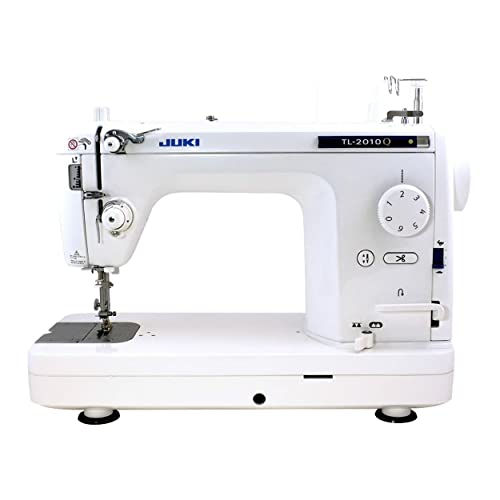
Juki TL-2010Q
A defined station with other stitch categories handled separately.
Check Price on AmazonThis is a TL-2010Q bonus-pack offer. Confirm the seller’s included accessories and US warranty.
HZL-F300: Start With a General Household Requirement
The F300 is the relevant category when one machine needs to sew ordinary seams, utility patterns, and buttonholes. Its computerized operating conveniences should be evaluated through the work you repeat. The presence of a screen does not make every function automatic or turn decorative sewing into hoop embroidery.
Make a short project list before comparing it with the F600. If the smaller menu and exact package already support those operations, additional decoration may add little. Check optional equipment carefully: the F300’s wide table and knee lifter should not be assumed included in every offer. A retailer can create a bundle, but that must be confirmed in the inventory.
Use a garment sample with a suitable closure and, if relevant, a quilt sandwich. Those tests ask different questions about the same general-purpose station. Compare the complete result and comfortable operation rather than a claim that one feed-system name guarantees perfect handling.
HZL-F600: Consider the Broader Package for a Real Purpose
The F600 adds a broader decorative and equipment comparison within the household role. It makes sense to evaluate when the actual controls and supplied tools contribute to your projects. The right question is what the additional purchase changes in your workflow, not whether the pattern total sounds more advanced.
Try a relevant decorative sequence if that is a reason for choosing the model. Use the intended material and assess the result after appropriate support is removed. Lettering and ordinary sewing patterns are not equivalent to importing an arbitrary logo into a hoop embroidery system.
Compare the written packages and seller support. A machine-only offer and an offer with useful compatible accessories are different purchases. Use the same sample and question list on the F300 and F600 so the result is grounded in a fair comparison of the actual work.
The TL-2010Q Is a Different Equipment Decision
The detailed specialist discussion below concerns the TL-2010Q, not a promise that every Juki has its features. Choose that direction when repeated straight stitching deserves a dedicated role and the operations it cannot perform are covered elsewhere. A garment maker who needs frequent buttonholes may reach a different sensible decision from a quilter who mainly pieces stable woven blocks.
Industrial Juki machines form further categories with their own feed systems, access shapes, installation, and operating requirements. Do not transfer a household model’s features or a specialist’s portability description to the entire brand. Match a specific machine to a specific recurring operation and request a demonstration.
Understand its machine category first
The TL-2010Q forms a straight lockstitch. That can suit a focused sewing and quilting routine, but the stitch category matters more than an industrial-sounding description. Do not buy it expecting a library of utility and decorative stitches or computerized hoop embroidery. A machine can be useful for serious sewing without doing every operation found on a general-purpose domestic model.
If you make varied garments, list the operations you need outside straight seams. Stretch construction, some edge finishes, and buttonholes may require another machine or a different method. Keeping a suitable general-purpose machine alongside a straight-stitch specialist can be a deliberate workflow choice. The second machine’s space and cost should be part of the plan rather than an unexpected discovery after purchase.
Juki describes the unit as portable, but moving it still deserves consideration. The manufacturer lists a machine weight of 25.4 pounds. Evaluate how you will carry, store, and position the actual package. Portable should not be read as effortless to lift for every person or suitable for every lightweight folding surface.
Compare the documented controls
| Feature | Why it may be useful | What to verify in a demonstration |
|---|---|---|
| Maximum-speed control | Sets a working pace for supported sewing | Comfortable slow starts and stops |
| Adjustable foot pressure | Adapts a documented setup to material | A labeled sample before and after adjustment |
| Needle up/down control | Helps manage pivots and placement | The stopping behavior you expect |
| Thread trimming | Reduces one finishing operation | Operation with the planned thread setup |
| Knee lifter | Changes how the foot is raised | Comfortable placement in your own seated position |
| Auxiliary table | Supports work beside the machine | Stable fit and room for the whole project |
These controls are reasons to request a demonstration, not guarantees that every fabric will feed perfectly. A feature becomes useful when it solves a task in your own routine. Record the sample materials and settings so the demonstration can be compared with another machine on the same basis.
Five advantages and two limitations
Documented advantages to evaluate in a demonstration are:
- A speed-control slider for setting a suitable maximum working pace.
- Adjustable presser foot pressure for a documented material setup.
- Needle up/down control for planned stopping and placement.
- Automatic thread trimming as a finishing convenience.
- A knee lifter that may suit your seated working arrangement.
Their value depends on how these controls fit your projects and comfort. Test each operation separately rather than assuming that the presence of five features guarantees a better result on every fabric.
Two central limitations are:
- Straight stitch only; other stitch categories require a suitable separate machine or method.
- Physical size and weight that require a planned surface, storage space, and lifting arrangement.
Consider the whole station before buying. If you need zigzag or automatic buttonholes on the same machine, compare a different category. If storage requires frequent lifting or moving, try the actual handling arrangement instead of relying on the portable label.
Evaluate quilting as two different operations
Piecing joins fabric components into a quilt top. Quilting joins the top, batting, and backing through the planned stitch pattern. Those operations place different demands on work support and material handling. A machine that feels convenient for small pieced blocks may still require a carefully arranged table for a larger layered quilt.
Use the actual proposed fabric, batting, and backing in a sample. Compare the intended foot and feeding arrangement, then inspect the back as well as the top. If free-motion work is part of the plan, follow the documented setup and evaluate a controlled sample. The ability to lower feed dogs does not remove the need to learn coordinated movement and speed.
Do not confuse the auxiliary table’s width with the machine’s throat opening. Juki’s table dimensions describe support around the machine, not an enlarged opening inside the arm. A large quilt still has to be managed through the available space. Plan how its weight will be supported so it does not pull against the stitching area.
Compare garment and bag projects realistically
A straight-stitch specialist can be relevant to many stable woven seams, but garment sewing includes more than assembling those seams. Write down closures, stretch requirements, edge finishes, topstitching, and access needs. Decide which operations will remain on another machine and whether changing stations fits the way you work.
For bags or layered projects, make a sample of the thickest actual junction. Include interfacing, seam allowances, zipper tape, or other components that will be present. A flat leather or canvas scrap does not prove that a thick folded construction is suitable. Choose the machine category from the operation and feeding requirements rather than the material name alone.
If leather is involved, check the needle, foot, thread, and material specifications carefully. A domestic-style straight-stitch specialist is not automatically interchangeable with an industrial compound-feed setup. Ask for a demonstration of the construction you intend to repeat and stop if the machine or needle struggles.
Plan the workstation around the controls
Set the machine on a suitable stable surface with room for the auxiliary table if you plan to use it. Check the stated load rating and the actual furniture arrangement. Keep space for the fabric to move and for access to the bobbin and other routine points. A table that supports the stored machine may still be inconvenient during operation.
Try the chair, pedal, and knee lifter together. The knee control should be evaluated in your normal seated position rather than as an isolated accessory on a showroom table. Ensure that the furniture does not obstruct it or force an uncomfortable posture. There is no universal desk height that makes every combination work for every person.
Plan storage for feet, needles, bobbins, and the manual. This model’s accessory compatibility should be checked specifically rather than assumed from the appearance of household snap-on feet. A large collection of unrelated accessories is less useful than a small set of documented compatible tools for your actual work.
Test speed, pressure, and trimming separately
Begin with a suitable normal setup and a representative sample. Evaluate slow operation and stopping accuracy before considering maximum speed. Juki lists a maximum of 1,500 stitches per minute, but that figure is not a statement about how fast you should sew every seam. Your control, material, and operation still determine a useful working pace.
If pressure adjustment is part of the comparison, record the starting point and change it according to the manual. Sew another labeled sample instead of changing pressure, tension, needle, and foot at the same time. An improvement is easier to understand when you can identify which change produced it.
Try the thread trimmer with the intended compatible thread setup. Inspect the result and learn how the control is operated so it is not triggered unexpectedly. A convenience feature should become part of a deliberate routine. Ask how the machine should be prepared for ordinary cleaning and maintenance after the demonstration.
Compare total cost and support
Confirm the seller’s condition description, included feet and table, training, service arrangements, and return terms. For a used machine, request a full demonstration and ask about repair history. A powered-on machine or an attractive photograph does not establish that all controls and the feeding system work correctly.
Include any second machine needed for zigzag or buttonholes in the workspace and budget comparison. That does not make the TL-2010Q a poor choice; it makes the specialist role explicit. Compare it with other machines that address the same operation rather than ranking it against an embroidery-only model that serves a different purpose.
The three product boxes identify different Juki roles accurately. Confirm the exact seller condition, accessories, service arrangement, and return terms for the model you choose rather than treating a related machine as an equivalent substitute.
Plan the second-machine question before buying
List one week of realistic sewing tasks, separating straight seams, edge finishing, stretch seams, buttonholes, and embroidery. Mark which tasks the TL-2010Q’s straight-stitch category addresses and which require another machine or method. This turns the specialist decision into a workflow comparison rather than a contest between model names.
For example, a quilter who mainly pieces stable woven blocks may value repeatable straight-stitch controls, while a garment sewer making varied knit and woven clothes may still need other stitch types regularly. Neither user is inherently more advanced. They are asking the equipment to solve different operations, and the surrounding machines and workspace should reflect that difference.
Measure the full station with the auxiliary table, pedal, knee lifter, chair movement, and fabric support. If a second machine remains in use, include the changeover and storage arrangement. A specialist that fits only after every other tool is put away may still suit one person, but the setup time should be a deliberate accepted tradeoff.
Keep a sample from the ordinary straight seam and another from the thickest planned junction. Record the needle, thread, foot, pressure setting where relevant, and sewing arrangement. Those samples answer different questions. A smooth flat seam does not prove that a complicated folded bag attachment will feed the same way, and a difficult oversized stack does not erase the usefulness of the machine for compatible work.
Ask the dealer to explain the documented maintenance routine and accessory compatibility for the actual model. Check whether any foot or support used in the demonstration is optional. If the proposed purchase is used, repeat the complete demonstration on that unit rather than relying on a video of another TL-2010Q.
The decision becomes clearer when you can name the operation the specialist improves, the operations it leaves elsewhere, and the space and support the complete arrangement requires. If those answers remain vague, more specification reading may be less useful than a practical demonstration of the intended projects.
For a dealer appointment, bring a short written test sequence: one ordinary seam, one pivot, one planned thick junction, a trimming check, and a trial of the knee lifter while seated. Take the same sequence to another specialist demonstration. Keep the two samples labeled with their setups instead of ranking the machines from memory. If a function cannot be demonstrated on the offered unit, mark it as an unresolved buying question rather than assuming that a successful example from another machine establishes its condition.
For other brand and equipment perspectives, read our Brother model guide, Janome comparison, Singer 4423 review, control-system guide, and combination-machine explanation. Compare like operations rather than treating a brand name as a universal capability.
Frequently Asked Questions
Which Juki is suitable for varied household sewing?
Compare a general-purpose model such as F300 or F600 when utility stitches and buttonholes are required. Test the actual operations and complete package rather than expecting every Juki category to serve the same role.
Does TL-2010Q replace a zigzag machine?
No. It is a straight-stitch specialist. Decide how zigzag, buttonholes, and other required formations will be handled before selecting it as the only station.
Are F300 and F600 bundles identical?
No assumption of identical equipment should be made. Check exact included feet, table, knee lifter, condition, and support. Retailer bundles can differ from the standard manufacturer package.
Do these machines import embroidery artwork?
The household sewing and straight-stitch roles discussed here are not hoop embroidery systems. Decorative patterns and sewn lettering should not be confused with automatic stitching of an imported logo in a hoop.
How should I choose between the categories?
List the recurring operations, test representative materials, and compare the full workstation and support. Choose a specialist only when its narrower role improves work you can identify and its missing operations remain covered.
Final Recommendation
Choose the TL-2010Q because a straight-stitch specialist addresses work you can describe and demonstrate. Evaluate the controls, material handling, table arrangement, and any complementary machine you need. Its documented features are most useful when they fit a repeatable sewing routine rather than a general expectation that one machine should do everything.