
John Deer is an embroidery educator and author, while deer-themed craft kits are a different kind of product. A book about digitizing is also different from software or a machine embroidery file. This guide clarifies those distinctions, checks five existing references, and helps you choose between learning digitizing, obtaining a compatible design file and stitching an animal motif by hand, while keeping the required tools and project checks clear throughout.


This is a documentation-based guide. We have not tested software, compared kit weights or measured learning times. As an Amazon Associate, we earn from qualifying purchases through the existing product references.
Separate the person’s name, the company name and the animal
Embroidery Legacy’s own history identifies John Deer in its embroidery and digitizing business. The same history separately refers to John Deere, the tractor company, as a customer. Those are different names and entities. An animal motif described as a deer is another category again.
A search phrase can bring these subjects together, but it does not prove a product’s creator, brand relationship or contents. Check the named author, publisher, designer or manufacturer of the exact item. The mere presence of a deer in a picture is not evidence that it belongs to John Deer’s design collection.
| Product type | What you receive | Main check |
|---|---|---|
| Instructional book | Reading and illustrations explaining a subject. | Author, ISBN, edition and the topics covered. |
| Digitizing software | A program or licence for creating or editing stitch designs. | Current system requirements, functions and licence terms. |
| Ready-to-stitch machine file | A design prepared for a supported embroidery workflow. | File format, design dimensions, instructions and permitted use. |
| Hand-embroidery or counted-cross-stitch kit | Physical project materials and the stated instructions. | Technique, fabric, contents, chart or printed guide and required tools. |
Five retained references, accurately identified or qualified
Digitizing Made Easy by John Deer: a book
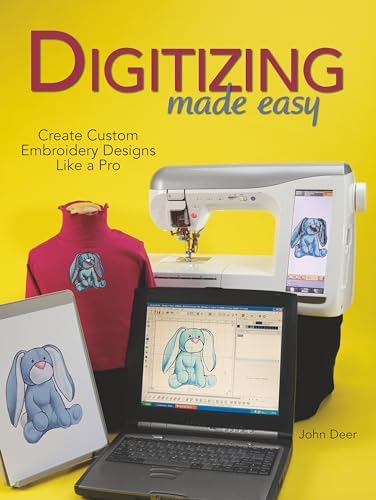
Penguin Random House identifies Digitizing Made Easy by John Deer, ISBN 9780896894921, as a 128-page book published by Krause in 2008. The retained retailer listing matches that title and author. It is instructional reading about digitizing, not a software licence or a ready-to-stitch file collection.
Useful features or reasons to consider it
- The author and ISBN can be checked against the publisher's record.
- Its stated subject is relevant to understanding how artwork becomes stitches.
Limitations and checks
- A 2008 book does not verify the interface or compatibility of today's software.
- No computer-performance or thirty-percent-lighter comparison with software is meaningful for this book.
Earlier deer-and-floral kit reference: listing unverified

The actual retained retailer page could not be retrieved, so its current brand, fabric, dimensions and included tools remain unverified. It is kept as an older deer-kit reference, not presented as a verified John Deer design, a John Deere branded item or a tested all-in-one package.
Useful features or reasons to consider it
- An animal motif is a project theme to consider if the actual kit and instructions suit your method.
Limitations and checks
- The earlier eight-inch-hoop and complete-contents claims are not confirmed.
- No comparative weight, comfort or beginner-success claim is supported.
Verification remains incomplete for reference B0F2MLBD8T. Read the exact current offer before relying on its contents or instructions.
Huacan deer-and-floral hand-embroidery reference

The actual retailer title identifies a Huacan stitched-deer/floral embroidery kit. That corrects the previous generic name, but a separate manufacturer instruction sheet was not verified. Treat the title as a retailer identity check, not proof of every tool, fabric specification or stitch instruction previously described.
Useful features or reasons to consider it
- The retailer identifies an animal-themed handcraft kit.
- Its role differs from digitizing software or a downloadable machine file.
Limitations and checks
- Confirm actual contents and instructions for the selected offer.
- No evidence links this kit's authorship to John Deer or establishes the old comparative claims.
Verification remains incomplete for reference B0F4N76NGV. Read the exact current offer before relying on its contents or instructions.
Thea Gouverneur Deer Family: exact retailer variant unresolved

The exact retained Amazon page could not be fetched. Thea Gouverneur currently documents a Deer Family counted-cross-stitch kit in white sixteen-count Aida and also has other variants. That maker's family information does not establish which fabric or edition this older Amazon reference supplies.
Useful features or reasons to consider it
- The maker's current catalogue distinguishes a counted-cross-stitch project from a printed hand-embroidery kit.
Limitations and checks
- Do not transfer current variant specifications to the unverified retained ASIN.
- Confirm fabric, finished size, thread contents and chart before buying.
Verification remains incomplete for reference B01DDTU2SY. Read the exact current offer before relying on its contents or instructions.
JOINRUN beginner deer kit: retailer identity checked

The actual retailer page identifies JOINRUN and a pre-printed deer embroidery kit with tutorial material. This is a hand-stitching reference, not evidence of a design authored by John Deer. Separate manufacturer instructions and the exact selected pack were not independently confirmed.
Useful features or reasons to consider it
- A pre-printed guide is a relevant method to compare when you want to stitch by hand.
- The current retailer identity can be separated from the article's author-name keyword.
Limitations and checks
- Check the actual tools, materials and tutorial access before ordering.
- A beginner label does not establish the learning time, finished quality or comparison with unrelated machine brands.
Verification remains incomplete for reference B0DCLT6RMN. Read the exact current offer before relying on its contents or instructions.
If your goal is to learn digitizing
Digitizing is the process of planning how a design will be made with stitches for a machine-embroidery workflow. A book may explain the ideas; software provides the tools used to create or edit the resulting stitch plan. Buying the instructional book does not itself supply a current software licence or establish compatibility with your computer.
The publisher describes John Deer’s book as covering topics such as artwork, stitch types, mapping, sequencing, underlay and blending. Use that description to decide whether the subject suits your learning goal. Because the listed edition was published in 2008, verify current application commands and operating-system requirements directly with the software provider.
Write a useful learning brief
Choose a simple project and identify what you want to understand: preparing artwork, choosing stitch types, organizing the order of work or evaluating a stitched result. A clear question makes a tutorial or book chapter easier to use. Avoid making an elaborate garment project your only test of several unfamiliar tools at once.
Keep the original artwork, your working files and notes about changes organized. Distinguish an editable working project from an exported stitch file. Ask the software provider which formats support further editing and which are intended for the machine. The ability to view a design is not necessarily the ability to edit every feature of its original project.
Evaluate a representative sample
A design should be assessed on a suitable sample using the intended fabric and preparation method. Review placement, readability and the face and back of the stitching. A screen preview is useful for planning but cannot by itself establish the appearance of every finished material or garment.
Record the project conditions and any changes you make. If a result is unsuitable, identify a specific question to investigate rather than assuming a different program will solve it automatically. This guide provides no comparative software-speed benchmark and no unsupported claim that one product has fewer available colors than another.
If your goal is to obtain a machine embroidery design
Read the actual design offer before downloading or purchasing. A product photograph, a drawing and a stitch file are different deliverables. Confirm that the offer includes a file your exact machine can read and that the complete design fits its supported embroidery field in the intended orientation.
- Identify the exact design and supplier. Record the creator or seller, design name and version. Do not infer authorship from a search keyword. Make sure you are looking at the selected design rather than a photograph of an unrelated finished sample.
- Check the supplied formats. Compare the offer’s file list with your machine’s documented requirements. An ordinary picture is not automatically a compatible stitch file. If conversion is necessary, establish which supported tool or service performs it.
- Check full design dimensions. Consider width and height, not just whether the motif appears small on the screen. Include any border or lettering. Confirm whether the offer requires multiple positions or a special process rather than assuming a single hoop placement.
- Read the preparation requirements. Identify the intended fabric, thread information, backing or other supports and any special techniques. If these details are missing, ask the supplier before relying on the design for a costly item.
- Check what you may change and how the offer may be used. Read the selected product’s stated terms and editing guidance. Do not assume that buying a book, kit or file grants the same permissions or editing functions as another product.
- Keep the instructions and sample record. Save the file information with the project, then evaluate an appropriate sample before decorating the finished item. A successful sample is evidence about that setup, not a promise about every fabric or every future run.
For the machine side of that decision, our home embroidery machine guide discusses design size, space and setup. The Brother SE700 guide provides a model-specific example of checking the computer and embroidery workflow.
If your goal is a deer-themed hand-stitching project
Choose the technique before choosing an attractive photograph. A counted-cross-stitch kit normally relies on a chart and the appropriate fabric structure; a pre-printed hand-embroidery kit supplies guide marks on the cloth. Those methods create different reading, counting and stitching tasks. Confirm which one the actual offer supplies.
Inspect the written contents for the chosen version. Identify the fabric, thread information, needle, instructions and any separately required holding or finishing tools. A picture displaying a hoop or a framed example does not establish that the same accessory is included. The inaccessible references in this guide remain qualified rather than being described as complete kits.
Use the maker’s current variant information carefully
Thea Gouverneur’s current Deer Family family includes separately described versions. Its white sixteen-count Aida listing is a useful manufacturer reference, but it does not resolve the older retained Amazon page that could not be fetched. Check the exact fabric and pattern code on the offered pack instead of copying specifications from a different current variant.
Likewise, the retrieved Huacan and JOINRUN retailer identities help distinguish those kits from John Deer’s instructional work, but separate manufacturer instructions were not verified. We therefore do not invent exact fabric dimensions, comparative weight advantages, guaranteed tutorial access or a fixed time to finish.
Plan the finished project and its materials
Write down where the finished design will be used: a display piece, a fabric panel or part of an item you intend to construct. Check the planned dimensions and leave space for mounting, seams or other finishing. A kit image can suggest a finished appearance without explaining all of the steps required to achieve it.
Record the thread choices and any substitutions, keeping the original chart or instruction key available. Use care information for the actual materials rather than assuming that all embroidery projects share one washing rule. If a transfer method is involved, check its application and removal directions separately from the thread instructions.
| Record | Why it helps |
|---|---|
| Exact product and version | Prevents a book, file or kit from being confused with another reference. |
| Author or maker | Keeps verified identity separate from a similar name or animal motif. |
| Technique and instructions | Shows whether the project needs counting, tracing, hand stitching or a machine workflow. |
| Dimensions and materials | Supports checks for fabric access, mounting, assembly and compatible supplies. |
| Open questions | Keeps unresolved variant, content or instruction details visible before purchase. |
Frequently asked questions
Is Digitizing Made Easy software?
The retained reference is John Deer’s book, confirmed by the publisher and matching retailer record. It does not establish a software licence, computer requirement or benchmark against another application.
Are all deer embroidery kits designed by John Deer?
No such connection is established. Check the exact author, designer or maker. An animal motif or a similar search phrase is not evidence of authorship.
Does John Deer mean the tractor brand?
Embroidery Legacy identifies John Deer in its embroidery business and separately names John Deere as the tractor company. Keep those identities separate when choosing a book, design or branded item.
Can I use a hand-embroidery kit as a machine design file?
A physical kit does not automatically provide a compatible machine file. Read the actual deliverables and check the intended technique. A printed guide or counted chart is not itself a machine-ready stitch file.
Are the older kit specifications verified?
Not all of them. The inaccessible listings and missing manufacturer instructions are explicitly marked. Current maker information for a related family is not being substituted for an unverified retailer variant.
