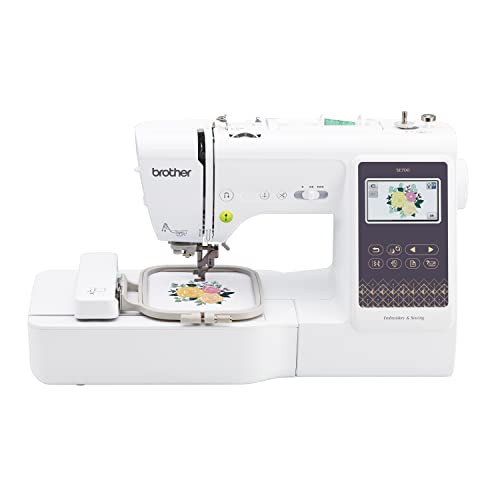
The SE700 is a useful combination-machine candidate when you want ordinary sewing and small-field embroidery in one space. The tradeoff is mode switching and a 4 × 4 embroidery limit. It cannot sew a seam while it is running an embroidery design. Compare the complete setup with your own planned projects. Confirm the exact model and supplied accessories before buying. Choose a purchase that fits your actual project and support needs.
Who should consider it?
A home user who needs both construction and compact personalization but has room for one machine.
Documented features and important limits
| Item | Documented detail |
|---|---|
| Maximum embroidery field | 4 × 4 inches |
| Embroidery designs | 135 |
| Sewing stitches | 103 |
| Embroidery fonts | Ten |
| Transfer | Wireless and USB |
| Function | Ordinary sewing and computerized embroidery |
Confirm the exact model’s features and accessories in the manufacturer information.

- Sewing and Embroidery in One: The SE700 Brother sewing and embroidery machine is the ideal...
- Wireless Lan Enabled: Transmit embroidery files from your PC to your embroidery sewing...
- Artspira Mobile App for Customization: Make custom embroidery patterns by drawing on your...
- 4" x4" Embroidery Field: This computerized combo home sewing machine with embroidery is...
- Large 3.7" Touchscreen: The 3.7-inch LCD color touchscreen enables easy on-screen editing...

Two functions mean two working modes
A combination machine can construct a project and decorate it, but those stages use different arrangements. You change the relevant setup between sewing and embroidery. The convenience is one machine body and a coordinated interface, not simultaneous production.
Think through a real project: embroider the panel, remove the embroidery setup, then assemble and finish the item. If you need to sew other work during embroidery, a separate sewing machine has an operational advantage. If space is the more important constraint, combining the functions may be worth the changes.
Compare the relevant equipment categories using the embroidery machine buying guide.
Choose the embroidery field before the stitch menu
A large ordinary sewing-stitch count does not increase the embroidery dimensions. The machine may cover many household sewing operations while still limiting the imported motif to a compact field. Check the dimensions of your planned name or logo before buying.
The right beginner project can fit comfortably in that field. A stable patch or small motif provides a manageable learning exercise. The wrong purchase is one where the buyer’s main design is already too large and the decision relies on an accessory hoop somehow solving the programmed limit.
Plan design files and project sizes with the embroidery designs and file guide.
What a combined demonstration should include
Ask for both a sewing sample and a complete embroidery sample. On the sewing side, try the seam operations your pattern requires. On the embroidery side, evaluate transfer, placement, hooping, and a multicolor stitchout. One mode working well does not establish every detail of the other.
Perform the mode change yourself with guidance. That reveals whether storing and attaching the unit feels practical at your table. Include room for hoop movement and places to put accessories temporarily. A small footprint in a product photograph is not the same as the clearance needed during embroidery.
Connect construction and decoration steps using the sewing and embroidery project guide.
SE700 versus PE545 and SE2000
The PE545 is relevant when you already have sewing covered and prefer a dedicated small-field embroidery machine. The SE2000 is relevant when your designs require a larger field while keeping both functions in one machine. These are distinct comparison paths.
For a computer-based workflow, check current software support before relying on wireless transfer. Your individual Windows computer has not been tested here. A supported file format, suitable file dimensions, and a permitted design license remain necessary regardless of which transfer route you choose.
Five advantages and two limitations
Advantages
- One body provides ordinary sewing and embroidery functions.
- Wireless and USB transfer provide design-delivery options.
- Compact motifs suit many home personalization projects.
- The sewing stitch menu supports varied household operations.
- A single machine can suit a space-limited work area.
Limitations
- The 4 × 4 field restricts larger embroidery designs.
- Mode changes interrupt sewing when embroidery is running.
Buying and demonstration checklist
| Step | What to check |
|---|---|
| 1 | Demonstrate the change between sewing and embroidery. |
| 2 | Try a zipper or buttonhole sample as well as an embroidery motif. |
| 3 | Measure hoop clearance around the intended table. |
| 4 | Check the largest design and current computer requirements. |
Named alternatives to compare
Brother PE545 is a separate comparison model. The link below is not represented as the reviewed machine.
Brother SE2000 is a separate comparison model. The link below is not represented as the reviewed machine.
A cached Amazon listing confirms product identity for this draft. It does not confirm current stock, price, seller, warranty or the present AAWP data response.
Frequently asked questions
Does the SE700 sew and embroider?
Yes. It combines ordinary sewing with computerized embroidery in separate working modes.
Can it sew while embroidering?
No. One machine cannot perform both operations simultaneously.
What is the embroidery field?
Brother lists a maximum 4 × 4 inch field.
Can the sewing stitch count enlarge the design area?
No. Sewing stitches and maximum embroidery dimensions are separate specifications.
When should I compare the SE2000?
When a larger embroidery field is a real project requirement and you still want combination-machine operation.
Related Practical Textile guides
- Brother sewing and embroidery comparison
- machine parts, needles and accessories
- embroidery machine category
Explore sewing, embroidery, dyeing, printing and other fabric topics at Practical Textile.
Sources and research method
Manufacturer pages, product documentation and exact listing identities were checked on 2026-10-13. Feature-based recommendations are editorial judgments; they are not measured performance results. Availability, software requirements, packages and lifecycle can change.