The best sewing machine for jeans and leather depends on very different material and construction requirements. A denim hem, a soft garment-leather seam, and a reinforced leather bag are not equivalent tests. This guide compares household and industrial roles, explains needle and thread choices, feeding, visible holes, and project access, and shows how to evaluate the complete assembly before assuming one heavy-duty label covers everything you plan to sew next.
As an Amazon Associate, Practical Textile earns from qualifying purchases. Product links may earn us a commission.
Quick Answer
Compare a suitable household machine for manageable denim and compatible light projects, and an appropriate industrial feed system for recurring demanding leather assemblies. Singer 4423 and Juki F300 represent different household controls; DNU-1541 is a distinct industrial unison-feed candidate. No model here is a universal recommendation for every leather type, denim weight, or reinforced stack.
This guide compares published specifications and project fit; it does not report hands-on testing.
Singer Heavy Duty 4423
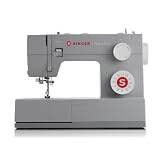
Test the actual folded denim and any compatible light material setup.
Juki HZL-F300
No verified Amazon offer is linked for this model; read the buying checks below.
Compare controls and feeding on appropriate construction, not a material-name promise.
Juki DNU-1541
No verified Amazon offer is linked for this model; read the buying checks below.
Confirm the exact variant and installed station for the intended leather work.
Jeans and Leather Need Separate Buying Questions
Denim is a woven fabric category with substantial variation in weight, density, finish, and stretch. Leather also varies in thickness, firmness, surface, and intended use. A machine that handles one flat sample has not established suitability for every project made from either material.
Faux leather is another construction to identify accurately. A coated fabric backing can behave differently from natural leather, and the surface may create friction or retain marks. Do not choose needles, thread, or finishing methods solely from a seller’s broad material label.
Start with the actual item. A trouser hem crosses folded seam allowances, while a leather bag may combine reinforcement, zipper tape, and several layers at a handle attachment. Those assemblies can demand different feed systems, thread ranges, and access shapes.
| Project | Equipment role to assess | Critical sample |
|---|---|---|
| Suitable denim clothing and hems | Appropriate household utility sewing | The folded hem crossing the side seam |
| Compatible light fashion material | A tested household setup | Actual surface, backing, needle, and seam |
| Recurring demanding leather assemblies | Appropriate industrial feed and access | Complete reinforced junction |
| Three-dimensional or narrow work | A suitable machine-bed configuration or other method | Access at the partly assembled stage |
Singer 4423: A Mechanical Household Candidate
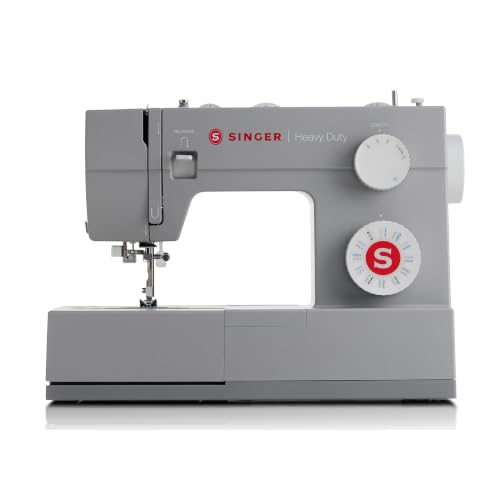
The 4423 is worth comparing for suitable household denim projects and other materials that pass a realistic test. Its adjustable presser-foot pressure is one setup variable. The heavy-duty name is not an unlimited capacity rating for thick leather or every folded jeans seam.
Try the controller at the pace needed for the difficult junction. There is no separate computerized speed slider. Slow starting, stopping, and guiding can matter more for an alteration than the advertised maximum sewing speed.
Its utility-stitch role remains useful when the project includes ordinary garment operations. A buyer who needs buttonholes, zigzag, and repairs may value that versatility. Additional stitch patterns, however, should not be interpreted as additional material-handling power.
Our Singer 4423 review, 4411 comparison, and 4432 review explain related household options. Use the complete sample rather than transferring a success claim across the whole range.
Juki F300: Compare a Different Household Workflow
The F300 provides computerized household controls and a box-feed system to evaluate on appropriate projects. It is a different operating approach from the mechanical Singer, not a promise that any material called leather becomes suitable.
Compare needle positioning, speed control, pressure adjustment, and thread cutting through a realistic sewing sequence. Ask to operate the machine yourself. A feature is useful when it improves the work you repeat, not simply because it appears in a more expensive category.
Box feed is not industrial compound or unison feed. If the complete construction needs that different mechanism, use the appropriate equipment class. Also confirm the exact F300 package; optional equipment used in a demonstration should not be assumed included in every offer.
For a buyer making denim clothing and varied household projects, a suitable general-purpose machine can remain practical. For a buyer repeatedly assembling dense leather products, the industrial station question below may be more relevant than comparing larger decorative menus.
Juki DNU-1541: A Distinct Industrial Decision
Juki describes DNU-1541 as a single-needle unison-feed lockstitch machine. It belongs in the discussion when recurring heavy layered work calls for coordinated industrial feeding. That is not the same mechanism as attaching a household walking foot.
Confirm the full model suffix and installation. DNU-1541, DNU-1541S, and DNU-1541-7 are distinct variants. Do not assign a safety mechanism or automatic thread trimmer from one to another without checking the quoted unit.
The head, motor, table, controls, needle and thread setup, delivery, installation, and service form the usable station. A marketplace title alone does not establish that all those items are included. Ask for a complete written scope and a demonstration of the intended construction.
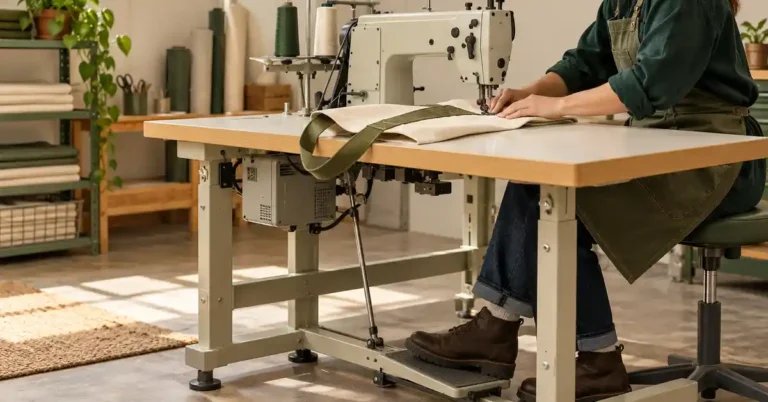
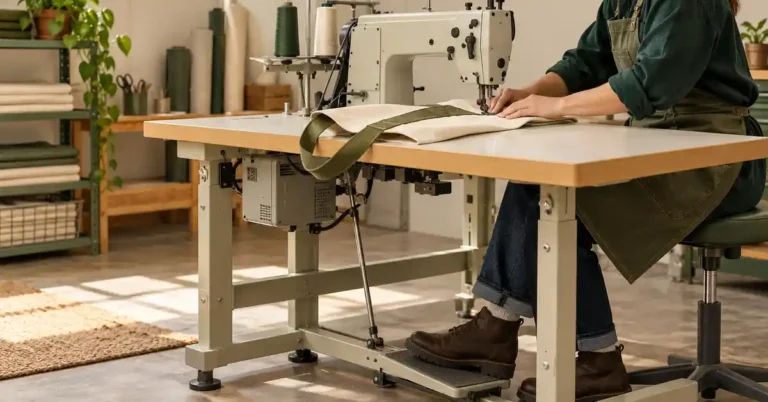
A flat-bed industrial machine still may not reach every narrow or partly assembled item. Evaluate access separately. Some projects call for a cylinder-bed, post-bed, or another supported method; the word industrial does not make every configuration universal.
Test Jeans at the Hardest Folded Crossing
Prepare the actual denim and reproduce the hem or other junction, including the folded allowances. The machine should move from the normal section across the appropriate thicker part without forcing the material or helping the motor overcome an unsuitable stack.
Use the correct compatible needle and thread and an appropriate leveling aid only as directed. Available presser-foot lift is not a universal thickness rating. A stack fitting underneath the foot does not establish that it can be sewn reliably.
Inspect both faces and the material around the seam. Stop if stitches fail repeatedly, the needle deflects, the machine strains, or the work cannot advance normally. A successful demonstration is normal suitable operation, not a dramatic forced layer-count test.
Leather: Surface, Firmness and Visible Holes Matter
Test the actual leather and seam construction. Soft garment leather and a firm reinforced assembly create different demands. A general statement that a machine sews leather is incomplete unless it identifies the material, thread, needle, layers, and operation.
Needle holes can remain visible after unpicking, so establish the stitch and placement on scrap first. Check surface marking as well as stitch formation. The result must suit the product’s appearance and construction, not simply show that the needle penetrated once.
Use holding and marking methods appropriate to the material and pattern. Do not assume that pins, pressing, or a woven-fabric finishing method transfers unchanged. Follow the material’s care and application guidance and test any proposed product on scrap.
Our leather bag construction guide explains related seam and machine-limit questions. It does not turn a household machine into a universal choice for every leather accessory.
Needle System, Point and Thread Must Work Together
Use the needle system specified for the exact machine. A household and industrial needle with a similar size number are not automatically interchangeable. Within the correct system, select a point and size appropriate to the material and permitted thread.
A leather-cutting point should not automatically be transferred to a woven denim setup. Likewise, a larger needle is not a universal cure for skipped stitches. Threading, needle condition, compatibility, feeding, and the construction all deserve systematic checks.
Very thick thread can exceed a domestic machine’s appropriate range. Do not select it only because it looks strong. The thread needs to pass correctly through the needle and tension system and form a balanced seam. Ask a qualified supplier to demonstrate the intended industrial combination where relevant.
Walking-Foot Attachments and Industrial Feed Are Different
A compatible household walking foot can help some layer-shifting problems within the machine’s limits. It does not change the underlying drive, needle system, thread range, or access configuration. A nonstick foot addresses another concern, surface friction, rather than supplying every kind of upper feeding.
Our walking-foot guide provides compatibility context for applicable Brother models. Check exact attachment and operating restrictions instead of assuming every foot described for a brand fits every machine.
When the recurring job needs a particular industrial mechanism, compare models that actually supply it. Request the same seam sample from each seller so the discussion remains about the operation rather than competing uses of heavy-duty terminology.
Plan Support and Access Around the Item
Support large material so its weight cannot pull against the feed system. Leave room for the partly assembled product to turn and move. A flat panel and a stiff finished bag can create very different handling requirements.
Review construction order before cutting. Appropriate operations may be easier while components remain flat. Do not remove required reinforcement merely to make an item fit a smaller machine. A neat seam does not establish a load rating for an attachment or structural product.
For ordinary household construction examples, our tote, pouch, and wallet guide provides context. Treat each material and changed construction as a new sample question rather than assuming one familiar pattern proves every variation.
Five Useful Selection Principles
- Separate denim, leather, and coated-fabric requirements.
- Test the complete difficult junction.
- Match the actual feed mechanism and needle system.
- Inspect surface appearance and both stitch faces.
- Compare the complete installed or household setup.
Two Limits
- A material name and heavy-duty label do not establish capacity.
- A flat sample does not prove access or reliability at the final assembly stage.
Compare the Exact Offer and Support
Confirm condition, included parts, return terms, warranty, service route, and any installation requirements. For a used machine, demonstrate the actual unit and ask about repair history. A power-on photograph is not proof of the operations you need.
Keep a reference sample and settings record after purchase. If the material or assembly changes, repeat the relevant test. Our Brother category guide and Janome overview add household comparisons, while the exact industrial manual controls specialized setup and maintenance.
Bring a sample that includes the actual seam crossing, not only two flat pieces of material. Ask the seller to show slow starts, reverse stitching and the underside of the seam. That demonstration answers more than a stack of unrelated scraps or a maximum speed claim.
A Project Check Before You Commit
Prepare separate denim and leather samples instead of treating them as one heavy-material test. Denim is woven and may form bulky folded crossings; leather has permanent needle holes and can retain feed marks. The same foot, needle point, thread, and pressure setup may not be suitable for both materials.
For jeans, include the real hem intersection or waistband transition. For leather, use an offcut with the actual lining and reinforcement. Ask to start slowly, cross the raised area, secure the seam appropriately, and remove the piece. Inspect both sides and the visible finish after the material rests. A machine that pierces one stack successfully has not proven it can repeat every construction at an acceptable appearance or within its documented range.
Label the two successful material samples separately. Keeping their needle, thread, and foot requirements distinct reduces confusion when switching between denim repairs and a leather project on the same workstation.
Frequently Asked Questions
Can one machine sew every kind of jeans and leather?
No universal claim is useful. Material, seam stack, needle and thread requirements, feeding, access, and intended use determine suitability. Test the actual construction.
Does a heavy-duty domestic machine replace unison feed?
No. A household label or walking-foot attachment does not establish the industrial mechanism. Compare the feed system actually supplied by the model.
Should I use the same needle on denim and leather?
Do not assume so. Match the correct needle system, point, size, and thread to each material and machine. A leather-cutting point is not automatically appropriate for woven denim.
Does the DNU-1541 listing always include a complete station?
No assumption should be made. Confirm the exact suffix, head, motor, table, controls, setup, delivery, and support in the offer.
What sample is most useful?
Bring the hardest complete junction and an ordinary seam from the actual project. Inspect normal feeding, both stitch faces, surface marking, and access at the relevant construction stage.
Final Recommendation
Choose household equipment for compatible denim and light-project roles only after a realistic sample. Evaluate an appropriate industrial station such as DNU-1541 when recurring demanding leather work calls for it. Keep material, feed system, visible finish, access, and the complete ownership arrangement explicit instead of expecting one machine name to solve every jeans-and-leather project.