

The 4411 makes sense for someone who wants a small stitch menu and is comfortable controlling speed with a pedal. Its four-step buttonhole is a material difference from the 4423. The Heavy Duty name does not make it an industrial walking-foot machine. The discussion below separates documented capabilities from practical selection considerations for your work. Its purpose is to support an informed comparison of suitable equipment, not promise universal results.
Who should consider it?
A household sewist who prioritizes utility seams over a large menu of decorative stitches.
Documented features and important limits
| Item | Documented detail |
|---|---|
| Built-in stitches | 11 |
| Stitch applications | 69; not 69 separate stitches |
| Buttonhole | Four-step |
| Presser-foot pressure | Adjustable |
| Manufacturer maximum speed | 1,100 stitches per minute |
| Machine category | Household sewing |
Confirm the exact model’s features and accessories in the manufacturer information.
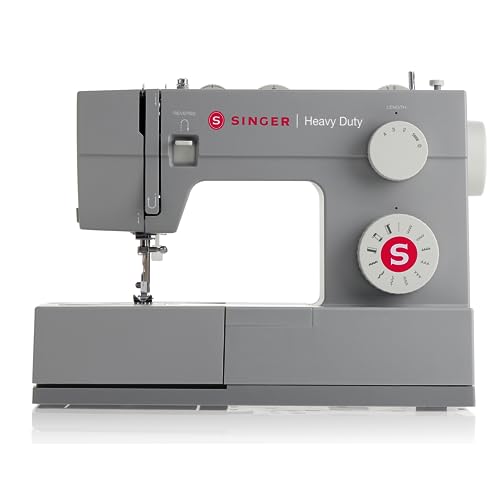
- POWERFUL FOR TOUGH FABRICS: With 50% more power, the SINGER Heavy Duty 4411 is built to...
- VERSATILE STITCH APPLICATIONS: Offering 69 stitch applications, the SINGER 4411 lets you...
- HIGH-SPEED STITCHING: Achieve faster results with up to 1,100 stitches per minute...
- DURABLE METAL FRAME: The heavy-duty metal frame ensures skip-free sewing and provides...
- TOP DROP-IN BOBBIN SYSTEM: The convenient top drop-in bobbin system, complete with a...
Eleven stitches are different from 69 applications
Singer describes several techniques that can be performed with its available stitches as stitch applications. This is useful teaching language, but it should not be mistaken for a separate pattern for every application. If you compare the 4411 with another machine, compare built-in stitches with built-in stitches, then consider the operations your projects need.
For a simple tote or a curtain, the quality of a straight seam and the ability to keep seam allowance consistent are more relevant than the total count. For a stretch garment, inspect the stitch chart and test your proposed seam. A small menu can be adequate, but a missing stitch cannot be added by changing a presser foot.
Compare the relevant equipment categories using the sewing machine buying guide.
The four-step buttonhole is the main buying tradeoff
A four-step buttonhole requires the operator to move through stages. That is manageable once learned, but it takes more attention than choosing a one-step operation. For a shirt with several visible buttonholes, repeatability matters. Mark the position, stabilize the fabric, and make multiple samples before cutting the garment.
If you know you will make button-front clothes frequently, compare the 4423 before choosing the 4411. Paying less for the machine can be a false economy if you dislike the operation you perform most often. Conversely, a sewist who rarely makes buttonholes may reasonably prefer the simpler purchase.
For related sewing preparation and problem-solving, see the sewing techniques and troubleshooting.
How to evaluate its Heavy Duty claim
Treat thickness as a seam problem. A flat pair of denim layers is a different task from crossing a folded side seam with several layers concentrated under the foot. Ask to sew the actual junction you plan to make. Stop if the needle deflects, the motor stalls, or the fabric no longer feeds predictably.
Pressure adjustment can help refine feeding, but it is not a substitute for a suitable needle, proper thread, or an appropriate machine category. For repeated upholstery or leather work, compare an industrial unison-feed machine and its service requirements. The 4411 remains a household sewing machine even when it handles a heavier sample.
Explore accessory categories in our sewing machine parts and accessories; use the exact manufacturer manual for compatibility and maintenance.
Speed is useful only when control is comfortable
The advertised maximum speed is a machine capability, not a target for your first seam. A new user needs smooth low-speed starts and accurate stops. A fast run across a long straight seam can hide poor behavior around corners, zippers, and bulky intersections.
During a demonstration, draw a small rectangle and sew around it slowly. Assess whether you can stop before each corner without overshooting. If the pedal response feels abrupt to you, compare another machine rather than assuming experience will remove every difficulty. Comfortable control is a practical buying criterion.
Five advantages and two limitations
Advantages
- A short stitch menu suits utility-focused sewing.
- Adjustable foot pressure provides a feeding adjustment.
- The top-loading bobbin is accessible for setup.
- A free arm helps with some tubular garment sections.
- Drop feed supports compatible free-motion techniques.
Limitations
- The four-step buttonhole needs more operator involvement.
- It lacks a speed slider and industrial compound feeding.
Buying and demonstration checklist
| Step | What to check |
|---|---|
| 1 | Repeat three buttonholes on interfaced scraps. |
| 2 | Start at low speed without a sudden long first stitch. |
| 3 | Cross the thickest planned hem junction. |
| 4 | Ask which exact accessories are supplied with the grey model. |
Named alternatives to compare
Singer 4423 is a separate comparison model. The link below is not represented as the reviewed machine.
Singer 4452 is a separate comparison model. The link below is not represented as the reviewed machine.
A cached Amazon listing confirms product identity for this draft. It does not confirm current stock, price, seller, warranty or the present AAWP data response.
Frequently asked questions
Does the 4411 have 69 stitches?
No. Singer lists 11 built-in stitches and 69 stitch applications. Applications describe techniques performed with those stitches.
Is its buttonhole automatic in one step?
No. The 4411 uses a four-step buttonhole. If that operation matters, compare it with a one-step model.
Is the 4411 an industrial machine?
No. It is a household mechanical machine. It does not have the compound feeding of an industrial upholstery machine.
Is 1,100 stitches per minute always the right speed?
No. Use a speed appropriate to the fabric, seam, and your control. The maximum specification is not a requirement.
Can I add an automatic needle threader with a foot?
A presser foot does not add that mechanism. Check the original machine features rather than assuming an accessory changes its core design.
Related Practical Textile guides
Explore sewing, embroidery, dyeing, printing and other fabric topics at Practical Textile.
Sources and research method
Manufacturer pages, product documentation and exact listing identities were checked on 2026-10-13. Feature-based recommendations are editorial judgments; they are not measured performance results. Availability, software requirements, packages and lifecycle can change.
