Best Cutting Table for Sewing Rooms: 3 Practical Picks
A good cutting table supports fabric without forcing you to crawl around on the floor or bend over a low dining table. We compare three serious options and explain the surface, height, folding and storage details that matter when cutting cloth.

Quick answer
The best cutting table for sewing rooms is the Sew Ready Folding Multipurpose Hobby and Cutting Grid Table for most buyers because it combines a dedicated gridded worktop, useful storage and a foldable layout. Choose the Arrow Bertha Sewing Cabinet for a more permanent sewing centre, or the Arrow Sidekick Sewing Table when room layout must stay flexible.
Key takeaways
- A stable, flat top matters more than a printed grid when cutting fabric accurately.
- Choose the largest unfolded surface your room can keep clear on cutting day.
- A 91 cm to 97 cm cutting height usually reduces bending for many standing adults, but check your own elbow height.
- Locking casters and rigid leg bracing prevent fabric creep and wavy rotary-cut edges.
- Cabinet tables suit permanent rooms; folding tables make better use of shared spaces.
Contents8 sections
The best cutting table for sewing rooms is the Sew Ready Folding Multipurpose Hobby and Cutting Grid Table for most people. It gives you a dedicated cutting surface, storage close to hand and the ability to recover floor space when the project ends. The Arrow Bertha Sewing Cabinet is the stronger choice for a permanent studio, while the Arrow Sidekick Sewing Table fits a smaller, more changeable room.
Do not choose a table by appearance alone. Fabric cutting puts a different load on furniture than sewing: the top must remain flat while you pull out 1.5 m to 3 m of cloth, lean on a ruler, place pattern weights and run a rotary cutter along the edge.
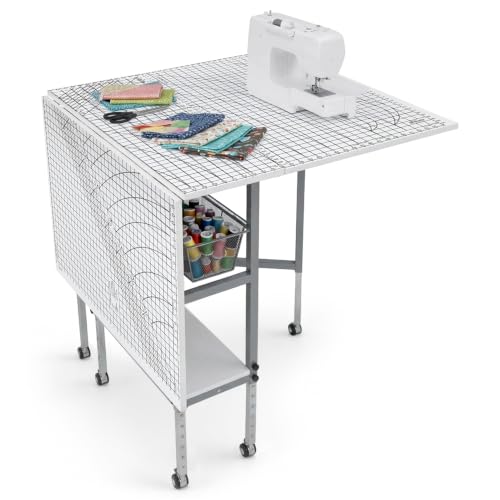
Sew Ready Folding Multipurpose Hobby and Cutting Grid Table
- Dedicated cutting layout
- Folds between projects
- Useful integrated storage

Arrow Bertha Sewing Cabinet
- Furniture-style storage
- Permanent room solution
- Supports organised workflow

Arrow Sidekick Sewing Table
- Adaptable room layout
- Smaller visual footprint
- Useful supporting surface
What’s in this article8 sections
Cutting table for sewing rooms at a glance
These three tables serve different room layouts, so the best choice depends mainly on whether you need a dedicated cutting station, permanent furniture or a flexible support surface.
| # | Photo | Product | Best for | Main drawback | Link |
|---|---|---|---|---|---|
| 1 | Sew Ready Folding Multipurpose Hobby and Cutting Grid Table | Most home sewing rooms | Needs open-floor space | View | |
| 2 |  | Arrow Bertha Sewing Cabinet | Dedicated sewing studios | Large permanent footprint | View |
| 3 |  | Arrow Sidekick Sewing Table | Small adaptable sewing spaces | Limited cutting span | View |
| Table | Best room type | Main strength | Watch before buying |
|---|---|---|---|
| Sew Ready Folding Multipurpose Hobby and Cutting Grid Table | Shared sewing room | Purpose-led foldable cutting surface | Open footprint and caster locks |
| Arrow Bertha Sewing Cabinet | Permanent studio | Furniture-style organised workstation | Open configuration and moving access |
| Arrow Sidekick Sewing Table | Small adaptable room | Flexible supporting worktop | Uninterrupted cutting width |
How we chose these cutting tables
We chose these options from their stated design, intended function and features a sewist can verify on the current product listing, rather than making claims from product testing. A cutting table is simple furniture, but small design choices decide whether it helps fabric handling or becomes another surface covered in half-finished projects.
A flat, stable working surface
A pattern ruler transfers your hand pressure into the table. If a top bows, rocks or rolls when you lean on it, the fabric moves a few millimetres and a supposed straight cut becomes a shallow curve. That matters most with woven cotton, linen and stable fusible-interfaced pieces, where an inaccurate edge stays inaccurate during sewing.
We prioritised tables designed as work surfaces rather than lightweight occasional furniture. Buyers should check for positive wheel locks, cross-bracing, leg locks and a stated maximum load where the maker provides one. Locking casters stop travel across the floor; they do not necessarily stop a table top from flexing under a long ruler.
Usable size, not just furniture size
The useful surface is the clear, continuous area after drawers, hinges, machine cut-outs and raised edges are accounted for. A tabletop can look large in a photograph but have only a narrow strip free for cutting. For garment work, you want enough width to support the pattern section and enough length to keep the grainline straight without continually dragging cloth around.
Measure your largest common job. A bodice pattern may fit comfortably on a modest top; a trouser leg, bias-cut skirt panel or quilt border needs far more length. Fabric hanging over an edge is not always a problem, but hanging cloth pulls on the piece and can shift the grain before you make the cut.
Working height and body position
Cutting usually happens standing, with both hands applying downward pressure to a ruler or scissors. A low table makes you round your back and bend your wrists; a high table lifts the shoulders and makes rotary cutting less controlled. For many adults, a top around 91 cm to 97 cm, or 36 in to 38 in, is a useful starting range, but your own standing elbow height is the better reference.
Stand relaxed with your upper arms vertical. A cutting top slightly below the elbow usually gives a comfortable angle for a 45 mm rotary cutter and a clear view of the ruler marks. If two adults share the room and differ substantially in height, a mobile folding table can be easier to raise with robust furniture risers than a heavy cabinet, provided the maker permits that arrangement.
Storage that does not obstruct cutting
Storage is valuable when it holds rulers, weights, clips, tape and spare blades within one step of the cutting area. It becomes a nuisance when drawers project into your knees, baskets catch fabric or a raised storage rail blocks a long ruler. We gave preference to layouts that keep the centre of the top clear.
Keep sharp tools separately. A rotary cutter belongs with its blade guard engaged, and shears need a sleeve or closed drawer rather than a loose open bin. If you cut with a powered tool, review our guide to the best electric rotary fabric cutters before deciding how much clear support space the tool needs.
Room logistics and long-term use
Large furniture works only if it can enter the room, open fully and still leave a walking route. Measure door widths, stair turns, skirting boards, radiators and the space in front of drawers before you order. We also considered whether the table can be folded, rolled or kept permanently open without turning every cutting session into a furniture-moving task.
- Best room
- Folding grid table: Shared or changing
- Sewing cabinet: Dedicated sewing room
- Set-up
- Folding grid table: Open for cutting
- Sewing cabinet: Usually stays positioned
- Storage
- Folding grid table: Visible drawers or bins
- Sewing cabinet: Enclosed cabinet space
- Cutting area
- Folding grid table: Wide when opened
- Sewing cabinet: Depends on configuration
- Mobility
- Folding grid table: Often rolls or folds
- Sewing cabinet: Heavier to move
Match the table structure to how your room is used.
Sew Ready Folding Multipurpose Hobby and Cutting Grid Table
Sew Ready Folding Multipurpose Hobby and Cutting Grid Table
Best for: Most home sewing rooms
Its purpose-built gridded cutting surface, folding format and integrated storage make it the most balanced option for regular garment, quilt and craft cutting. Check the current unfolded dimensions, caster locks and supplied storage pieces before ordering.
What we like
- Dedicated cutting layout
- Folds between projects
- Useful integrated storage
- Grid aids alignment
Watch out for
- Needs floor clearance open
- Grid still needs checking
- Not a heavy cabinet
Skip it if: you need an enclosed sewing machine cabinet or a fixed furniture-style work centre.
The Sew Ready Folding Multipurpose Hobby and Cutting Grid Table is our best overall choice because its design starts with cutting rather than asking a sewing cabinet to do every job. A gridded top gives you a visible reference for squaring fabric, checking a fold and placing a pattern on grain. The folding format makes sense in a spare bedroom, dining area or craft room where the same floor must serve another purpose.
A printed grid is useful, but treat it as a layout aid, not as a calibrated measuring instrument. Before relying on it for a 50 cm or 20 in line, compare several divisions against a good steel rule. Printed lines can be slightly out of square, and a rotary blade can damage the finish if you cut directly on the top; use a self-healing mat for every rotary-cut task.
The table should suit sewists who cut garment panels, quilting patches, craft felt and interfacing regularly but cannot leave a large table permanently open. When examining the listing, check the fully open top dimensions rather than only the folded product size. Also confirm where the legs and drawers sit when open, whether the casters lock securely, and whether the listed accessories are included in the version being sold.
Compared with Bertha, this is the more direct answer to “where do I cut fabric?” It does not offer the same enclosed, furniture-like sewing centre, but its dedicated surface and practical fold-away approach make better use of a shared room. Compared with the Sidekick, it should be the better choice when a clear cutting layout matters more than the smallest possible footprint.
Arrow Bertha Sewing Cabinet
Arrow Bertha Sewing Cabinet
Best for: Dedicated sewing studios
Bertha suits buyers building a fixed sewing station who value a substantial cabinet format and a work surface that can support a wider workflow. Confirm the machine-platform arrangement, closed and open dimensions, and the exact cutting-space configuration on
What we like
- Furniture-style storage
- Permanent room solution
- Supports organised workflow
- Substantial work centre
Watch out for
- Takes more space
- Less quick to relocate
- Configuration needs checking
Skip it if: your sewing area doubles as a guest room or must be cleared away after each project.
The Arrow Bertha Sewing Cabinet is the pick for a dedicated room where sewing, pressing and cutting happen often enough to justify a permanent work centre. A cabinet format can keep tools, projects and sewing equipment organised behind a more finished exterior than an open utility table. That matters if the room must look orderly between projects or shares space with other household use without needing to be fully cleared.
Bertha is not simply a cutting board on legs, so study the current configuration before assuming how much flat space you receive. Cabinet furniture may include leaves, doors, machine platforms or storage sections that change the usable top area in different positions. Look at the open and closed dimension drawings, not just a staged photograph with a compact sewing machine and neatly folded fabric.
Think about fabric travel around the cabinet. When you spread 150 cm-wide cloth, you need a route to walk around the top without catching the selvedge on handles, drawers or a nearby wall. A cabinet can be excellent for pressing a small panel, trimming blocks or cutting accessories, yet still be less convenient than a wide grid table for laying out a floor-length dress or a broad quilt backing.
It is also the least casual option to move. Confirm the shipped carton dimensions, room access and assembly requirements, and place it where drawers and any folding sections can operate fully. If your machine has an unusual free-arm shape or bed size, verify machine compatibility separately; a cabinet opening and a cutting surface are related features, but they are not the same specification.
Arrow Sidekick Sewing Table
Arrow Sidekick Sewing Table
Best for: Small adaptable sewing spaces
The Sidekick is the sensible middle route for a sewist who needs a supporting table that can adapt to the room rather than dominate it. Check its working height, folded footprint, locking hardware and whether its top gives enough uninterrupted width for your u
What we like
- Adaptable room layout
- Smaller visual footprint
- Useful supporting surface
- Easier repositioning
Watch out for
- Less expansive top
- May need extra cutting mat
- Not a full cabinet
Skip it if: you routinely cut full-width garment lengths, wide quilt backs or several metres at once.
The Arrow Sidekick Sewing Table works best as a flexible supporting station, especially where a full cabinet would overwhelm the room. It can provide a place to stage pattern pieces, hold a compact cutting mat or extend the workflow beside a sewing machine. This arrangement can be more useful than one giant table when you sew in short sessions and must change the room back quickly.
Its key limitation is the clear span of the top. A support table can be perfectly adequate for face masks, small bags, doll clothes, quilt blocks and trimming seams, yet too narrow for a full garment layout. Check the uninterrupted width and length after any raised edges, hinges and storage sections are excluded, then compare those dimensions with your existing cutting mat and your most frequent pattern sheet.
We would also check its height against the sewing table or cabinet it will sit beside. Two adjacent tops that differ by even a small amount can catch fabric as you slide a large piece across them. That is annoying with stable poplin and more troublesome with slippery rayon, satin or lining, which can shift and fall before you can re-square it.
The Sidekick makes the most sense as a compact companion, not as an automatic replacement for a broad dedicated cutting table. It gives a practical work surface where flexibility is the priority. Choose the Sew Ready table instead if you cut long pieces often; choose Bertha if you want a fixed furniture installation with the room to support it.
What should you check before buying a cutting table for sewing?
Check the clear cutting area, standing height, stability, storage layout and fully open footprint before choosing a cutting table for sewing. Those five details determine whether you can lay fabric accurately and use the table without rearranging the room each time.
Measure fabric width and your usual pattern pieces
Most apparel fabric is sold in widths such as 112 cm, 140 cm or 150 cm, roughly 44 in, 55 in and 60 in. You do not need a table wider than the entire cloth to cut successfully, but you do need enough supported area to place your key pattern sections flat. A 60 cm by 90 cm mat works for many small pieces; it does not replace a broad table when you need to align grainlines on a long skirt or trouser panel.
For very long pieces, arrange the fabric so the supported cutting line is on the table and the excess is supported by a clean auxiliary surface. Do not let a heavy roll of fabric pull from one edge while you position a pattern. Woven fabric can be tugged off grain; stretch knits may lengthen under their own weight, especially when cut on the cross-grain.
Check top material and protect it from blades
A smooth, hard top lets fabric lie flat and makes pins, weights and rulers easier to manage. However, no ordinary furniture finish is a cutting mat. Repeated rotary cutting scores laminate, paint or veneer, creates burrs that snag delicate cloth, and eventually exposes the substrate to moisture.
Use a self-healing mat large enough for the area you cut most often. Replace it when cuts no longer close, the surface has deep grooves or it has developed a permanent curl. Store mats flat and away from direct heat: a warped mat makes a ruler rock and can throw off a cut by several millimetres over its length.
Choose the right cutting tool for the top
Scissors, rotary cutters and electric cutters need different clearance. Dressmaking shears need the fabric supported near the blade tips, or the lower blade lifts the cloth and distorts the edge. A rotary cutter needs a mat, a non-slip ruler and a stable top; use a blade size appropriate to the fabric stack rather than forcing a dull blade through several layers.
A digital cutter can reduce repeated hand cutting for appliqué, labels and small components, but it needs its own clear loading and unloading space. Our comparison of the best fabric cutting machines explains the different materials and work sizes these machines suit. Keep electronic machines away from the edge of a folding top, where vibration and an accidental cord pull are more likely.
Assess legs, wheels and floor contact
Set a table on the same floor it will use. A table that feels solid on level tile may rock on a carpet seam or uneven timber floor. If it has casters, engage every brake before spreading fabric; if it has adjustable feet, set them so all feet bear evenly without twisting the frame.
Use a long ruler as a simple practical check. Press at the centre of the top, then along both long edges. You should not see a meaningful change in level or hear repeated creaking from a joint. A little movement in a folding mechanism is normal, but a table should not wander as you make a continuous 90 cm cut.
Plan storage by cutting sequence
Put tools where they are used: rulers and weights close to the cutting edge, clips and marking tools in a shallow drawer, and patterns in a vertical file or wide box. Deep bins are fine for batting, scraps and stabiliser, but they turn into a tangle when used for small metal weights, blades and chalk pencils. A labelled container also prevents you from putting a fresh rotary blade back with dull ones.
Keep steam and liquids off the cutting top. A pressing station is useful nearby, but a wet iron base or spray bottle can swell exposed board edges and stain unfinished fabric. Follow the furniture maker’s care instructions and work in a ventilated space whenever using spray adhesive, temporary basting products or cleaning chemicals.
Set up the table for accurate cutting
Accurate cutting begins with fabric preparation, not the first pass of the blade. Follow these steps each time you set up a new fabric type or a large pattern layout.
- Clean lint, thread snippets and pins from the top and mat.
- Lock casters or confirm that every table foot contacts the floor.
- Press major creases from the fabric, using the fibre-appropriate iron setting.
- Square the cut end and align the fabric grain before placing pattern pieces.
- Support overhanging cloth so it does not pull the layout sideways.
- Place weights or pins, then cut with a sharp blade or properly adjusted shears.
Solve the cause before blaming the cutter or pattern.
Allow room for maintenance and replacement parts
Tables need modest but real maintenance. Vacuum dust from hinges and wheel housings, wipe the top with the cleaner approved by the manufacturer, and periodically check visible fasteners for loosening. Do not over-tighten particleboard fittings: crushed board no longer grips screws well, and a stripped joint often needs a proper repair rather than a larger screw forced into the same hole.
For folding models, inspect locking parts before every major cutting session. For a cabinet, keep its moving leaves clear of loose threads and fabric strips. If you need a new mat, caster, drawer stop or hinge, identify the product version first; similar-looking furniture can use different parts across production runs.
FAQ
What is a good height for a cutting table for sewing?
For many standing sewists, a cutting surface around 91 cm to 97 cm (36 in to 38 in) is a useful starting range. The best height is usually slightly below your relaxed elbow, so you can press a ruler down without rounding your back or lifting your shoulders.
Can I use a sewing cabinet as a cutting table?
You can use a sewing cabinet for smaller cutting jobs if it has a clear, flat and stable section of top. Check the uninterrupted surface, machine opening and fold-out sections first, because cabinet features can limit how much fabric lies flat.
Do I need a cutting mat on a sewing cutting table?
Yes, use a self-healing cutting mat whenever you use a rotary cutter. It protects the table finish, supports a clean blade path and prevents the grooves and snag points that develop when blades score ordinary furniture surfaces.
How large should a fabric cutting table be?
Choose the biggest stable surface your room can accommodate when fully open and still leave space to walk around it. Small bags and quilt blocks need far less area than full garments, wide fabric or quilt backs, so base the decision on your largest regular project.
Is a folding cutting table stable enough for fabric cutting?
A well-made folding table can be stable enough when its legs are fully locked, its casters are braked and the floor is level. Before cutting, press along the surface with a long ruler; if the top rocks or flexes noticeably, correct the setup before using a rotary cutter.
Final verdict
Final verdict
Most buyers: Sew Ready Folding Multipurpose Hobby and Cutting Grid Table. Dedicated cutting features without committing the room permanently.
Check priceDedicated studio owners: Arrow Bertha Sewing Cabinet. Best suited to a fixed, furniture-style sewing centre.
Check priceSmall-space sewists: Arrow Sidekick Sewing Table. A flexible support table for changing room layouts.
Check priceChoose the Sew Ready Folding Multipurpose Hobby and Cutting Grid Table if you want the most capable all-round cutting table without dedicating the whole room to furniture. Pick Arrow Bertha for a settled sewing studio and the Arrow Sidekick Sewing Table when a compact supporting surface makes more sense than a large fixed work centre. In every case, measure the open footprint first and protect the top with a quality cutting mat.