What Is Damask? Damask vs Jacquard vs Brocade and How It Is Woven
Damask is the reversible, sheen-patterned fabric of fine table linens and classic upholstery. Learn how it is woven, how it differs from jacquard and brocade, and how to care for it.

Quick answer
Damask is a reversible patterned fabric woven on a jacquard loom. The design is formed by contrasting weaves, usually shiny satin areas against matte sateen areas, so a single-colour damask shows its pattern through changes in sheen. The back shows the same pattern in reverse. Damask is made from linen, cotton, silk, wool or synthetics and is classic for tablecloths, napkins, upholstery, curtains and bedding.
Key takeaways
- Damask is a weave structure, not a print: the pattern is woven in and is visible on both sides.
- All damask is a jacquard fabric, but not every jacquard fabric is damask.
- Brocade adds extra raised weft yarns and is not reversible; damask is flat and reversible.
- Linen damask table linen gets better with washing; iron it damp to bring out the sheen.
Contents10 sections
What’s in this article10 sections
What is damask?
Damask is a patterned fabric in which the design is woven in, not printed or embroidered. It is made on a jacquard loom by switching between two weaves: a warp-faced satin and a weft-faced sateen. Because light reflects differently from each weave, a damask woven in one colour still shows a clear pattern of shiny and matte areas. Turn it over and the same pattern appears in reverse, which makes damask a reversible fabric.
The name comes from Damascus, a historic centre of silk weaving and trade. Damask weaving spread to Italy, France, Flanders and later Ireland and Scotland, where linen damask table linen became a household treasure.
Damask at a glance
- Construction
- Jacquard woven, satin and sateen contrast
- Fibres
- Linen, cotton, silk, wool, viscose, polyester
- Reversible
- Yes, pattern reversed on the back
- Look
- Flat, smooth, pattern shown by sheen
- Uses
- Table linen, upholstery, curtains, bedding, garments
- Care
- Depends on fibre; linen and cotton are washable
How damask is woven
Early damasks were woven on draw looms, where an assistant lifted groups of warp threads by hand to form the pattern. In 1804 Joseph-Marie Jacquard introduced a punched-card mechanism that controlled each warp thread automatically. Modern electronic jacquard looms work on the same principle with digital pattern files.
In the pattern areas the warp floats over several weft threads (satin), so the surface shows mostly warp. In the background the weft floats over the warp (sateen), so the surface shows mostly weft. Even when warp and weft are the same colour, the two surfaces catch light differently. Damasks can also use different coloured warp and weft for a two-colour design.
Damask vs jacquard vs brocade
Jacquard is the broad family: any fabric whose pattern is woven on a jacquard mechanism, including damask, brocade, matelassé and many tapestry fabrics. Damask is the flat, reversible member of that family. Brocade adds extra weft yarns, often metallic or in several colours, that float on the surface to create raised motifs, so the back is messy and the fabric is not reversible.
- Pattern made by
- Damask: Contrast of satin and sateen weaves
- Brocade: Extra (supplementary) weft yarns
- Surface
- Damask: Flat, smooth
- Brocade: Raised, embossed look
- Reversible
- Damask: Yes, pattern shows in reverse
- Brocade: No, back has floating threads
- Colours
- Damask: Often one colour, pattern seen by sheen
- Brocade: Often several colours, often metallic yarns
- Typical uses
- Damask: Table linen, bedding, upholstery, curtains
- Brocade: Formal wear, upholstery, ceremonial textiles
Both are jacquard-woven figured fabrics with very different construction.
Types of damask
- Linen damask: the classic for tablecloths and napkins; heavy, cool, long lasting and lustrous after ironing.
- Cotton damask: softer and more affordable, used for table linen, hotel bedding and damask-stripe sheets.
- Silk damask: luxurious upholstery, wall coverings, drapery and historic dress.
- Wool damask: used historically for furnishing and garments.
- Synthetic damask: polyester or viscose blends for affordable curtains, cushions and linings.
- Two-colour and lampas styles: richer figured fabrics related to damask, used in decorative furnishing.
Strengths
- Pattern woven in, so it never fades off like a print
- Reversible, elegant and timeless
- Linen and cotton damask are very durable and washable
- Satin areas give a subtle, luxurious sheen
Drawbacks
- Satin floats can snag on sharp objects
- Linen and cotton versions need ironing to look their best
- Good damask is more expensive than printed fabrics
- Silk damask needs professional cleaning
What is damask used for?
- Table linen: tablecloths, napkins and runners. See our guide to the best fabric for tablecloths for how damask compares.
- Upholstery and curtains: traditional and hotel interiors.
- Bedding: cotton damask duvet covers, pillowcases and damask-stripe sheets.
- Garments and linings: jackets, waistcoats, ties and evening wear.
- Embroidery: plain linen is easier to stitch on than damask; if you want to decorate table linen, read about linen tablecloths for embroidery.
How to recognise true woven damask
- Turn it over: true damask shows the same pattern on the back with the shine reversed.
- Look at the surface: the pattern lies flat in the cloth; there are no raised threads, prints or stitches.
- Tilt it in the light: the motif appears and fades as the angle changes, because it is made by sheen, not ink.
- Check for floats: long, loose threads on the back point to brocade or another jacquard, not damask.
Choosing damask table linen
Linen damask is the most luxurious and long lasting; it is heavy, cool, absorbent and becomes more lustrous with each wash and press. Cotton damask is softer, cheaper and easier to iron, and is common in hotels and restaurants. Polyester or poly-cotton damask resists stains and wrinkles but is less absorbent for napkins.
To size a tablecloth, measure the table and add twice the drop you want. A drop of about 20 to 30 cm suits everyday dining, while formal settings often use a longer drop. For napkins, around 50 cm square is a common dinner size.
Damask in bedding and interiors
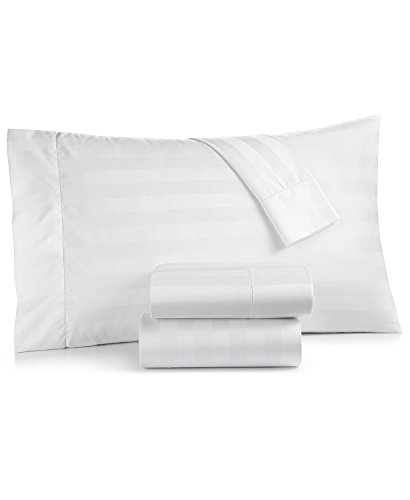
Damask-stripe sheets alternate satin and sateen stripes in the same colour, giving a subtle tone-on-tone look common in hotels. In interiors, silk and viscose damask cover walls, chairs and cushions, while large damask motifs inspired the patterned wallpapers and prints sold as “damask style”.
How to care for damask
Care depends on fibre. Linen and cotton damask can be washed and ironed; silk and many upholstery damasks need professional cleaning.
- Treat stains earlyRinse food and wine stains in cold water before they set.
- WashWarm wash with mild detergent; oxygen bleach for white linen.
- Dry until dampLine dry or tumble briefly and remove while still damp.
- Iron the backIron on the wrong side first with a hot iron to flatten the cloth.
- Iron the faceFinish lightly on the right side to raise the satin sheen.
- Store rolledRoll or fold loosely with tissue to avoid permanent fold lines.
Proper ironing brings out the contrast between satin and sateen areas.
- Avoid chlorine bleach on coloured damask and on silk.
- Vacuum upholstery damask gently with a brush attachment and protect it from strong sunlight.
- For heirloom linen, store clean and unstarched, as starch can attract insects.
Compare damask with other woven fabrics in our fabric types and specifications guide.
Frequently asked questions
What is damask fabric made of?
Damask can be made from linen, cotton, silk, wool, viscose or polyester. Linen and cotton damask are traditional for table linen; silk damask is used for luxury upholstery and garments; polyester damask is common in budget furnishing.
Is damask the same as jacquard?
Damask is one type of jacquard fabric. Jacquard refers to the loom mechanism that controls individual warp threads to weave complex patterns. Damask is a specific reversible jacquard where satin and sateen areas create the design.
Why is it called damask?
The name comes from Damascus in Syria, an important centre of luxury silk weaving and trade on the routes between Asia and Europe.
Is damask reversible?
Yes. The pattern appears on both sides with reversed sheen: shiny areas on the face are matte on the back and the other way round.
What is a damask pattern?
In decor, damask pattern often means large, symmetrical floral or scroll motifs inspired by damask textiles. Printed wallpaper or fabric with that pattern is not true damask unless the design is woven.
Does damask wrinkle?
Linen and cotton damask wrinkle like any plant-fibre fabric, but they press beautifully. Silk and synthetic damasks wrinkle less.