The best sewing machine with a walking foot depends on whether you need an accessory for household sewing, integrated dual feed, or an industrial mechanism for heavier layered work. These arrangements are often mixed together in product descriptions. This guide separates their roles, compares relevant machines, and provides a practical sample checklist so you can choose the feeding system, controls, and complete workstation that fit your materials and intended construction.
As an Amazon Associate, Practical Textile earns from qualifying purchases. Product links may earn us a commission.
Quick Answer
Compare Singer 4452 for a household package with an even-feed attachment, Pfaff ambition 620 for integrated IDT dual feed, and Juki DNU-1541 for industrial unison-feed straight sewing. They serve different requirements. A walking-foot attachment does not transform a household machine into an industrial one, and a powerful industrial station does not replace every household stitch or garment function.
This guide compares published specifications and project fit; it does not report hands-on testing.
Singer Heavy Duty 4452
Check the included even-feed foot and the exact seller inventory.
Check Price on AmazonThis is a 4452 Holiday Bundle offer. Included accessories may differ from other 4452 packages.
Juki DNU-1541
No verified Amazon offer is linked for this model; read the buying checks below.
Confirm the complete station, exact suffix, and suitable materials.
Singer Patchwork 7285Q
A different package to compare when quilting controls also matter.
Three Meanings Behind Walking-Foot Searches
| Arrangement | Example to compare | What to verify |
|---|---|---|
| Household even-feed attachment | Singer 4452 package | Compatibility, included foot, suitable stitches, and material limits |
| Integrated household dual feed | Pfaff ambition 620 IDT | Compatible feet and the required operation |
| Industrial unison feed | Juki DNU-1541 | Needle/thread range, station, access, and exact variant |
Begin by identifying the problem. Layers may shift while sewing, a slippery fabric may be difficult to guide, or a bulky crossing may feed inconsistently. Those issues do not necessarily require the same remedy. Preparation, pressure, the correct needle, and supporting the work can matter alongside the feeding mechanism.
A useful machine comparison asks how the layers move and whether the complete setup produces the required seam. It does not begin with the assumption that every product using the words walking foot has equivalent capacity. That assumption can lead to buying an attachment for a task that needs an industrial machine, or a fixed station for a simple household project.
Singer 4452: Household Sewing With an Even-Feed Accessory
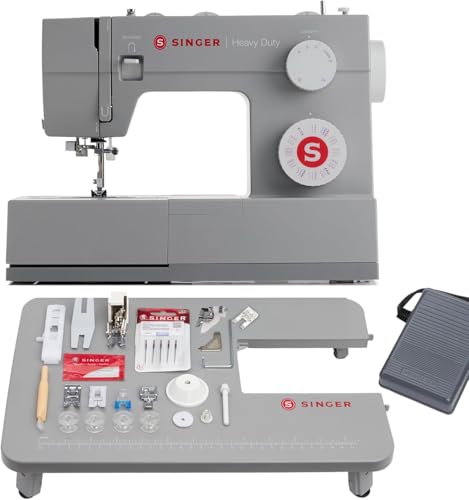

The 4452’s advertised accessory package includes an even-feed walking foot. This makes it a relevant household comparison for suitable layered projects. Confirm that the actual seller includes the foot, particularly for used, refurbished, and open-box offers. A general model photograph does not establish the contents of every carton.
An attachment operates within the machine’s existing sewing system. It does not enlarge the internal working space, change the needle system into an industrial one, or establish compatibility with every thread and material. Use the foot according to the machine and accessory instructions, including any restrictions on stitch choice and operation.
The 4452 is mechanical, so test the controller at the pace you prefer. It does not offer an independent electronic speed-limit slider. For detailed layered work, comfortable slow control may matter more than maximum sewing speed. Try starting near a marked point and approaching a thickness change without pulling the material.
Foot-pressure adjustment provides another handling control, but pressure and thread tension solve different problems. Change one setting at a time on a representative sample. If you alter pressure, needle, thread, stitch length, and preparation together, it becomes difficult to identify which change improved the seam.
Five reasons to compare the 4452:
- The advertised even-feed accessory addresses a household layered-sewing need.
- Mechanical controls provide direct stitch adjustments.
- Foot-pressure adjustment adds handling flexibility.
- Utility stitches and buttonholes preserve general household versatility.
- A suitable complete package may avoid a separate foot purchase.
Two limitations:
- The attachment does not provide industrial unison-feed capacity.
- There is no separate electronic speed-limit slider for detailed work.
Pfaff ambition 620: Integrated IDT Is a Different Household Approach
The ambition 620 specifies Pfaff’s Original IDT integrated dual-feed system. This is a useful comparison when you want household sewing versatility with an integrated feeding aid. It should not be described as identical to an industrial compound-feed machine or assumed to handle every leather or upholstery construction.
Ask which feet in the package are compatible with IDT and how the system is engaged. A buyer sewing zippers, edge stitching, and decorative work needs to understand which setup applies to each operation. The convenience of an integrated system is meaningful only when the required feet and methods fit the projects.
Electronic speed control, needle positioning, and automatic snipping add a different workflow from the 4452’s mechanical arrangement. Test whether those functions remove tasks you repeat. If you mostly sew long straight seams on straightforward materials, some conveniences may be less valuable than a useful table or accessible instruction.
No exact US Amazon listing for this Pfaff configuration is represented by the boxes in this guide. The model remains a plain-text comparison rather than being given another machine’s image or purchase link. Compare a complete dealer quote, including compatible feet and support, against the actual alternatives.
Five reasons to investigate it:
- IDT provides a model-specific integrated feed option.
- Compatible feet allow different household operations.
- The speed slider supports controlled work.
- Needle positioning assists planned pivots.
- Automatic snipping can reduce repeated finishing motions.
Two limitations:
- IDT is not a universal substitute for industrial unison feed.
- Compatible accessory and dealer-package costs need checking.
Juki DNU-1541: Industrial Unison Feed for a Defined Straight-Seam Role
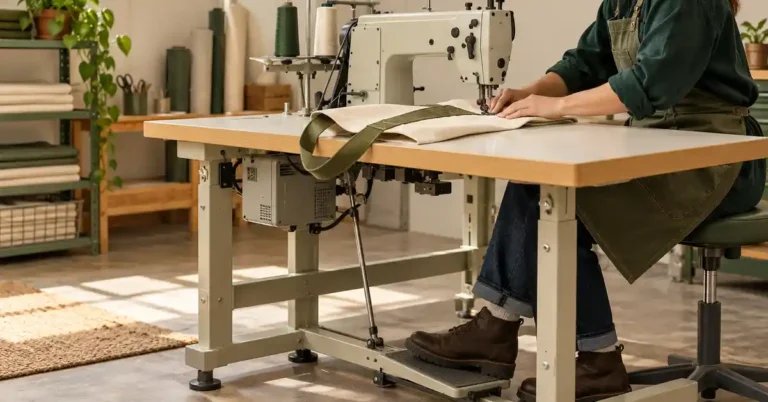
The DNU-1541 is an industrial unison-feed straight-stitch machine. It belongs in the comparison when heavier layered work calls for a machine designed around that operation. It is not a general household machine with zigzag and buttonholes, and its flat bed does not provide every kind of access needed by shaped or tubular projects.
Confirm the exact suffix. The DNU-1541 family includes configurations with different safety or automatic functions. A feature from a related variant should not be copied into the base model’s specification. Ask for the label, matching manual, and complete equipment inventory before comparing offers.
Determine whether the price covers a head or a usable station. A compatible motor, controller, table, stand, and setup may be separate. The correct needle system and supported thread range also matter; familiar household consumables are not automatically interchangeable. Ask the seller to demonstrate the required material and seam with an appropriate setup.
Our DNU-1541 guide explains the industrial role. Choose this category because it solves a defined feed and construction problem, not because the word industrial sounds stronger. A station that forms excellent heavy straight seams can still be the wrong tool for a delicate blouse or a buttonhole.
Five reasons to compare it:
- Industrial unison feed addresses a defined layered-sewing requirement.
- Straight-stitch specialization suits repeated suitable seams.
- A fixed station can support a planned workshop layout.
- Model-specific documentation identifies the intended setup.
- Appropriate feet and guides can support repeat operations.
Two limitations:
- It does not supply ordinary household zigzag and buttonhole versatility.
- Complete station cost, installation, and access requirements are substantial buying considerations.
Singer 7285Q: Compare Electronic Quilting Controls Too
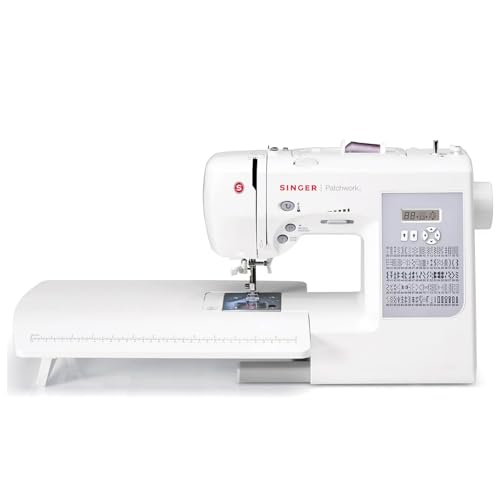
The 7285Q is another household comparison if a listed walking-foot package and electronic quilting conveniences are both important. Check the current seller’s accessories rather than assuming the factory package is complete. Needle positioning and speed limiting serve different purposes from even feeding and should be evaluated separately.
Its external table does not enlarge the internal working space. For a bulky quilt, try moving the representative sandwich around the machine. A useful foot cannot solve every handling problem created by limited space or unsupported weight. Our quilting guide separates those considerations.
Use a Sample That Exposes the Feeding Problem
For matched stripes or checks, mark reference points on both layers. Sew the intended seam and inspect alignment afterward. This is more useful than a claim that a machine never slips. Keep the material, needle suitability, thread, and preparation comparable across the machines being evaluated.
For a quilt sandwich, include the actual batting and backing. Support its weight so the sample tests the feed rather than the pull of material hanging off the table. Examine both sides and measure any visible displacement. A tiny flat sample does not reproduce the handling of a larger project.
For a bag, include the seam crossing, reinforcement, and webbing. The difficult point is often the transition rather than the long flat panel. Check surface marks as well as stitch formation. Our bag construction guide helps identify those steps before equipment shopping.
For leather, test matching offcuts and inspect permanent needle holes and feed marks. A machine that penetrates the stack may still leave an unacceptable visible finish. The leather project guide explains why material preparation and access matter alongside strength.
If You Already Own a Machine, Check Before Replacing It
A compatible attachment may address the actual problem without a new machine. Identify the exact model, shank arrangement, stitch restrictions, and manufacturer’s compatible accessory. Do not assume a generic foot fits because its mounting point looks similar. Clearance and correct operation matter as much as attachment.
Our Brother walking-foot guide provides an accessory perspective. Compare that route with the cost and disruption of replacement. If the existing machine already handles the material and the issue is modest layer movement, a suitable foot and improved preparation may be enough.
If the problem is insufficient access, repeated stalling on the real stack, or a thread requirement outside the machine’s range, an attachment may not solve it. Define the limitation before spending more on accessories. A sequence of incompatible or ineffective add-ons can cost more than a properly selected machine.
Compare the Complete Workflow and Station
List the machine, feet, table or case, motor where relevant, consumables, instruction, delivery, and service. Compare offers with equivalent usable equipment. A household bundle and a head-only industrial listing are not complete alternatives until the missing items are priced.
Ask who supports the exact model locally and what the written coverage includes. Confirm the US electrical specification and the return arrangement for a bulky shipment. During acceptance, test the intended seam, controlled starts, reverse, threading, and accessory changes. Keep a successful sample and its settings as a reference.
For broader household choices, our Brother comparison and operating-style guide help distinguish controls from feeding. A machine can have useful electronics without the feed mechanism your construction requires, and the reverse can also be true.
A Project Check Before You Commit
Test the setup after changing from the walking-foot operation back to ordinary sewing. Check that the correct foot, settings, and any feed engagement are restored according to the manual. A useful workflow includes those changeovers, particularly when a project alternates between layered seams and other construction.
Store each foot with its model compatibility and instructions. Several attachments can look similar while serving different mechanisms or restrictions. Clear identification is especially useful in a room with multiple machines and reduces the temptation to improvise a fit.
Frequently Asked Questions
Is a walking-foot attachment the same as industrial unison feed?
No. An attachment works within a household machine’s existing system. Industrial unison feed is a different mechanism and machine category. Compare the exact arrangement and the material sample rather than treating the names as interchangeable.
Does the Singer 4452 include a walking foot?
The advertised manufacturer package includes an even-feed accessory. Confirm the exact seller’s inventory, especially for used or open-box offers. A photograph of a complete factory bundle does not guarantee every item in a particular purchase.
Is Pfaff IDT suitable for every heavy material?
No universal capacity claim is justified. IDT is an integrated household feeding system on the model discussed. The actual material stack, needle, thread, foot, and machine limits still determine suitability.
Can the DNU-1541 replace my general sewing machine?
It serves a specialized industrial straight-seam role. It does not supply every household stitch, buttonhole, or access requirement. Many workshops use complementary machines rather than expecting one model to perform all operations.
Should I upgrade the machine or buy a compatible foot?
Identify the limitation first. A suitable attachment may help layer feeding within existing capacity. It will not solve every access, thread-range, working-space, or heavy-material requirement. Compare a representative sample before spending.
Final Recommendation
Choose the feed arrangement that solves your actual sewing problem. Compare 4452 or 7285Q packages for household attachments, ambition 620 for integrated IDT, and DNU-1541 for an industrial unison-feed station. Verify compatibility, test the complete seam, and calculate the usable setup before deciding.