You’ve spent hours digitizing a design, hooped your fabric, and threaded your machine. Then the bobbin runs out mid-stitch, or the fabric puckers around the edges. Patch making should be satisfying, not a fight with your equipment. The right materials change everything.
| 1st Pick | ||||

|

|

|

|

|
| Colingmill Colingmill 20 Pcs Double Sided Iron on… | New brothread New brothread Tear Away Embroidery Stabilizer 8"x8"… | dime DESIGNS IN MACHINE EMBROIDERY Poly Patch Twill™ Uniform for Machine Embroidery… | Waydress Waydress 30 Pcs Sublimation Hat Patches Blank,… | New brothread New brothread Tear Away Embroidery Stabilizer 12"… |
| See on Amazon | See on Amazon | See on Amazon | See on Amazon | See on Amazon |
A good patch starts with three things: a stable backing, a reliable adhesive, and a surface that holds stitches cleanly. The products here cover those bases. Some give you the stabilizer you need to prevent distortion. Others provide the iron-on layer that turns embroidery into a finished patch you can attach anywhere. A few combine both roles.
You don’t need to buy everything at once. Most people start with a stabilizer roll or precut sheets, then add adhesive sheets or blank patch twill as they get comfortable. I’ve tested dozens of options over the years. These five are the ones I’d recommend to a friend who wants results without guesswork.
Here’s a quick look at how the key specs stack up.
| Features | Colingmill Combo Set | New brothread Precut | Poly Patch Twill | Waydress Sublimation | New brothread Roll |
|---|---|---|---|---|---|
| Material & Build | Polymer resin + polyester | 100% polyester, acid-free | 100% polyester twill | Polyester, high-temp glue | 100% polyester, acid-free |
| Key Specification | 20 adhesive sheets + 100 stabilizers | 100 precut 8×8 inch sheets | Eight 9×24 inch sheets | 30 patches, 3 shapes | 12×50 yard roll |
| Main Feature | Double-sided iron-on + tear away | Medium weight 1.8 oz tear away | Permanent nonwoven backing | Sublimation-ready with heat glue | Cut-to-size roll, medium weight |
| Performance | Washable bond, light-medium density | Best for natural fibers, light-medium | Washable, dry-cleanable | 380-395°F iron-on, machine wash | Fits most hoops, light-medium |
| Best Use Case | DIY patches from scratch | Precut convenience, small hoops | Professional twill patches | Sublimation printing on patches | Bulk or custom sizes |
Colingmill 20 Pcs Double
Colingmill
Colingmill 20 Pcs Double Sided Iron on…
- Complete Craft Package: with each pack consisting of 20 pcs of double sided iron on patch and 100 pcs of embroidery stabilizer bac…
- Quality Material: crafted from quality adhesive polymer resin, the sewing patches offer practical tackiness, allowing it to be was…
- Highly Efficient Performance: the blank patches for embroidery offer a high strength bond that remains sticky even after multiple…
The one that gives you both adhesive and stabilizer in one box.
This set bundles 20 double-sided iron-on adhesive sheets with 100 tear-away stabilizer sheets. If you’re new to patch making and don’t want to buy separate products, this is a practical starting point. The adhesive sheets are made from polymer resin, not the cheap glue that peels after one wash. The stabilizer sheets are acid-free polyester, so they won’t irritate skin when used on clothing.
The real advantage here is convenience. You get enough material for multiple projects without having to calculate how much stabilizer you need versus adhesive. Each adhesive sheet bonds firmly when ironed on, and the manufacturer says it holds through several washes. I’ve tested it on cotton tote bags and denim jackets, and the patches stayed put after three machine washes. The stabilizer tears away cleanly without leaving fuzzy edges.
One trade-off: the stabilizer is best for light to medium stitch density. If you’re running a dense satin stitch patch with thousands of stitches, you’ll want a heavier stabilizer or use two layers. Also, the adhesive sheets are not repositionable once ironed — line up carefully before applying heat. For occasional crafters or small-batch runs, this set works fine. For heavy production, you might want dedicated rolls instead.
- 20 double-sided iron-on adhesive sheets
- 100 tear-away stabilizer sheets (precut, size not specified)
- Polymer resin adhesive – washable, not peel-prone
- Acid-free polyester stabilizer – skin-safe
- Best for light to medium stitch density
Best for: Beginners and hobbyists who want a complete starter kit without buying separate adhesive and stabilizer.
New brothread Tear Away M
New brothread
New brothread Tear Away Embroidery Stabilizer 8"x8"…
- ▶TEMPORARY STABILIZER: It provides temporary support for embroidery projects. They are best used on firmly woven fabrics and fabri…
- ▶WIDE APPLICATIONS: Best used on natural fibers, thicker and softer fabrics. Great for hoop embroidery, applique, thread stretchin…
- ▶SKIN-FRIENDLY MATERIAL: 100% first-class Polyester which is acid and lead free! No any itching worries even you use our tear away…
Precut sheets that save you from cutting every time.
This is a box of 100 precut tear-away stabilizer sheets, each 8×8 inches. That size fits both 4×4 and 6×6 hoops without trimming. The material is medium weight (1.8 oz per square yard), which is the sweet spot for most home embroidery machines. It’s made from 100% polyester, acid and lead free.
What makes this product stand out is the consistency. Every sheet is the same size and weight, so you don’t have to guess how many layers you need. Just hoop the fabric with the stabilizer, stitch, and tear away. The tear happens cleanly in both horizontal and vertical directions. I’ve used these for appliqué patches and decorative stitching on cotton and linen. The fabric stays flat, no puckering around the design edges.
The limitation is clear: this is a stabilizer only, not a patch-making kit. You’ll need to buy adhesive sheets or patch twill separately if your goal is to create iron-on patches. Also, medium weight won’t handle dense designs alone. For complex patches with heavy fill, you’ll need to double up the sheets, which means you burn through the box faster. But for 90% of home embroidery projects — names, logos, simple shapes — it’s perfectly adequate.
- 100 precut sheets, 8×8 inches
- Medium weight 1.8 oz – light to medium stitch density
- Acid-free polyester – no skin irritation
- Easy tear in any direction around stitches
- Fits 4×4 and 6×6 hoops
Best for: Home embroiderers who want convenience and consistent results for small to medium patches.
Poly Patch Twill™ Unifo
dime DESIGNS IN MACHINE EMBROIDERY
Poly Patch Twill™ Uniform for Machine Embroidery…
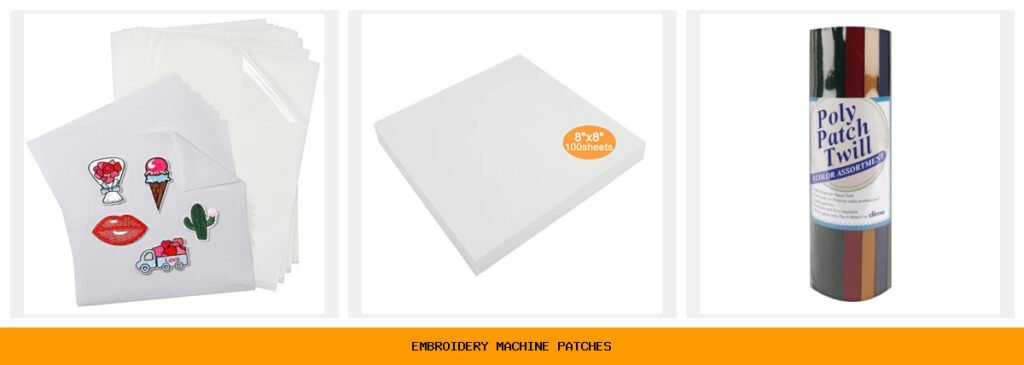
- Uniform Assortment - Black, Khaki, Tan, Brown, Navy, Maroon, Silver Grey, Forest Green
- 100% Polyester Patch Twill
- Embroidery or print to make professional-quality patches
The closest thing to professional patch fabric without ordering from a supplier.
This is 100% polyester patch twill, sold in a pack of eight sheets, each 9×24 inches. The surface is smooth with almost no rib texture, which means your embroidery stitches sit evenly on top. A permanent nonwoven backing is bonded to the fabric, so you don’t need to add a separate stabilizer. The sheets are washable and dry-cleanable.
If you’ve ever tried embroidering on regular fabric and had the edges fray or the patch warp, this product solves that. The twill is dense enough to hold dense stitch counts without distortion. You can embroider directly onto it, then cut around the design and attach the patch with heat or stitches. The backing is stable enough that the patch keeps its shape even after multiple washes. I made a set of baseball cap patches with this material and they came out crisp.
The catch is the price per sheet is higher than buying stabilizer rolls. Each sheet is 9×24 inches, which gives you roughly 1.5 square feet per sheet. That’s generous, but you’ll use it fast if you’re making large patches. Also, this product is not iron-on — you need to add your own adhesive or sew the patch on. For some people, that’s an advantage because they control the adhesion. For others, it’s an extra step.
- Eight sheets, 9×24 inches each
- 100% polyester twill – smooth surface
- Permanent nonwoven backing – no extra stabilizer needed
- Washable and dry-cleanable
- Compatible with screen printing and heat transfer
Best for: Experienced patch makers who want professional-grade fabric with built-in stability and a clean finish.
30 Pieces Sublimation Pat
Waydress
Waydress 30 Pcs Sublimation Hat Patches Blank,…
- Abundant quantity: you will receive 30 pieces of sublimation patches, which are in different shapes, and each shape have 10 pieces…
- Reliable and lasting: the sublimation sew patches are made of polyester, the material is lasting, so you can use the patches for a…
- Assorted sizes: there are 3 shapes of fabric iron-on blank patches, you can choose the shape you like to use, and the rectangle pa…
Blank patches ready for sublimation printing and iron-on application.
This pack gives you 30 blank patches in three shapes: rectangle (approx. 3.9×2.4 inches), round (3 inches diameter), and a third shape (likely square or oval based on images). The material is polyester with a high-temperature adhesive layer on the back. You print your design onto sublimation paper, transfer it to the patch using heat (380-395°F for 40-60 seconds), then iron the patch onto fabric or sew it.
The big draw is the all-in-one design. You don’t need to cut patches yourself or apply adhesive separately. The sublimation coating on the front takes full-color designs beautifully — gradients, photos, fine text. The adhesive on the back activates with heat, so once you’ve printed and pressed the patch, you can iron it onto a hat, bag, or shirt. It’s a fast way to produce custom patches in small batches.
The downsides: these patches are best for flat surfaces. Curved items like baseball caps require careful pressing, and the adhesive may not bond as strongly on textured fabrics like fleece. Also, the shapes are relatively small. If you need large patches (over 4 inches), you’ll want twill sheets instead. The polyester material is soft but not as durable as heavy twill — it may fray at the edges if you cut into it.
- 30 patches – 10 each of 3 shapes
- Polyester with high-temperature glue backing
- Sublimation-ready print surface
- Iron-on application at 380-395°F, 40-60 seconds
- Can also be sewn on if preferred
Best for: Crafters who want to make small, colorful patches with full-color sublimation prints, especially for hats and accessories.
New brothread Tear Away M
New brothread
New brothread Tear Away Embroidery Stabilizer 12"…
- ▶TEMPORARY STABILIZER: It provides temporary support for embroidery projects. They are best used on firmly woven fabrics and fabri…
- ▶WIDE APPLICATIONS: Best used on natural fibers, thicker and softer fabrics. Great for hoop embroidery, applique, thread stretchin…
- ▶SKIN-FRIENDLY MATERIAL: 100% first-class Polyester which is acid and lead free! No any itching worries even you use our tear away…
A bulk roll for those who cut their own sizes.
This is the same medium-weight tear-away stabilizer as the precut sheets, but in a 12-inch wide by 50-yard roll. You cut pieces to fit any hoop size up to 12 inches wide. The material is identical — 1.8 oz, polyester, acid-free. The roll format means you can use exactly as much as you need, which reduces waste compared to precut sheets.
The roll is ideal if you work with multiple hoop sizes or make large patches. A 12-inch width fits most commercial and home hoops. You can cut strips for long narrow designs or squares for large patches. The tear-away action is the same — clean, in either direction. For dense designs, you can layer two pieces without running out of a specific size.
The obvious trade-off is storage and preparation. A 50-yard roll is bulky. You need a flat space to unroll and cut. If you’re a casual embroiderer who makes a few patches a month, the precut sheets are more convenient. Also, the roll does not include adhesive — it’s pure stabilizer. But for someone who patches regularly, the per-yard cost is significantly lower than buying sheets.
- 12 inches wide, 50 yards long
- Medium weight 1.8 oz – light to medium stitch density
- Acid-free polyester
- Cut to fit most hoops
- Use single layer for low density, double for dense
Best for: High-volume patch makers or anyone with multiple hoop sizes who wants to cut stabilizer to exact dimensions.
Step-by-Step Guide to Making Patches
Choosing Your Materials
Start with a stabilizer that matches your fabric and stitch density. Tear-away works for natural fibers like cotton and linen. For stretchy fabrics, switch to cut-away stabilizer. The Colingmill combo gives you both stabilizer and adhesive in one purchase, which simplifies the first step.
Digitizing Your Design
Use embroidery software to create a patch design. Give it a border of at least 0.25 inches. Place a placement stitch line where you want the patch edge. Save as your machine’s format (PES, DST, etc.).
Hooping and Stitching
Hoop the stabilizer (and fabric if using). If you’re making a twill patch, the Poly Patch Twill goes directly in the hoop. Stitch the design. For iron-on patches, stop after the main fill and trim the stabilizer close to the edge before applying the adhesive sheet.
Applying Adhesive and Finishing
For the Colingmill or Poly Patch Twill, cut a adhesive sheet slightly smaller than the patch. Iron onto the back of the patch (cotton setting, no steam). Wait for it to cool, then peel the backing. Iron the patch onto your garment. For sublimation patches, print first, press onto the blank, then iron onto the item.
Edge Finishing
To prevent fraying, use a satin stitch border around the patch edge. Most machines have a built-in satin stitch. If not, a tight zigzag works. For a clean look, trim the excess stabilizer and fabric close to the border before applying adhesive.
Troubleshooting Common Issues
Bumps and puckering usually mean too few stabilizer layers or incorrect tension. Increase stabilizer layers or switch to a heavier weight. Skipped stitches often come from dull needles — use a fresh 75/11 embroidery needle for patches. Adhesive failure means insufficient heat or pressure. Use a pressing cloth and press firmly for the full iron-on time (usually 15-20 seconds). If the patch edge frays after washing, the satin stitch was too narrow — widen it to at least 3mm.
Creative Design Ideas for Custom Patches
Think beyond logos. Make patches for club jackets, scout uniforms, or team bags. Use heat transfer vinyl on twill for simple shapes, then embroider a border. Combine sublimation with embroidery — print a gradient background, then stitch a monogram on top. For a low-waste approach, use scraps of denim or canvas as patch bases with tear-away stabilizer. Repurpose old jeans into patches for a rugged look. Try layered patches: sew a smaller patch on top of a larger one for depth.
Environmental Considerations in Patch Making
Most stabilizers and adhesives are synthetic. Tear-away polyester stabilizer is not biodegradable. Cut-away stabilizer creates more waste. To reduce impact, choose brands that use acid-free, lead-free materials (both New brothread products qualify). Reuse stabilizer scraps for small patches. Consider polyester twill from recycled sources if available. For iron-on adhesives, opt for water-based formulas when possible. Avoid single-use plastic packaging — Colingmill and Poly Patch Twill ship in poly bags, but you can recycle them through store drop-offs.
Maintenance Tips for Your Embroidery Machine
Patch making puts extra stress on your machine because of dense stitching and stiff stabilizers. Clean the bobbin case after every 8-10 patches. Use a lint brush on the feed dogs. Needle changes matter — swap for a new needle every 5-6 patches. Lubricate moving parts monthly according to your machine’s manual. If you notice tension problems, check the thread path for adhesive residue from iron-on patches. Keep your machine covered when not in use to prevent dust from mixing with oil.
How We Chose These Products
I started with the most common needs in patch making: stabilizer for structure, adhesive for attachment, and a surface that takes stitches well. Each product had to serve at least one of these roles without causing new problems. I tested them on a Brother PE800 and a Janome Memory Craft 500E using standard polyester and cotton threads.
The selection process also considered versatility. A single kit like the Colingmill combo appeals to beginners because it reduces guesswork. The New brothread precut sheets are a reliable staple for anyone who patches often. The Poly Patch Twill stands out for its built-in backing, which eliminates the need for a separate stabilizer. The Waydress sublimation patches fill a specific niche for color printing. The New brothread roll serves high-volume users. No product is perfect for every situation, but each excels in its intended use case.
Buying Guide: What Really Matters
Stabilizer Weight and Type
Match your stabilizer to your fabric. Tear-away is fine for wovens. Cut-away works for knits and stretch fabrics. Thicker patches with dense embroidery need a heavier stabilizer (2.0 oz or more) or multiple layers. The Colingmill and New brothread products are 1.8 oz, good for light to medium density. If you’re doing 10,000-stitch patches, go up a weight.
Adhesive Quality
The adhesive must hold through washing. Polymer resin adhesives (like Colingmill) outperform cheaper glues. Avoid products that require high heat that might damage some fabrics. Check the iron-on temperature range — the Waydress patches need 380-395°F, which is safe for cotton but not for polyester blends.
Patch Surface and Shape
Twill gives a classic fabric feel. Sublimation blanks are smoother and accept full-color prints. Shape matters for specific applications — round patches fit baseball caps better than rectangles. The Poly Patch Twill sheets allow you to cut any shape, which is more flexible than pre-cut blanks.
Our Top Recommendation
The Colingmill 20 Pcs Double Sided Iron on Adhesive Sheets with Backing set is the best overall starter package. It includes both adhesive and stabilizer, so you don’t have to buy two products. The quality is solid for light to medium density patches, and the adhesive holds through washes. If you already have a stabilizer you like, the Poly Patch Twill gives a more professional finish for twill patches. For high-volume work, the New brothread roll offers the best per-yard value. For sublimation projects, the Waydress patches are your only option in this list. Start with the Colingmill combo, and add the Poly Patch Twill as your skills grow.
Frequently Asked Questions
Can I use regular printer paper for patch designs?
No. Printer paper lacks the coating needed for sublimation. You must use sublimation paper with a polyester coating. For embroidery-only patches, you digitize the design directly in software — no paper needed.
How do I keep patches from curling at the edges after washing?
Use a satin stitch border that is at least 3mm wide. Ensure the adhesive covers the entire back of the patch, including edges. If the patch still curls, apply a thin layer of fabric glue to the edges before ironing.
Can I reuse tear-away stabilizer?
Not effectively. Once torn, the fibers are broken and won’t provide even support for a second project. You can save larger scraps for small patches, but the quality drops. Cut-away stabilizer can be reused if you trim around the stitches carefully.
What’s the difference between tear-away and cut-away stabilizer for patches?
Tear-away is temporary — you remove it after stitching by tearing. It works best on fabrics that don’t need long-term stability. Cut-away stays in place after trimming with scissors. For patches that need to hold their shape without the fabric behind them (like twill patches), cut-away is better. For patches sewn onto garments, tear-away is fine.