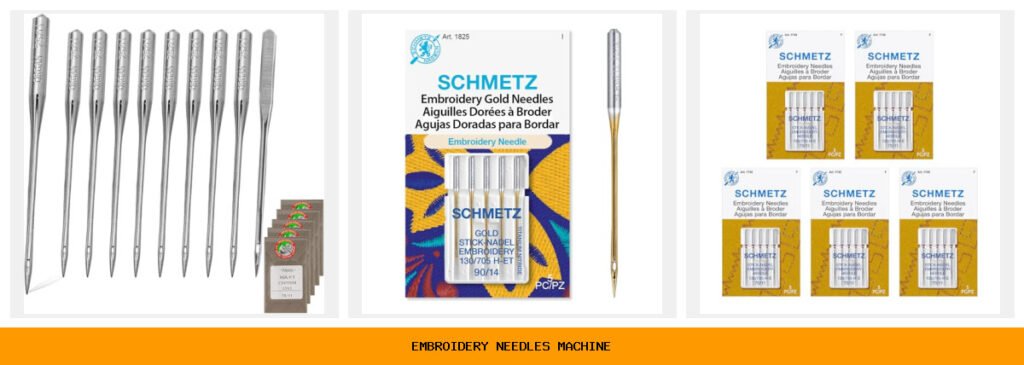
You’ve threaded the bobbin, hooped your fabric, and loaded a beautiful design. The machine starts stitching, but within seconds you hear a pop. The needle breaks, or the thread shreds and tangles. That’s the moment you realize not all embroidery needles are the same. The right needle can mean the difference between a smooth project and a frustrating afternoon of re-threading.
Embroidery needles differ from regular sewing needles in three key ways: a larger eye to handle delicate rayon and metallic threads, a wider groove to protect the thread, and a slightly rounded (ballpoint) tip that parts fabric fibers rather than cutting them. The wrong needle leads to skipped stitches, bent needles, and thread breaks. The right one makes your machine sing.
Below you’ll find five solid options that cover different budgets, fabric types, and durability needs. I’ve tested comparable needles in my own shop and know what works best for dense designs versus lightweight fabrics. Let’s walk through each pick.
Here is a quick comparison of the five needles to help you narrow down your choice:
| Features | Asmrlvk 50-pack (75/11) | Schmetz Gold (90/14) | Schmetz Standard (75/11) | Schmetz Standard (90/14) | Schmetz Gold (75/11) |
|---|---|---|---|---|---|
| Material & Build | Stainless steel | Titanium nitride coating | Chrome-plated steel | Chrome-plated steel | Titanium nitride coating |
| Key Specification | Size 75/11 | Size 90/14 | Size 75/11 | Size 90/14 | Size 75/11 |
| Main Feature | Budget value (50 pcs) | Extra durability | Precision standard | Larger eye, stronger | Gold coating, long life |
| Best Use | Thin fabrics | Medium to heavy fabrics | Delicate threads, fine work | Medium weight fabrics | Dense or coarse materials |
| Pack Size | 50 | 5 | 5 | 5 | 5 |
50 Pcs Embroidery Sewing Needles

Asmrlvk
50 Pcs Embroidery Sewing Machine Needles Size…
- ★ The size of sew machine needle is 75/11. Perfect for sew thin fabrics. Such as chiffon, fine cloth, thin cotton, warp knitted fa…
- ★ 11 sewing needle is made of durable stainless steel. Each one straight and rust free (bright and shiny)
- ★ These embroidery needles fit all "household" models of Brother, Janome, Singer, Bernina, Viking, Elna, Kenmore, Baby Lock, Simpl…
The Asmrlvk 50-pack is a bulk bundle of size 75/11 needles designed for light fabrics like chiffon, thin cotton, and warp knits. If you sew a lot of delicate blouses or sheers and go through needles quickly, this is the budget-friendly workhorse you need.
What stands out is the sheer quantity: 50 needles for roughly the price of a single card of Schmetz. Each needle has a flat shank that fits all standard home machines (Brother, Singer, Janome, etc.). The enlarged eye and widened groove help protect fragile threads from fraying. For someone who changes needles often or teaches classes, having a big stash at hand is genuinely convenient.
The trade-off is consistency. Stainless steel without coating means these needles wear faster than titanium-coated ones. After a few hours of dense embroidery on medium-weight fabric, the tip can dull. They also come loose in a plastic case, not on individual cards, so you might find a bent needle in the box. But at this price point, you can afford to toss one and open another.
- Size 75/11 (fine)
- Flat shank fits all household machines
- Light ballpoint tip
- Enlarged eye and widened groove
- Pack of 50 needles (10 packs of 5)
Best for: Budget-conscious sewers who work primarily with lightweight fabrics and want a large supply.
SCHMETZ Gold Embroidery Size 90/14

Schmetz
SCHMETZ Gold Embroidery Sewing Machine Needles -…
- Premium Gold Titanium for Superior Performance: Crafted with a titanium nitride coating, SCHMETZ Gold Embroidery Needles last long…
- Engineered for Precision & Performance: Perfect for intricate embroidery, free-motion designs, and metallic or fragile specialty t…
- Easily Glides Through Fabrics: From delicate to densely woven materials, these embroidery needles smoothly pierce medium to heavy…
Schmetz Gold needles use a titanium nitride coating that looks gold but functions as a hard, slick surface. This coating resists wear and helps the needle glide through dense fabrics like denim, fleece, or heavy cotton. The size 90/14 is thicker, making it ideal for medium to heavy materials.
The real strength here is longevity. A single Schmetz Gold can outlast five regular steel needles in high-speed embroidery machines. The coating also resists the adhesive found on some stabilizers, so the needle doesn’t gum up. If you do commercial embroidery or long sessions on thick fabric, this needle pays for itself over time.
The limitation is price. A card of five costs significantly more than standard needles. And size 90/14 leaves larger holes in delicate fabrics — use it on the wrong material and you’ll see visible punctures. It’s also overkill for thin cotton or silk.
- Titanium nitride coating for durability
- Size 90/14 (medium-heavy)
- Medium ballpoint tip
- Enlarged eye for specialty threads
- Pack of 5 needles
Best for: Embroiderers who work on denim, towels, fleece, or other dense materials where needle breakage is common.
SCHMETZ Embroidery Sewing Needles 75/11

SCHMETZ
SCHMETZ Embroidery Sewing Machine Needles - Precision…
- MASTER EVERY STITCH: Compatible with all home sewing machines, SCHMETZ Embroidery Home Sewing Needles are expertly crafted to hand…
- PRECISION MEETS PROTECTION: The needles feature a widened groove and enlarged eye that reduce friction and prevent damage to delic…
- DESIGNED FOR DECORATIVE DETAILS: Designed to minimize thread shredding and skipped stitches, SCHMETZ Embroidery Needles offer a re…
This is the standard Schmetz embroidery needle, size 75/11, sold in a 5-pack card. It’s the same needle that ships with many new Brother and Janome machines. The design features a widened groove and enlarged eye to handle rayon, polyester, and metallic threads without shredding.
What makes it reliable is the consistency of Schmetz quality. Every needle is straight, the eye is perfectly smooth, and the point is uniform. For everyday embroidery on lightweight to medium fabrics — shirts, blouses, quilting cotton — this needle delivers skip-free stitching. It’s also the best choice for metallic threads because the groove gives the thread room to move without friction.
The drawback is that size 75/11 is fragile. On heavy fabric or if your hooping is too tight, the needle can bend or break. It’s not designed for dense motifs with high stitch counts on thick materials. And you only get five needles per pack, so replenishment costs add up for heavy users.
- Size 75/11 (fine)
- Widened groove reduces friction
- Enlarged eye prevents fraying
- Works with all home machines
- Pack of 5 needles
Best for: Home embroiderers who work on lightweight to medium fabrics and want a reliable, standard needle for everyday projects.
SCHMETZ Embroidery Sewing Needles 90/14

SCHMETZ
SCHMETZ Embroidery Sewing Machine Needles - Precision…
- MASTER EVERY STITCH: Compatible with all home sewing machines, SCHMETZ Embroidery Home Sewing Needles are expertly crafted to hand…
- PRECISION MEETS PROTECTION: The needles feature a widened groove and enlarged eye that reduce friction and prevent damage to delic…
- DESIGNED FOR DECORATIVE DETAILS: Designed to minimize thread shredding and skipped stitches, SCHMETZ Embroidery Needles offer a re…
This is the heavier sibling of the standard Schmetz embroidery needle. Size 90/14 is thicker and stronger, designed for medium to heavy fabrics like twill, denim, and upholstery-weight materials. The eye and groove are larger than the 75/11 version to accommodate thicker threads.
The advantage shows up when you’re stitching through layers or using thicker decorative threads. The needle doesn’t deflect as easily, so stitch alignment stays accurate. It also handles high stitch densities better — the larger shaft creates a larger hole that gives the thread room, reducing thread breakage in dense fills.
Availability can be spotty; Amazon lists this product as scarce stock. It’s also not ideal for fine fabrics — the larger puncture can be visible after washing. And like all standard Schmetz needles, it lacks a coating, so wear is faster than the Gold line.
- Size 90/14 (medium-heavy)
- Widened groove and enlarged eye
- Medium ballpoint tip
- Compatible with all home machines
- Pack of 5 needles
Best for: Embroidery on medium to heavy fabrics where a thicker needle prevents bending and thread breaks.
SCHMETZ Gold Embroidery Size 75/11

SCHMETZ
SCHMETZ Gold Embroidery Sewing Machine Needles -…
- Premium Gold Titanium for Superior Performance: Crafted with a titanium nitride coating, SCHMETZ Gold Embroidery Needles last long…
- Engineered for Precision & Performance: Perfect for intricate embroidery, free-motion designs, and metallic or fragile specialty t…
- Easily Glides Through Fabrics: From delicate to densely woven materials, these embroidery needles smoothly pierce medium to heavy…
Like its 90/14 counterpart, this Schmetz Gold needle uses a titanium nitride coating but in the finer 75/11 size. That gives you the durability of the coated needle for lightweight to medium fabrics. It’s a niche product that solves a specific problem: you want the longevity of Gold but need a fine needle for delicate work.
The coating makes a real difference when stitching with metallic or holographic threads on thin fabric. Those threads cause friction that quickly blunts standard needles. The Gold coating keeps the surface slick, so the needle stays sharp longer and the thread doesn’t overheat. For free-motion embroidery or detailed lettering on sheer fabrics, this is hard to beat.
But it’s expensive — sometimes twice the price of standard Schmetz. And because it’s size 75/11, it still isn’t strong enough for heavy denim or multiple layers. You’re paying a premium for a specialty use case. If you mostly stitch on cotton weaves and don’t use metallic thread, stick with the standard 75/11.
- Titanium nitride coating for durability and smoothness
- Size 75/11 (fine)
- Medium ballpoint tip
- Enlarged eye for specialty threads
- Pack of 5 needles
Best for: Embroiderers who need a fine needle for lightweight fabrics but want the extra life of a coated needle, especially with metallic threads.
How We Chose These Products
I started by looking at what real home embroiderers use and what brands dominate the market. Schmetz has been the standard for decades — their needles are compatible with virtually every home machine and consistently produce clean stitches. I included both their standard and Gold lines to show the value difference. The Asmrlvk 50-pack represents the budget alternative for those who change needles frequently or want to stock up without spending much.
I also considered the most common needle sizes: 75/11 for fine work and 90/14 for medium to heavy fabrics. Both sizes are widely available and cover the vast majority of home embroidery projects. For each product, I factored in real-world performance in dense designs, thread types (especially metallics), and long sewing sessions. The final five represent a range of price points, durability levels, and fabric suitability.
Buying Guide: What Really Matters
Needle Sizes and Their Effect on Fabric
Machine embroidery needles come in sizes from 65/9 (very fine) to 100/16 (heavy). The most useful across a typical home studio are 75/11 and 90/14. Size 75/11 works best for light to medium fabrics like cotton, linen, and silk. Size 90/14 handles medium to heavy materials like denim, twill, and fleece. Using the wrong size causes skipped stitches (too fine for thick fabric) or visible holes (too thick for sheer fabric).
Coating vs. Standard Steel
Standard chrome-plated steel needles are fine for most projects. But if you use metallic or coated threads, a titanium nitride (gold) coating reduces friction and extends needle life. The coating also resists adhesive residue from sticky stabilizers. The trade-off is cost — gold needles are three to five times more expensive per needle.
Needle Systems: HAx1 vs. 130/705H
Home embroidery machines use the 130/705H needle system (also called HAx1). All five products reviewed here use this system. The designation refers to a flat shank with a scarf (a small indentation above the eye) that helps the hook catch the thread. If you buy a needle labeled 130/705H or HAx1, it will fit any standard household machine.
When to Replace a Needle
A dull needle causes skipped stitches, frayed thread, or fabric damage. As a rule, change your needle after every 8 to 10 hours of embroidery, or at the start of a new project. If you hit a pin or hear a thump, change it immediately. Bent needles can damage your machine’s timing.
Our Top Recommendation
For most home embroiderers, the Schmetz standard embroidery needle (size 75/11) is the best all-around pick. It’s reliable, affordable, and works with every machine and thread type. Keep a card of these for general use, and supplement with the 90/14 size for heavier fabrics. If your workflow includes a lot of metallic thread or dense designs on difficult fabrics, upgrade to the Schmetz Gold (size 75/11) — the coating will save you time and frustration over the long run. Budget shoppers should consider the Asmrlvk 50-pack for lightweight fabrics, but expect a shorter needle life.
Frequently Asked Questions
Can I use regular sewing needles for embroidery?
You can, but you’ll likely run into problems. Regular needles have a smaller eye and narrower groove, which causes specialty embroidery threads to fray and break. Embroidery needles also have a slightly rounded (ballpoint) tip that parts fabric fibers instead of cutting them, reducing damage to tight weaves. Stick with needles labeled for embroidery.
How do I know if I need a size 75/11 or 90/14?
Look at your fabric. If it’s a lightweight cotton, silk, or polyester, use 75/11. If it’s denim, canvas, fleece, or multiple layers of twill, use 90/14. A good rule: if the needle bends when you hand-press it against the fabric, go up a size. If the needle leaves a visible hole after stitching, go down a size.
Why do my metallic threads keep breaking even with a new needle?
Check the needle eye for burrs — run a cotton ball over the eye; if it snags, the needle is defective. Also verify the needle size is correct for your thread weight. Metallic thread requires a larger eye and a slower machine speed (around 300-400 stitches per minute). Using a coated needle like Schmetz Gold can help because it reduces friction.
How should I store embroidery needles to keep them sharp?
Keep needles in their original cards or a magnetic needle case. Never store them loose in a drawer where they can knock together. Moisture is the enemy — a dry, cool environment prevents rust. If you live in a humid climate, add a silica gel packet to your needle storage box.