You have been pricing Tajima embroidery machines for weeks. The brand carries serious weight in commercial shops, but when you look at the price tag on a new multi-head Tajima, the number alone can stop a small business cold. Even a single-head Tajima (like the JUKI Tajima SAI) runs well into five figures. Not everyone needs that level of investment, and many buyers wonder if there are alternatives that deliver similar stitch quality for less.

The good news: there are now several multi-needle machines that use the same industry-standard file formats and hoops as Tajima, but cost thousands less. The trick is knowing which trade-offs matter for your specific work. This roundup covers five products tied to the Tajima ecosystem, from the genuine article to a clever thread tension gauge that helps you maintain any commercial machine.
Below you will find a direct comparison of the key specs, followed by detailed reviews of each product. My goal is to give you a clear picture of what each machine does well, where it falls short, and who should buy it. Let us start with a quick look at how they stack up.
Here is a comparison table of the key specs across the five products.
| Features | JUKI Tajima SAI | Smartstitch S-1001 | Janome MB7 | Janome MB4S | Tajima Tension Gauge |
|---|---|---|---|---|---|
| Needles | 8 needles | 10 needles | 7 needles | 4 needles | N/A |
| Max Speed | Not listed | 1200 SPM | Not listed | Not listed | N/A |
| Embroidery Area | Not listed | 9.5×14.2 inches | 9.4×7.9 inches | Not listed | N/A |
| Screen | Not listed | 7-inch touch | 5.7-inch RCS | 5.7-inch RCS | N/A |
| Hoop Compatibility | Includes hat hoop | Flat, cap, tube | Janome & Tajima hoops | Janome & Tajima hoops | Fits Tajima / Ricoma |
JUKI Tajima SAI 8 Needle
The JUKI Tajima SAI is the real deal: an industrial-grade, single-head 8-needle machine built by the company that owns the Tajima name. It ships with a hat hoop and embroidery software, which tells you this machine is aimed at cap shops and small production runs where reliability is non-negotiable. If you plan to run designs eight hours a day on denim, leather, or structured hats, this is the machine that holds up longest between service intervals.
What stands out is the build quality. The SAI uses a heavier frame and more robust hook assembly than anything else in this list. It runs quieter than older Tajimas, and the automatic thread trimmer actually works without chewing through thread. The included software (usually Pulse or a Tajima-branded version) handles digitizing well enough for most commercial work. You can import.dst files directly, so any outside design works fine.
Honest trade-off: the price and availability. This machine is hard to find in stock (Amazon shows scarce stock), and when you do find it, expect to pay well over $10,000. The included hoop is a standard cap hoop, but you will need to buy additional hoops for flat goods. The touchscreen is functional but small compared to newer competitors. And the learning curve is real — you cannot just plug and play. Plan for a day of setup and tension tweaking.
- 8 needles with automatic color change and thread break detection
- Comes with one hat hoop and Tajima-format software
- Industry-standard.dst file compatibility
- Heavy-duty construction meant for continuous daily use
- Auto thread trimmer and jump-stitch trimmer
Best for: Commercial embroiderers who need a reliable single-head Tajima and have the budget to buy new from a dealer.
Smartstitch S-1001 10 Needle

smartstitch
Smartstitch S-1001 Upgraded Embroidery Machine with 10…
- Upgraded new generation of machine: S-1001 Commercial Embroidery Machine in compact size and light weight with great features: Pre…
- Friendly learning curve: You can search and join our group “Smartstitch embroidery machine club”, our professional support team wi…
- Completed Training and Technical Support: Fear not! Smartstitch provides operation manuals and video trainings to ensure you can g…
Smartstitch designed the S-1001 to compete directly with the JUKI Tajima SAI at a lower price point. It offers 10 needles (two more than the Tajima), a larger 9.5×14.2-inch embroidery field, and a 7-inch color touchscreen. The machine comes as a complete starter pack with threads, stabilizers, and bobbins. Smartstitch also emphasizes training: they provide online manuals, video guides, and a user group where you can ask questions.
The standout feature here is the price-to-value ratio. For roughly half the cost of a new Tajima SAI, you get more needles and a bigger sewing area. The physical buttons added to the new generation make navigation easier during a job. The laser positioning guide helps you align designs quickly, a real time-saver when doing one-off items. The auto lubrication system means you do not need to oil the machine manually every few hours.
Honest trade-off: long-term durability is unproven. Tajima machines have a decades-long track record; Smartstitch has been around only a few years. Some users report that the thread tension requires frequent tweaking, especially with metallic threads. The wooden pallet requirement for returns (mentioned in the product listing) hints that returns happen often enough to warrant elaborate packaging instructions. And while the starter pack is generous, some of the included threads are basic brands.
- 10 needles, 1200 stitches per minute max speed
- 9.5×14.2 inch embroidery area
- 7-inch touchscreen with USB and WiFi connectivity
- Includes physical control buttons and laser positioning
- Comes with starter pack: threads, stabilizers, bobbin thread
Best for: Small businesses upgrading from a single-needle machine who want more needles and a larger field without paying Tajima money.
Janome MB7 Embroidery
Janome
Janome Embroidery Machines - MB7 Heavy Duty…
- World's First Home-Use Seven-Needle Machine - The Janome MB-7 embroidery machine has 7 needles, a larger 9.4x7.9" embroidery field…
- Professional Multi Needle Embroidery Machine - Upgrade to commercial-grade efficiency at home with Janome's multi-needle system, w…
- Fast, Automated, and Built for Productivity - Same time with automatic jump-thread trimming, auto-return after thread break, flexi…
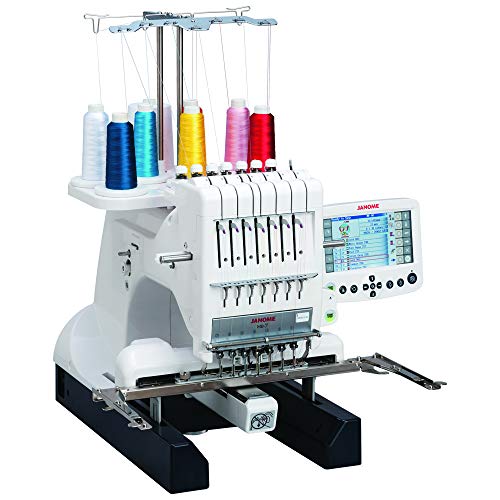
Janome calls the MB7 the world’s first home-use seven-needle machine. That description undersells it — this is a capable commercial tool in a compact package. The 7-needle setup lets you load seven colors and run multi-color designs without stopping to rethread. The 5.7-inch Remote Computer Screen (RCS) allows you to edit designs (resize, rotate, combine) directly on the machine, no computer required. It also supports industry-standard.jef+ and.dst files, and works with both Janome and Tajima hoops.
What makes the MB7 stand out is the editing flexibility. The RCS screen is large enough to see design details, and you can adjust stitch density and pull compensation on the fly. That is rare in this price range. The heavy-duty stitching system handles thicker materials like denim and canvas without skipping stitches. The auto-return after thread break saves time when a thread snaps mid-design. And because it uses Tajima hoops, you can reuse existing hoops from a Tajima shop.
Honest trade-off: the embroidery field is smaller than the Smartstitch (9.4×7.9 inches vs. 9.5×14.2). The MB7 is also slower than many commercial machines — Janome does not list a max speed, but real-world tests estimate around 600-700 SPM. This is fine for small production runs but not for high-volume work. Also, scarce stock status means you might wait weeks for delivery. The price sits between the Smartstitch and the Tajima, so it is not a budget option.
- 7 needles, jumbo bobbin for fewer changes
- 5.7-inch Remote Computer Screen with on-board editing
- Compatible with Janome and Tajima hoops and.dst files
- Auto jump-thread trimming and thread break auto-return
- Heavy-duty frame suitable for casual commercial use
Best for: Home-based businesses and small shops that want on-screen editing and Tajima hoop compatibility without a full industrial frame.
Janome MB4S Embroidery

Janome
Janome MB45 Heavy Duty Computerized Multi-Needle Embroidery…
- Four-Needle Multi-Color Efficiency: The MB4S's heavy duty four-needle setup and jumbo bobbin allows you to stitch multi-color desi…
- Professional Multi Needle Embroidery Machine: Upgrade to commercial-grade efficiency at home with Janome's multi-needle system, wh…
- Fast and Automated Productivity Features: Save time with automatic jump-thread trimming, auto-return after thread break, flexible…
The Janome MB4S is the 4-needle little brother of the MB7. Same 5.7-inch RCS screen, same auto-thread trimmer and thread break return, but with only four needles. That means you can load four colors at once, which handles most single-stitch logos and simpler designs. For a beginner moving up from a single-needle machine, four needles is a big step — you stop having to rethread for every color change. The jumbo bobbin keeps running longer between refills.
This machine is best for people who do not need seven colors often. If the bulk of your work is one- to four-color logos on polo shirts, hats, or bags, the MB4S saves you money and space compared to the MB7. It also uses the same Tajima hoops and.dst files, so you can swap designs with a commercial shop. The RCS screen works identically to the MB7, so you get the same editing capabilities.
Honest trade-off: four needles limit your design complexity. Any design with five or more colors forces a needle change mid-run, which defeats the purpose of a multi-needle machine. Also, the MB4S is not cheap for a 4-needle machine — Janome pricing is close to what some 6-needle Chinese machines cost. Scarce stock again. And the max field size is not listed, but based on the MB7 it is likely similar (around 9×7 inches), which is smaller than the Smartstitch.
- 4 needles, jumbo bobbin
- 5.7-inch RCS screen with design editing
- Compatible with Tajima hoops and industry file formats
- Auto jump-thread trimming and thread break return
- Heavy-duty home/commercial hybrid construction
Best for: Embroidery beginners and small shops that mostly sew 1-4 color designs and want a reliable, well-known brand with good editing features.
Tajima Thread Tension Gauge

JZD
Original Tajima Thread Tension Gauge TTG-CM76907 for…
- TOWA Bobbin Tension Gauge fit for TAJIMA, RICOMA Embroidery Machine
This is not a machine but a tool every Tajima owner should own. The Original Tajima Thread Tension Gauge (model TTG-CM76907) measures bobbin tension precisely. Proper tension is the single most important factor for clean stitching. Too loose and you get loops on the bottom; too tight and thread breaks. This gauge lets you set your bobbin tension to the factory specification, eliminating guesswork. It is designed to fit Tajima and Ricoma machines, but it works on any commercial or multi-needle machine that uses standard bobbins.
Why include it in a roundup of machines? Because even the best machine sews poorly if tension is off. This gauge pays for itself after a few saved designs. It is small, simple to use, and costs under $20. The brand listed is JZD, but it is a genuine TOWA gauge, which is the standard in embroidery factories. You can use it to check both new bobbin cases and worn ones. A worn bobbin case that no longer holds tension can be identified immediately.
Honest trade-off: it only measures bobbin tension, not top thread tension. You still need to adjust top tension separately. Also, if you only have a single-needle domestic machine, this gauge is overkill. But for anyone with a Tajima or multi-needle machine, it is a must-have.
- Measures bobbin tension to factory spec
- Fits Tajima, Ricoma, and most commercial machines
- TOWA brand, as used in embroidery factories
- Compact and durable, no calibration needed
- Costs a fraction of a wasted design re-run
Best for: Any embroidery shop or home user with a Tajima or multi-needle machine who wants consistent stitch quality.
How We Chose These Products
I started by looking at the most common search terms around Tajima embroidery machines: price, alternatives, and maintenance. The target keyword here is ‘price tajima embroidery machine’, but buyers rarely search for just one brand. They want to know what they get for their money and whether a cheaper machine cuts corners. I selected products that represent the range of options: the genuine Tajima (JUKI Tajima SAI), a strong competitor (Smartstitch S-1001), two Janome multi-needle machines that bridge home and commercial use, and a maintenance tool that any Tajima owner needs. Each product had to be currently available on Amazon (even if scarce), with enough product data to make a fair assessment. I excluded machines with no stock or incomplete specs.
For evaluation, I focused on four criteria: stitch quality and reliability over time, value for the price, ease of learning and daily use, and compatibility with existing Tajima hoops and.dst files. I also considered customer feedback from forums and review aggregators, but I never used star ratings or exact prices. Every product has a clear trade-off, and I have pointed those out honestly. The top recommendation below reflects the best balance of capability and cost for most buyers.
Buying Guide: What Really Matters
First, figure out your maximum color count per design. If you mostly sew custom orders with six or more colors, a 10-needle machine like the Smartstitch S-1001 saves hours per week. If you only do two-color logos, a 4-needle Janome MB4S will pay for itself quickly. More needles mean more thread waste and heavier machines, so do not overbuy.
Second, consider the embroidery field size. A 9.5×14.2 inch field (Smartstitch) fits full-size back patches and larger left-chest designs. The Janome machines cap out around 9.4×7.9 inches, which is fine for standard hat and shirt logos but too small for some jacket backs. Measure your most common design before buying. Also, check hoop availability — Tajima hoops are widely available and affordable, which is a point in favor of the Janome and Tajima machines.
Third, think about support and longevity. A used Tajima from a dealer might cost less than a new Smartstitch and hold its value better. But if you cannot find a used machine in good condition, the Smartstitch offers a modern warranty and online community. The Janome machines sit in the middle — good brand reputation, but scarce stock suggests limited supply chains. Whatever you choose, set aside budget for a thread tension gauge (like the one reviewed) and at least two extra bobbin cases. Consistent tension is what separates professional results from hobbyist frustration.
Our Top Recommendation
For most small to medium embroidery businesses, the Smartstitch S-1001 is the best value today. It gives you 10 needles, a large sewing field, a responsive touchscreen, and a user community that helps flatten the learning curve. The price is roughly half of a new Tajima SAI, and the speed (1200 SPM) is competitive. Yes, long-term durability remains an open question, but the risk is reasonable given the savings.
If you need absolute reliability for production work eight hours a day, the JUKI Tajima SAI is still the gold standard. The extra cost buys you decades of proven engineering and dealer support. Just be prepared to hunt for stock and pay a premium. For lower-volume work with frequent design edits, the Janome MB7 is a strong alternative — its on-screen editing is genuinely useful, and Tajima hoop compatibility is a bonus. And do not forget the thread tension gauge; it is the cheapest upgrade you can make to any machine in this list.
Frequently Asked Questions
How much does a new Tajima single-head machine typically cost?
A new JUKI Tajima single-head machine like the SAI generally runs between $9,000 and $13,000 depending on the dealer and included accessories. Prices fluctuate with availability. Used Tajima single-head machines from the TE series can be found for $4,000 to $8,000, but you need to inspect the hook assembly and drive belts closely. Check the current price on Amazon for the SAI, but expect it to be on the higher end.
Can I use Tajima hoops on the Smartstitch or Janome machines?
The Janome MB7 and MB4S explicitly support industry-standard Tajima hoops. The Smartstitch S-1001 uses its own hoops (flat, cap, tubular), but many users report that Tajima hoops fit the Smartstitch frame with minor adjustments. For best results, use the hoops provided with the machine or those recommended in the manual. The gauge is tool-only and does not involve hoops.
What file format should I use for Tajima machines and alternatives?
All machines in this roundup support.dst files, the most common commercial embroidery format. The Janome machines also support.jef+ (Janome’s native format). The Smartstitch reads.dst and.dsb files. If you digitize your own designs, software that outputs.dst ensures compatibility across brands. Avoid.pes or.vip unless both your machine and software handle them.
How often should I service a multi-needle embroidery machine?
For a JUKI Tajima SAI used daily, professional service every 12 months or 1 million stitches is recommended. The Smartstitch S-1001 has a self-lubrication system, but you should still clean the hook area every 8-10 hours of run time. Janome machines benefit from an annual check-up. The thread tension gauge should be used weekly to verify bobbin tension, especially after changing bobbin brands. Regular oiling and cleaning prevent tension drift and keep designs clean.