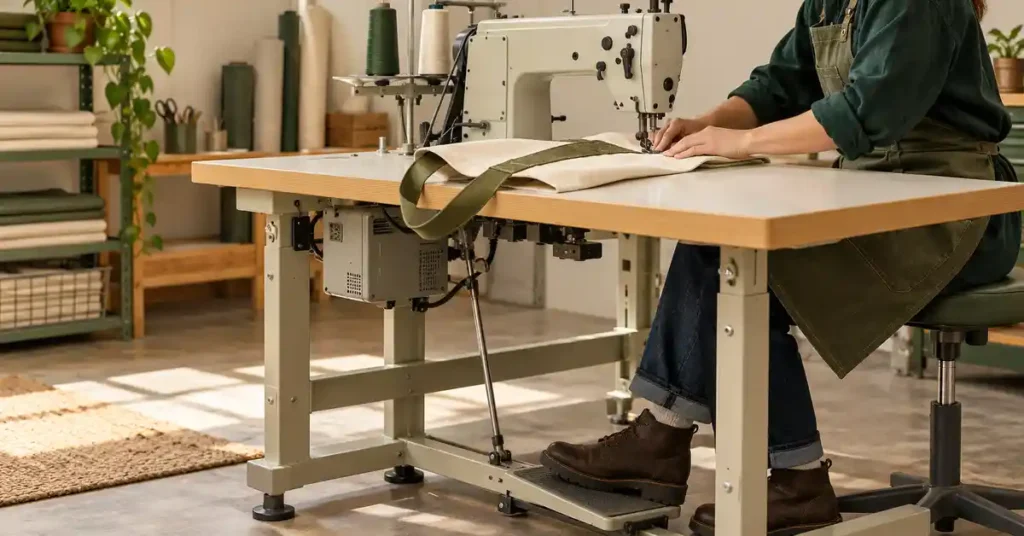
Sailrite and VEVOR sewing machine reviews should start with machine type, because a portable walking-foot model and a fixed industrial lockstitch station solve different problems. This guide compares Sailrite’s Ultrafeed LSZ with VEVOR’s listed JK-9803 station, explains the limits of brand-wide claims, and shows how to evaluate feeding, workspace, setup, and support before buying equipment for canvas, bags, upholstery panels, or other projects that exceed an ordinary household sewing routine.
As an Amazon Associate, Practical Textile earns from qualifying purchases. Product links may earn us a commission.
Quick Answer
Compare the Sailrite Ultrafeed LSZ when portable straight-and-zigzag walking-foot sewing is the requirement. Compare the VEVOR JK-9803 only as its specifically documented fixed straight-stitch station. Do not assume every VEVOR product is the same or that a motor rating establishes compound feed. The Amazon box below identifies a separate Juki industrial alternative, not either reviewed brand.
This guide compares published specifications and project fit; it does not report hands-on testing.
Juki DNU-1541
No verified Amazon offer is linked for this model; read the buying checks below.
A unison-feed alternative; check whether the offer is a head or complete station.
Two Different Machine Types
| Question | Sailrite Ultrafeed LSZ | VEVOR JK-9803 listing |
|---|---|---|
| Format | Portable walking-foot machine | Fixed industrial lockstitch station |
| Stitch role | Straight and zigzag | Straight stitch |
| Useful comparison | Moving between storage and project locations | A dedicated straight-sewing workstation |
| Purchase concern | Exact motor revision, case, and accessory package | Assembly, feed specification, electrical setup, and service |
These are not interchangeable simply because both can appear in heavy-material searches. One buyer may need zigzag for a specific construction and a machine that can be stored. Another may need a permanent station for repeated straight seams. Decide that first. Otherwise, a comparison of advertised power or speed can distract from a missing essential function.
Sailrite Sewing Machine Review: Ultrafeed LSZ
The Ultrafeed LSZ is a portable walking-foot machine that provides straight and zigzag stitching. The LS and LSZ names should not be treated as identical: Sailrite distinguishes the straight-stitch LS from the LSZ’s additional zigzag capability. Older used machines can also have different motor packages from current offers.
Portability is its practical distinction. That does not mean a complete machine, case, and project are effortless to carry. Check the actual lift, storage location, and table arrangement. A machine can be transportable while still requiring careful handling and a substantial work surface for a large cover or bag.
Walking-foot feeding is useful to investigate for layered work, but a successful demonstration should use the actual construction. A stack of flat canvas differs from a folded bound edge or a crossing containing webbing. Material type, thread, needle, seam geometry, and surface marking all influence whether the setup is appropriate.
The exact package matters because Sailrite offers accessories for different interests. A leather-oriented foot, a zipper foot, and a binder serve different tasks. Do not select a bundle because it has the largest advertised accessory value. Identify the operations in your first projects and check whether those specific tools are included and compatible.
For used LSZ offers, ask which motor and controls are fitted, whether modifications were made, and whether the case and essential accessories are present. A legacy listing or old photograph should not establish the specification of a current package. Request clear pictures and the model-specific manual.
Five reasons to compare the LSZ:
- Portable format can suit shared sewing spaces.
- Straight and zigzag capability broadens the relevant construction options.
- Walking-foot feeding addresses a different role from a basic household presser foot.
- Task-oriented accessories can support canvas, bags, and related projects.
- The machine can be evaluated through specific material and seam demonstrations.
Two limitations:
- Portable format does not eliminate lifting, storage, or work-support requirements.
- It should not be assumed to duplicate every industrial compound-feed capability.
VEVOR Sewing Machine Review: JK-9803 Station
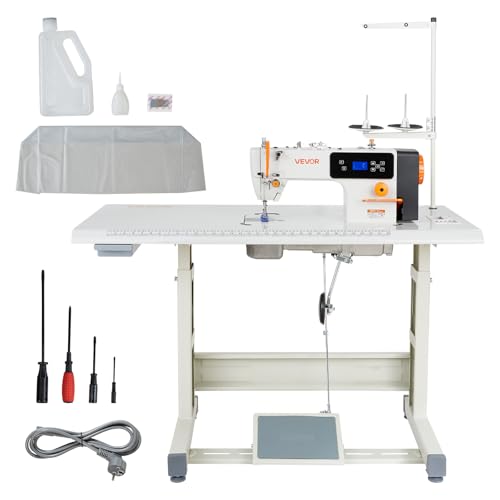
VEVOR’s US listing identifies the JK-9803 with a 550-watt servo motor, table and stand, a 110-volt specification, and straight-stitch operation. The listing also advertises a maximum of 5,000 stitches per minute. These details identify a particular station; they should not be applied to every VEVOR sewing product.
A motor rating is not a feed-system specification. Do not assume this station is a compound-feed walking-foot machine simply because the description mentions upholstery, leather, or heavy materials. Request the exact manual, feed mechanism, needle system, thread range, and a sample demonstration. If the seller cannot clarify a capability essential to your work, keep comparing.
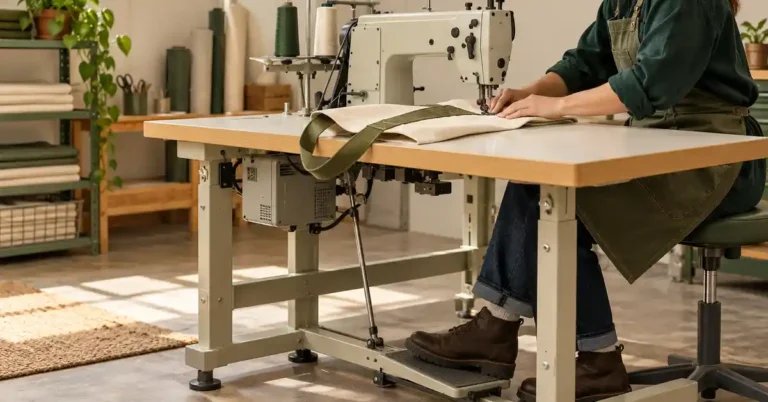
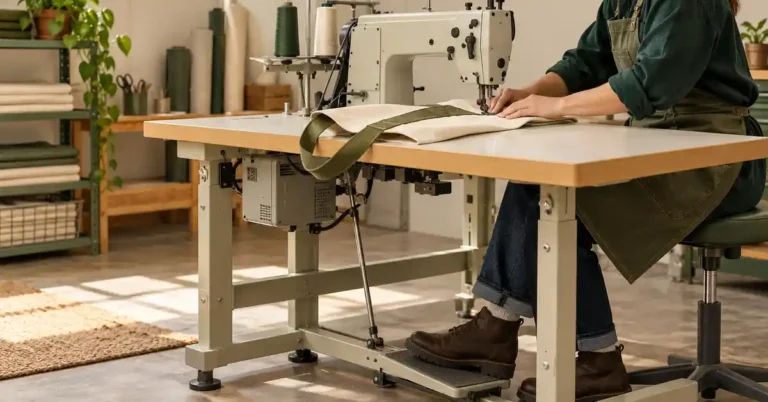
The listed table and stand create a different ownership requirement from a portable machine. Measure the assembled footprint and allow room for the operator, material, chair, and maintenance access. Ask how the shipment is divided, what assembly is required, and whether setup assistance is included. A collection of cartons is not yet a ready-to-use production station.
Maximum speed is not a recommendation for every seam. Detailed topstitching, corners, and dense crossings may need controlled slow operation. Ask to see starts and stops at the speed you expect to use. A fast straight run does not demonstrate accurate placement near the edge of a shaped project.
Read the model label and manual before ordering accessories or consumables. A machine sold under a broad brand umbrella may have a particular controller and mechanism requiring specific parts. Confirm who can service that exact model locally, rather than assuming any technician will accept it or have replacement electronic components readily available.
Five aspects worth evaluating:
- A fixed station can provide an organized permanent work area.
- The listing identifies a specific model and electrical configuration.
- A servo-driven station deserves a controlled-speed demonstration.
- Table and stand inclusion helps define the complete purchase.
- Straight-stitch specialization may suit repeated panel sewing.
Two reservations:
- The broad application list does not prove compound-feed performance or every material claim.
- Assembly, parts, and service arrangements need verification before purchase.
Walking Foot, Unison Feed, and Ordinary Straight Stitching
The term walking foot can describe different arrangements. A household attachment, a portable walking-foot machine, and an industrial unison-feed machine should not be treated as one mechanism. Ask what moves the material and how the layers are controlled. The useful answer is model-specific, followed by a demonstration on the seam that matters.
Needle penetration is only one part of the task. A machine might pierce a stack while feeding it inconsistently, leaving short stitches, shifting layers, or marking the surface. Inspect the entire finished seam and its underside. Avoid buying on a dramatic stack demonstration that ignores appearance, repeatability, or the thread required by the project.
Our household walking-foot guide helps distinguish an accessory from a machine category. For ordinary mechanical sewing, compare the Singer 4452, but do not treat its accessory kit as an industrial feed upgrade.
Juki DNU-1541: A Separate Industrial Unison-Feed Alternative
The DNU-1541 provides an industrial unison-feed comparison for heavier layered straight sewing. Its role differs from a portable zigzag machine and from an unspecified straight-stitch station. Match the exact suffix and package; related DNU models can differ in safety and automatic functions.
Confirm whether the seller supplies a machine head or a complete station with compatible motor, table, stand, and setup. A head-only price can look attractive while leaving substantial additional work and cost. Our DNU-1541 guide explains the category. It does not establish that every online package includes identical hardware.
If the project is flat garment production rather than layered upholstery, a different industrial class may be more suitable. The Juki DDL-8700 guide adds context for straight-stitch production. Industrial does not mean universally appropriate for every material or construction.
Choose by the Construction You Need to Complete
For a canvas bag, bring the complete corner or binding stack, including reinforcement and webbing. Flat panel seams may be easy while the last assembly step is difficult to access. Our bag construction guide helps identify those transitions before choosing a machine.
For leather, inspect visible marking as well as stitch formation. A toothed foot or unsuitable needle can leave damage even when the seam holds. Leather holes do not disappear when a seam is removed, so use scraps from the actual material. See the leather bag guide for construction planning and machine limits.
For upholstery panels, test piping, seam crossings, and the actual backing. Furniture and automotive materials are not one uniform category. Vehicle restraint-related upholstery also requires the correct professional procedures; an equipment review is not a guide to modifying airbag seams or safety systems.
For fine clothing, neither a portable heavy-material machine nor a fixed production station should be assumed to replace every household function. Buttonholes, zigzag, narrow hems, and delicate handling may justify another machine. A useful sewing room can contain complementary machines instead of forcing every operation onto one tool.
Compare the Complete Station and Support
Write down the delivered machine cost, table or case, motor, assembly, accessories, consumables, and instruction. Include any shipping surcharge and the cost of returning a bulky machine. Then ask who handles a fault and whether the support is practical from your location.
During acceptance, test threading, bobbin winding, reverse, controlled starts, and the actual seams you bought the machine to make. Check controller behavior and mechanical clearance using the manual. Keep sample settings and an equipment inventory. This makes it easier to distinguish an initial setup issue from a persistent fault.
A warranty headline does not establish labor, travel, electronic-component coverage, or freight terms. Ask for the written policy that applies to the exact purchase. If a local technician is part of your plan, confirm acceptance of the model before buying rather than discovering the limitation after the machine arrives.
Plan the Material Path Around the Machine
Measure more than the table footprint. A large cover needs somewhere to rest before it reaches the needle and after the seam passes through. If the material hangs from one side, its weight can distort feeding or pull the work away from the intended line. A portable machine still needs external support for a large project.
For a fixed station, check chair height, pedal position, lighting, and the room available behind the operator. Try loading and turning a representative panel before finalizing the layout. A cramped corner may fit the table while leaving no practical way to guide the item.
For shared rooms, plan storage of needles, thread, feet, and the machine case. Record how much setup is required before each session. The best portable arrangement is one you can assemble securely and repeat without losing essential parts or improvising the work surface every time.
A Project Check Before You Commit
For a stored portable machine, record the setup time before each session; for a fixed station, record the floor space occupied throughout the week. Those are different ownership costs even when the purchase totals are close. Choose the arrangement that fits how often and where you actually sew.
If the work includes both zigzag and straight seams, identify which stages require each stitch before comparing a straight-only station. Missing a required stitch is a functional limitation that a powerful motor cannot solve.
Frequently Asked Questions
Does the Ultrafeed LSZ sew zigzag?
Yes. Sailrite identifies the LSZ as a straight-and-zigzag walking-foot machine. Do not confuse it with the straight-stitch LS or assume every used example has the current motor and accessory package.
Are all VEVOR sewing machines industrial walking-foot machines?
No. Review the exact model. This guide discusses the listed JK-9803 straight-stitch station. A brand name, servo rating, or broad upholstery description does not establish a particular feed mechanism.
Is a portable machine automatically easy to carry?
No. Check the real machine, case, lifting requirements, and storage location. Portability means it can be moved as a setup; it does not mean every buyer will find lifting or transporting it comfortable.
Does a powerful motor prove the machine can sew my leather?
No. Feeding, needle and thread compatibility, access, and surface marking also matter. Test the actual construction and inspect the finished seam before assigning a machine to repeated leather work.
Which machine is best for a small workshop?
Choose by the required stitch, feed, access, and space. Portable straight-and-zigzag work suggests one comparison; repeated fixed-station straight sewing suggests another. Use sample results and complete support cost to decide.
Final Recommendation
Compare the LSZ for a portable straight-and-zigzag walking-foot workflow. Evaluate the VEVOR JK-9803 as its exact documented station, with unresolved feed and service questions settled before payment. For industrial unison feed, compare a correctly equipped alternative such as the DNU-1541. The right machine completes your construction, not merely a sales demonstration.