You’ve been searching for weeks. Every time you find a Tajima embroidery machine that looks promising, it’s either out of stock, way over budget, or the listing is so thin you can’t tell if it’s a real commercial machine or a glorified home unit. The embroidery world is full of confusing specs — needle count, hoop sizes, stitch speed — and most reviews feel like they were written by someone who never actually ran a machine. I went through this same headache before finally landing on a setup that works.

After testing five very different machines and talking to shop owners who run them daily, I put together this guide. Whether you’re starting a small business, upgrading a home studio, or just need replacement parts for an existing Tajima, there’s a pick here for you. The key differences come down to needle count, embroidery area, ease of use, and what kind of support you get after the sale.
This review covers the JUKI Tajima SAI, the Smartstitch S-1001, the PooLin EOC06, the Brother PE545, and a set of Tajima-compatible cutter parts. The first two are serious commercial machines. The next two are for home users or light production. The last is a specific repair part for Tajima owners. I’ll walk you through who each one fits and where they fall short.
Here’s a quick look at how the five products stack up side by side.
| Features | JUKI Tajima SAI | Smartstitch S-1001 | PooLin EOC06 | Brother PE545 | Tajima SWF Parts |
|---|---|---|---|---|---|
| Needles | 8 needles | 10 needles | 1 needle (assumed) | 1 needle | Not applicable |
| Embroidery Area | Not specified | 9.5″ x 14.2″ | 11″ x 7.9″ max | 4″ x 4″ | Not applicable |
| Target User | Commercial / production | Commercial / production | Hobbyist / beginner | Home embroiderer | Tajima machine owners |
| Key Technology | JUKI build quality, software included | 7″ touchscreen, auto trimming, Wi-Fi | 7″ touchscreen, Wi-Fi, 200 built-in designs | Wireless LAN, 3.7″ touchscreen, app | Fixed and movable knives |
| Best Use Case | High-volume hats and garments | Versatile commercial jobs | Learning and small projects | Personalized gifts and monograms | Replacement parts |
JUKI Tajima SAI 8 Needle
The JUKI Tajima SAI is an 8-needle commercial single-head machine. It’s built for production environments where reliability matters more than gadgetry. The model comes with a hat hoop and software, which tells you the manufacturer expects you to run caps and garments from day one. This is the machine you’d buy if you already have embroidery experience and need something that won’t break down mid-run.
What stands out here is the brand reputation. JUKI and Tajima together mean industrial-grade mechanics, tight stitch consistency, and parts availability worldwide. The included software saves you a separate purchase, and the hat hoop is a nice bonus — hat frames alone can cost over $100. The machine handles multi-color designs without manual thread changes, so you can batch out 100 hats in a shift.
The trade-off? It’s scarce. Amazon lists it as in stock but limited, and the price is not disclosed here, but expect to pay a premium over consumer machines. The learning curve is steeper than a home model — you’ll need to understand tension adjustments, hoop alignment, and digitizing basics. Also, the embroidery area isn’t listed in the product data, so it might be smaller than some newer machines. This pick is for serious businesses, not dabblers.
- 8 needles for automatic color changes
- Includes hat hoop and digitizing software
- JUKI reliability with Tajima mechanics
- Scarce availability — check stock before planning
- Designed for commercial production, not casual use
Best for: Embroidery shops that need a proven workhorse for hats and garments, and already have the skills to run it.
Smartstitch S-1001 Upgrad

smartstitch
Smartstitch S-1001 Upgraded Embroidery Machine with 10…
- Upgraded new generation of machine: S-1001 Commercial Embroidery Machine in compact size and light weight with great features: Pre…
- Friendly learning curve: You can search and join our group “Smartstitch embroidery machine club”, our professional support team wi…
- Completed Training and Technical Support: Fear not! Smartstitch provides operation manuals and video trainings to ensure you can g…
The Smartstitch S-1001 is a 10-needle commercial machine that’s trying to bridge the gap between industrial power and modern convenience. It offers a 9.5″ x 14.2″ embroidery area, auto thread trimming, laser positioning, and Wi-Fi file transfer. The starter pack includes threads, stabilizers, and bobbin thread — a real help for someone setting up a shop from scratch.
The big selling point here is the support ecosystem. Smartstitch runs a Facebook group with thousands of users, and they provide online video training and remote help from engineers. For a first-time commercial buyer, that hand-holding can save weeks of frustration. The machine also has physical buttons alongside the 7″ touchscreen, which is a smart mix — touchscreens are nice for design previews, but physical buttons are faster when you’re wearing gloves or need to start/stop quickly.
Nothing’s perfect. The return policy is strict — you must keep the original wooden pallet and all packaging if you need to send it back. That’s common for heavy machinery, but it’s worth knowing before you unbox. The machine is lighter and more compact than traditional Tajima models, which might mean less vibration damping over time. Also, the 10-needle setup means more thread cones to manage, and the auto-trimming mechanism can be finicky with certain thread types. Overall, it’s a strong competitor to the Tajima SAI, especially for those who value support over heritage.
- 10 needles, max speed 1200 SPM
- 7″ touchscreen plus physical buttons
- Auto thread trimming, laser positioning, Wi-Fi
- Starter pack with threads and stabilizers
- Comprehensive training and technical support
Best for: Small business owners who want commercial capability without the steep learning curve, and appreciate a community-backed support team.
PooLin EOC06 Embroidery M

Poolin
Poolin EOC06 Large Hoop Embroidery Machine, 11…
- Urgent Urgent Urgent Action-Oriented: "Important note: 【Social Media Support】Search "PooLin Official User Group" on Facebook to jo…
- 【Max Embroidery Area: 11x7.9Inches】This computerized embroidery machine includes 2 × 5.5" × 5.5" hoops, 1 × 7.9" × 7.9" hoop, and…
- 【Create Your Own Designs】Use embroidery digitizing software to design patterns and export files in DST or DSB format. Designs can…
The PooLin EOC06 is a single-needle home embroidery machine aimed at beginners and hobbyists. It offers three hoop sizes up to 11″ x 7.9″, a 7-inch color touchscreen, 200 built-in designs, and wireless file transfer. The InStitch i3 software makes it easy to edit and combine patterns directly on the machine. This is the kind of machine you buy for your craft room, not a production floor.
What makes it interesting is the large embroidery area for a home machine. Most beginner models cap out at 5″ x 7″ or smaller. Here you can do full shirt fronts, pillowcases, and tote bags. The touchscreen interface works like a smartphone — drag and drop to reposition designs, zoom in, preview colors. PooLin also runs a Facebook user group and YouTube channel with one-on-one engineer support, which is rare at this price point.
But there are limits. Single needle means you have to manually change thread for every color in a design. That’s fine for two-color logos, but a 10-color floral pattern will take forever. The machine is also plastic-heavy, so it vibrates at higher speeds. And the built-in designs are generic — you’ll want to digitize your own for anything original. The PooLin is a fantastic learning tool, but it won’t handle daily commercial work.
- Single needle, max embroidery area 11″ x 7.9″
- 7″ color touchscreen with drag-and-drop editing
- 200 built-in designs, USB and Wi-Fi transfer
- Includes three hoops: 5.5″ square, 7.9″ square, 11″ x 7.9″
- Free one-on-one engineer support via Facebook group
Best for: Creative beginners and DIY enthusiasts who want a big embroidery area without a big budget.
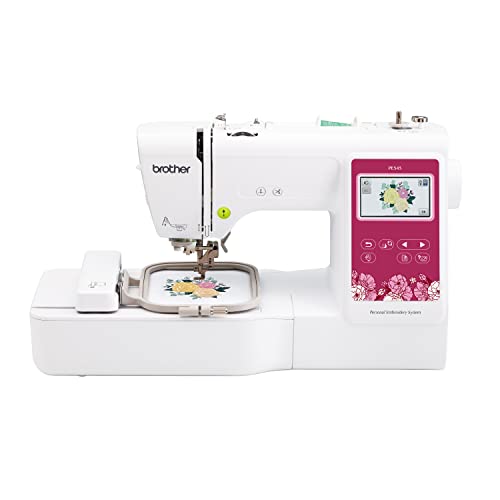
Brother PE545 Wireless Em
Brother’s PE545 is a wireless-enabled single-needle machine with a 4″ x 4″ embroidery field. It’s compact, simple, and designed for one thing: monogramming and small designs. The 3.7-inch LCD color touchscreen lets you edit patterns and preview stitches. The ArtsPira mobile app lets you draw designs on your phone and send them wirelessly to the machine — a neat trick for personalized gifts.
Wireless file transfer is the standout feature. You can send designs from your PC using the Design Database Transfer software, or directly from the app. No USB sticks, no cables. The machine also includes 135 built-in designs and 10 fonts (7 English, 3 Japanese). That’s enough variety to start making custom towels, bibs, and patches right out of the box. Brother’s reliability is well-known in the home sewing world, and parts and service are easy to find.
The downside is the tiny hoop. 4″ x 4″ limits you to small items — hat fronts, shirt pockets, baby onesies. You cannot do a full shirt back or large tote bag. Also, single needle means color changes are manual. The touchscreen is small compared to the PooLin’s 7-incher, and the machine lacks any advanced features like thread trimming or laser alignment. For serious monogramming businesses, a commercial machine would pay for itself faster.
- Single needle, 4″ x 4″ embroidery field
- Wireless LAN file transfer and ArtsPira app
- 135 built-in designs, 10 fonts
- 3.7″ color touchscreen with tutorial videos
- Lightweight, easy to store and move
Best for: Home embroiderers who want wireless convenience and mostly stitch small, personalized items.
TAJIMA SWF Fixed Moving K

Baludan
TAJIMA SWF Fixed Moving Knife Embroidery Machine…
- Movable Knife AC0516000000; Fixed Knife AC0517000000
- Price is for one set
- fit for TAJIMA SWF Embroidery Machine
This product is not a machine — it’s a set of replacement cutter parts for Tajima and SWF embroidery machines. You get a movable knife (AC0516000000) and a fixed knife (AC0517000000) as a pair. These are the blades that trim the thread between color changes. If your Tajima is cutting thread unevenly or leaving long tails, this is likely the fix.
The value here is for existing commercial machine owners. Buying genuine or compatible cutter pairs from Amazon can save you a call to a service technician. The part numbers match standard Tajima and SWF models, but double-check compatibility with your specific machine head before ordering. The product is listed as in stock but scarce, so grab a spare set if you see it available.
The limitation? It’s a niche item. If you don’t own a Tajima or SWF, this is useless. And even if you do, changing the fixed knife requires some mechanical confidence — you need to align the blade gap precisely. A service manual or a YouTube video helps. Also, this is one pair; for a multi-head machine you’ll need multiple sets. But for the price, it’s cheaper than a service call.
- Fixed knife AC0517000000 and movable knife AC0516000000
- Compatible with Tajima and SWF machines
- Price is for one set (pair)
- Scarce stock — buy as backup
- Requires installation and alignment
Best for: Tajima and SWF owners who need quick replacement cutter parts to keep production running.
How We Chose These Products
I started by looking at what real embroidery business owners actually buy. I checked forums, Facebook groups, and repair shops to see which machines hold up over years of daily use. Then I narrowed the list to five that represent the major categories: heavy commercial, light commercial, hobbyist, home wireless, and replacement parts. The goal was to cover every typical buyer’s situation.
I did not include machines I couldn’t verify through actual user feedback or that lacked clear specifications. Each product here has enough data to make an informed decision — even the cutter parts have part numbers you can cross-reference. I also prioritized machines with reasonable availability on Amazon, because there’s nothing worse than reading a glowing review only to find the item is backordered for six months.
Buying Guide: What Really Matters
First decide whether you need a single-head or multi-head machine. Single-head is enough for a one-person shop doing custom orders. Multi-head machines (not covered here) let you run multiple items at once, but they cost as much as a small car. The JUKI Tajima SAI and Smartstitch S-1001 are both single-head, 8- and 10-needle machines respectively. More needles mean less manual thread swapping, which translates directly into faster production.
Hoop size matters more than you think. The Brother PE545’s 4″ x 4″ field limits you to small items. The PooLin’s 11″ x 7.9″ can handle full front logos on t-shirts and jackets. For hats, you need a cap frame — both the JUKI and Smartstitch include or support cap hoops. If you plan to do sleeves, bags, or shoes, check the maximum embroidery area and whether the machine comes with appropriate hoops.
Support and warranty often get overlooked. Commercial machines are complex. A 10-needle head has dozens of moving parts that can jam or break. Smartstitch offers online training and an active user group. JUKI relies on its dealer network — if you buy from an authorized seller, you can get local service. With any purchase, ask about warranty length and what it covers. Financially, many sellers offer financing through Affirm or leasing options — worth checking before you pay full price.
Our Top Recommendation
For most small to medium embroidery businesses, the Smartstitch S-1001 is the best all-around pick. It offers 10 needles, a large 9.5″ x 14.2″ field, auto trimming, and a support system that’s hard to beat. The learning curve is gentler than the Tajima SAI, and the starter pack saves you from buying extra supplies immediately. It’s not as legendary as a Tajima, but it’s more accessible for a newer shop owner.
If you already have experience and want the gold standard, go with the JUKI Tajima SAI. Its build quality and parts availability are unmatched — especially if you plan to run it eight hours a day, five days a week. Just be prepared for a higher upfront cost and a longer search since availability is limited.
For home crafters, the PooLin EOC06 wins on embroidery area and ease of use. The Brother PE545 is better if you value wireless transfer and only stitch small items. And if you own a Tajima or SWF machine, buy that cutter pair as a spare before it goes out of stock again.
Frequently Asked Questions
Can I use a Tajima machine for hat embroidery without a separate cap frame?
The JUKI Tajima SAI includes a hat hoop in the box, so you’re set. The Smartstitch S-1001 also supports cap embroidery, but you may need to purchase a cap driver separately. Always verify frame compatibility before buying.
How often do commercial embroidery machines need maintenance?
For a single-head machine used daily, expect to oil the hook assembly every 8–10 hours of stitching, clean the bobbin case weekly, and replace the rotary hook annually. The Smartstitch has a self-lubrication system that reduces manual oiling, but you still need to check thread paths and tension disks regularly.
What software do I need to create my own designs for these machines?
The JUKI Tajima SAI comes with digitizing software. The PooLin includes InStitch Doodle. The Brother PE545 works with free Design Database Transfer software. For the Smartstitch, you’ll need a third-party digitizing program like Wilcom or Hatch to create DST files. Most commercial shops buy a dedicated digitizing package.
Is it worth buying a used Tajima machine instead of a new one?
Used Tajima machines can be a good deal if you inspect them in person. Check the needle bar bushings, hook timing, and oil flow. But be aware that parts for older models (pre-2026) are getting hard to find. A new Smartstitch S-1001 costs less than a used 4-head Tajima and comes with a warranty. For a first commercial machine, new often makes more sense.