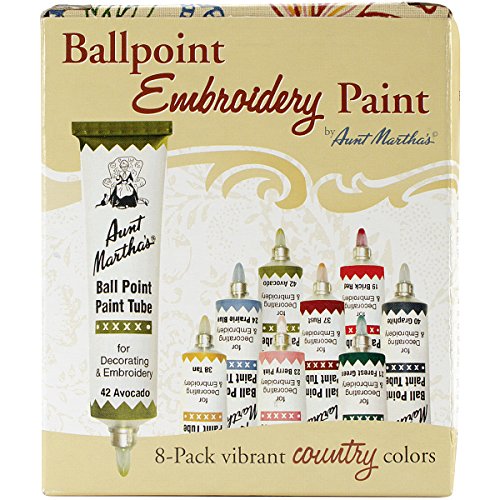

Aunt Martha’s liquid embroidery paint is a ballpoint fabric paint system for drawing decorative lines that resemble stitched detail. It does not turn a painted surface into needlework. This guide explains the paint packs, individual tubes and accessories, then shows how to plan a modest project and check its instructions. Product facts are attributed to the maker or retailer, with unresolved bundle details clearly identified before you choose your supplies.
This researched guide does not report physical product tests. References were checked on 28 October 2026. Prices, stock and ratings are not asserted here. Amazon links are affiliate links; qualifying purchases may earn a commission.


What’s in this article9 sections
What liquid embroidery means here
Colonial Patterns describes Aunt Martha’s ballpoint embroidery paint as an oil-based tube paint used to draw lines on fabric. The tip works on the ballpoint principle. The resulting decoration is paint on the surface, so the word embroidery describes the intended appearance, not the addition of needle-and-thread stitches. Decide which effect your project needs before choosing the supplies.
A painted outline can be appropriate when you want drawn lettering or a line motif. Hand stitching produces a different structure and involves thread selection, needles and stitch construction. A transfer pattern is another separate item: it supplies a guide for placing a design and is not necessarily the final decoration. The embroidery transfer guide explains that distinction.
Compare the retained product types
| Reference type | What it is for | What to confirm |
|---|---|---|
| Primary eight-color pack | Starting a small palette | Correct named set and tube format |
| Fully stocked Color Caddie | Keeping a collection with storage | Filled case versus case only; exact contents |
| Older painting-hoop bundle | Supporting fabric during application | Exact retailer identity and included blotter or extras |
| Replacement ballpoint tips | Replacing a compatible applicator part | Correct tube system and fitting instructions |
| Individual black tube | Outlining or replenishing one color | Shade and size on the supplied label |
These references are not a five-way ranking of paints. Two are accessories, and one is a larger bundle. Compare the job each performs before comparing a seller’s price. A large case can be unnecessary for one outlined motif, while an accessory-only order will not provide any paint for a first project.
Build a small project plan
Begin with a simple motif and an expendable piece of the intended fabric. Pick a few shapes with enough space between lines to observe the application. Use the same fabric color and finish as the eventual project whenever possible. A spare offcut is more informative than an unrelated sheet of paper when you are deciding how a design will look on cloth.
Check the textile’s own care label and the paint’s current instructions. Consider the whole object: a towel, bag or garment can have a lining, a coating, seams or trims that need different handling. Lay out where the motif will sit when the item is used. Keep the first design away from a bulky seam if you want to practice a smooth continuous line.
Plan the working support and how you will protect the reverse layer and table. Do not assume that the visible surface is the only layer that may receive paint. Use an appropriate barrier or support as directed for the project, then check the sample’s back. For a ready-made bag or shirt, separate the layers before application and verify that the chosen support fits the opening.
A controlled first sample
- Read the supplied directions. Identify the paint system, fabric guidance, preparation steps, drying or setting requirements and care instructions before opening several tubes.
- Prepare the sample and support. Follow any stated fabric preparation. Keep the working area flat or use the recommended painting support without distorting the cloth.
- Try one color. Follow the label’s starting procedure and draw a short line, a curve and a small repeated motif. Notice the movement and pressure needed without squeezing harder to compensate for every interruption.
- Inspect both sides. Compare the line with the intended design, and check whether paint has reached a backing layer. Change one aspect of your setup before making another sample.
- Complete the stated process. Use the actual drying, setting and first-care instructions. Record those directions with the sample rather than substituting a general fabric-paint timetable.
The purpose of this sample is to decide whether your materials and layout suit a particular project. It is not a standardized wash, abrasion or chemical-safety test. A sample that looks acceptable immediately after application does not establish years of durability. Keep the label or an instruction photograph so you can repeat the same process later.
Paint packs and accessories
Each card below identifies the retained destination and separates documented details from questions still needing confirmation. The existing photographs are product-reference images, not photographs of our own painted samples.
Aunt Martha's Primary eight-color paint pack

The retailer's Primary eight-pack matches Colonial Patterns' named Primary kit. The maker lists eight one-ounce tubes with black, brown, green, blue, yellow, orange, white and red. The tubes use ballpoint applicators. This is a paint assortment for drawing decorative lines, rather than a pack of embroidery thread or a complete stitched project.
Useful features or reasons to consider it
- A defined basic palette helps plan a small design without collecting every color.
- The maker identifies the tube format and colors, making the pack easier to compare.
Limitations and checks
- A palette is not a guarantee of coverage on every fabric color or finish.
- Follow the supplied product and fabric instructions for application, drying and care.
Aunt Martha's CC43 fully stocked Color Caddie

The retained retailer lists model CC43, matching Colonial Patterns' fully stocked Color Caddie. The maker specifies thirty-four paint colors, a cleaner, packs of tips, tube protectors and blotters, plus a ten-inch hoop that serves as the lid. This is the stocked version, distinct from a case-only purchase. Check the selected offer before ordering.
Useful features or reasons to consider it
- A stocked case can bring a palette and storage into one purchase.
- It may suit someone who already knows they want to keep using this paint system.
Limitations and checks
- Accessory packs contain multiple parts, so a mixed piece count should not be read as the number of paint tubes.
- It adds more supplies to store and maintain than a few individual colors.
Older painting-hoop bundle — exact contents unverified
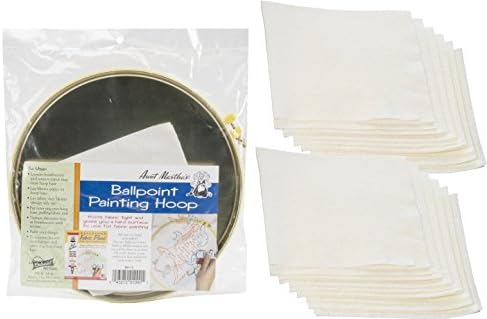
The retained Amazon page could not be retrieved. Colonial Patterns separately documents its MH10 ten-inch metal painting hoop with one blotter and a raised working surface. That maker page explains the accessory family but does not verify what this older retailer bundle contains. Do not assume that paint tubes, extra blotters or a cleaner are included.
Useful features or reasons to consider it
- A supported painting surface is a useful accessory to consider for line work.
Limitations and checks
- The described maker hoop is not proof of the exact retained ASIN's identity or bundle.
- Check the selected item's diameter, construction and included pieces before purchase.
Verification remains incomplete for reference B077GKYFZ2. Read the exact current offer before relying on its contents or instructions.
Aunt Martha's replacement ballpoint tips — six-pack

The retailer identifies a six-tip replacement pack, and Colonial Patterns lists replacement tips under SKU RT1. These are applicator parts for the paint tubes, not extra paint colors. The maker provides a removal and installation procedure; use that procedure for the matching tube rather than forcing a damaged tip or treating it as a universal craft nozzle.
Useful features or reasons to consider it
- A compatible replacement part may let you retain a tube with an unusable tip.
- A separately listed part avoids buying an entire palette merely for applicators.
Limitations and checks
- Tips do not resolve every paint-flow problem or replace dried-out paint.
- Check compatibility and follow the maker's handling instructions before fitting a replacement.
Aunt Martha's black ballpoint paint tube

The retailer identifies a one-ounce black tube, consistent with Colonial Patterns' number 901 Black paint. A single color is a practical choice for lettering, outlines or replenishing a frequently used shade. Its role in a design depends on the fabric and the line sample, not on an untested promise of professional results.
Useful features or reasons to consider it
- A single tube avoids buying a large set when only black is needed.
- The maker's color reference helps distinguish a refill from a mixed-color assortment.
Limitations and checks
- One tube does not provide a complete palette or a painting support.
- Painted detail differs in texture and construction from a stitched line.
Drying, setting and washing: use the actual directions
Colonial Patterns describes the ballpoint paint as permanent when dry and machine washable. That maker statement should be read alongside the current package directions and the textile’s care requirements. The pages checked for this review do not establish one universal drying interval, first-wash wait or heat-setting procedure for every fabric and paint application. This guide therefore makes no blanket claim that ironing is required or unnecessary.
If the printed directions are missing or unclear, obtain the instructions for the exact product from the maker before applying it to a valued item. Do not borrow a temperature and timing schedule from a different acrylic paint, marker or transfer paper. Materials sold under the broad term fabric paint can have different instructions, and a care claim for one formula does not verify another.
For a project combining paint, thread and trims, review the requirements of every component. Choose a design that can tolerate the intended handling, and keep a completed sample for reference. A towel used for decoration has different practical demands from one expected to be washed frequently. More layout ideas are in the kitchen-towel design guide, while the thread color-chart guide is useful if actual stitches will accompany the paint.
Resolve an application problem before adding more paint
| Problem | Check | Next step |
|---|---|---|
| Line stops or skips | Starting procedure, tip condition and working support | Follow the maker’s tip-care directions; do not force flow with excessive squeezing |
| Paint reaches another layer | Barrier placement and reverse of the sample | Correct the setup before decorating the finished object |
| Design looks too crowded | Spacing and line scale on the real fabric | Reduce detail or enlarge the motif on another sample |
| Replacement tip is needed | Compatibility with the tube system | Use the documented replacement procedure and matching part |
Do not assume that every inconsistent line comes from defective paint. The support, fabric texture and handling can also affect a drawing task. Equally, do not promise that changing a tip will restore every old tube. Stop if a tube is damaged or the supplied directions do not describe how to resolve the problem, and ask the maker for guidance.
Choose supplies without overbuying
Write a list divided by the jobs you actually need: colors, a suitable support, a pattern if desired, and compatible maintenance parts. Check what you already have. Order a replacement black tube when the rest of an existing palette is sufficient. Consider a complete collection only when its named colors and storage will support several planned projects. An accessory may be useful later without being necessary for the first sample.
Check a bundle’s photograph against its written contents and selected variation. A picture of a case filled with tubes does not establish that every offered variation is filled. Similarly, a hoop shown beside bottles does not prove they are supplied together. When a description is inconsistent, request an exact contents list before ordering instead of filling the gap with assumptions.
For planning the drawn guide itself, see iron-on patterns and transfers. If a project turns toward thread work, the floss-selection guide explains why brand, fiber and pack counts matter. Browse related textile topics through the Practical Textile homepage.
Questions about Aunt Martha’s ballpoint paint
Is liquid embroidery actual stitching?
Here it is the maker’s term for ballpoint paint that can draw embroidery-like lines. Needle-and-thread embroidery is a separate construction method.
Does it always need heat setting?
This review does not establish a universal heat-setting rule. Follow the exact product’s current directions and the fabric label, and ask the maker when those directions are missing.
Can I call every finished project machine washable?
No blanket claim is justified. The maker describes its paint as washable, but your fabric, trims, preparation and completion process also matter. Keep the applicable instructions with the project.
Is it automatically suitable for children?
Use the current package’s age guidance, precautions and supervision requirements. A general promotional safety term is not an age rating or permission to ignore the label.
Does the older hoop reference include paint?
Its exact retailer listing was inaccessible. The separate maker MH10 page documents a hoop with one blotter; it does not verify that older retailer bundle or any additional paints.