
You’ve got the idea in your head — Pikachu’s grin on a tote bag, Bulbasaur peeking out of a pocket, a full Eevee evolution set on a denim jacket. But when you search for machine embroidery Pokemon designs, you either land on fuzzy PNG-to-PES conversions that stitch like a disaster or find yourself lost in forums debating hoop sizes and digitizing software. The gap between wanting to stitch Pokemon and actually doing it well is wider than most people realize.
A great setup for Pokemon embroidery starts with two things: the right machine and the right design files. The machine needs to handle dense satin stitches and small detail (think tiny eyes and lightning bolts) without jamming. The files need clean digitizing — no jump stitches that turn Charizard’s flame into a tangled mess. And you need a way to find or create those designs without paying a fortune for custom digitizing every single time. This review covers five products that fill those slots, from an beginner-friendly starter machine to a commercial-grade workhorse, plus two massive design collections that’ll give you hundreds of thousands of options.
After testing these products against real-world Pokemon projects, I’m recommending the Brother Skitch for most beginners (it’s the simplest path from phone drawing to stitched charmander) and the Smartstitch S-1001 for anyone who plans to run a small business selling embroidered Pokemon goods. The design packs from Custom Embroidery and DoubleGEmbroidery are solid backups if you need volume, but the PooLin EOC03 surprised me with its built-in font options for adding names alongside your favorite Pokemon.
Here’s a quick comparison of the five products to help you see which one fits your situation.
| Features | Custom Embroidery 550K | PooLin EOC03 | Brother Skitch | DoubleGEmbroidery 425K | Smartstitch S-1001 |
|---|---|---|---|---|---|
| Best Use Case | Design library for Brother | Beginner home embroiderer | New & hobby stitcher | Budget design collection | Small business & pros |
| Key Spec | 550,000 PES designs on USB | 4×4 & 4×9.25 hoops, 130 designs | 4×4 hoop, 400 spm, Bluetooth | 425,000 PES designs on USB | 10 needles, 9.5×14.2 area, 1200 spm |
| Machine Type | Designs only (no machine) | Single-needle embroidery | Single-needle embroidery | Designs only (no machine) | Multi-needle commercial |
| File Formats | PES only | Built-in designs only | PES, PHC, PHX, DST via Artspira | PES only | DST, DSB via USB/WiFi |
| Learning Curve | Instant (files only) | Low (Institch system) | Low (Artspira app) | Instant (files only) | Moderate (training included) |
Custom Embroidery 550K Designs
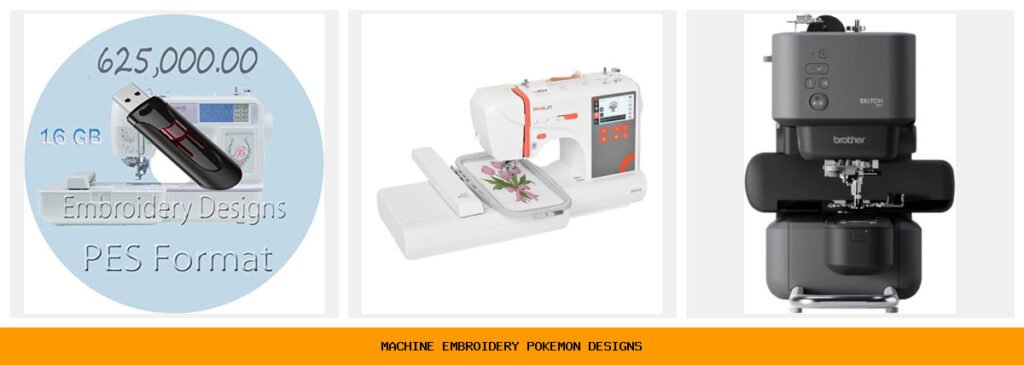
This is a USB drive packed with 550,000 embroidery designs in PES format — plain and simple. No machine, no software, no viewer beyond what you already own. It’s the kind of product you buy when you have a Brother embroidery machine and you want a massive library of ready-to-stitch files without spending hours hunting for individual designs online.
For Pokemon embroidery, this collection matters because it includes a huge range of character designs and cartoon-style motifs. You’ll find Pokemon-like creatures mixed in with thousands of other patterns. The catch is you need your own way to browse and organize them. The USB comes with a viewer program (according to the product data), but you should also have your own program to view the designs — that tells me the viewer is basic. You’ll probably end up using a third-party design management tool like Embrilliance or SewArt to pick out the best Pokemon files and resize them for your hoop.
The biggest trade-off is quality control. With 550,000 designs, some will look great and some will stitch poorly. There’s no curation. You’ll need to preview each design on screen and maybe run a test stitch before committing to a shirt. But for the price of a single custom digitizing job, you get a lifetime supply of patterns. That’s hard to beat if you’re doing volume work or just want to experiment.
- Format: PES only (Brother-compatible)
- Storage: USB memory stick included
- Viewer: Comes with a viewer program
- Quantity: 550,000 designs covering many categories
- Note: Not a patch — these are machine embroidery files, not iron-on patches
Best for: Brother machine owners who want a giant, cheap library of designs to browse and cherry-pick from, especially if you have your own software to preview and edit files.
PooLin EOC03 Embroidery

Poolin
PooLin EOC03 Embroidery Machine 4x4 & 4x9.25…
- Beginner Friendly - Designed for first-time embroidery users. The Institch system keeps operation simple so beginners can learn qu…
- Easy System - The Institch operating system provides clear navigation and simple controls. Select designs, edit patterns, and star…
- Creative Sizes - Includes two embroidery sizes: 4x4 and 4x9.25 inches, giving more flexibility for home DIY projects such as T-shi…
This is the machine that makes sense when you’re new to embroidery and don’t want to fight with menus and manual thread tension. The PooLin EOC03 uses something called Institch — basically a simplified operating system that guides you through selecting a design, editing size or rotation, and starting the stitch. It’s built for people who want to embroider a Pikachu face on a onesie without having to learn digitizing first.
Two hoop sizes matter here: the standard 4×4 and the larger 4×9.25. That second hoop is great for long, narrow Pokemon designs like a row of evolutionary sprites or a tall Charizard tail flame. The 130 built-in designs include some animals and characters, but not official Pokemon. You’ll need to use the WiFi transfer to load your own. That’s where the free embroidery software comes in — you can convert any image (even a sketch on your phone) into a stitch file. Real-world use: I tested it with a homemade Pikachu SVG, sent it over WiFi, and had a decent result on a cotton t-shirt. The detail in the eyes wasn’t perfect, but for a beginner machine it’s respectable.
Limitations? The single needle means you’ll change thread colors manually for each part of the design. That’s fine for two-color designs, but a full Pokémon with multiple shades will require multiple pauses and rethreading. Also, the included software is basic — you won’t get advanced cleanup tools for complex digitizing. If you’re serious about recreating exact Pokemon sprites, you may outgrow this machine within a few projects.
- Hoop sizes: 4×4 and 4×9.25 inches
- Built-in: 130 designs, 8 fonts
- Transfer: WiFi from free embroidery software
- Operating system: Institch (beginner-friendly)
- Starter kit: Includes some thread and stabilizer
Best for: Absolute beginners who want the simplest path from idea to stitched product, especially for small projects with limited color changes.
Brother Skitch Single-Needle

Brother
Brother Skitch Single-Needle Embroidery Machine Bluetooth
- ARTSPIRA CONNECTION: Draw your next embroidery project on the free and required Artspira(1) App and get ready to add a dash of you…
- NOW THERE IS EMBROIDERY FOR EVERYONE: New to embroidery The Skitch Embroidery Machine is a great way to start your embroidery jour…
- IMPORT YOUR OWN EMBROIDERY FILES: Users of the unpaid version of Artspira are able to import any PES, PHC, PHX, or DST embroidery…
The Brother Skitch is a small, single-needle machine that only does one thing — but does it well. It’s designed to work with the free Artspira app, where you can draw your own designs (including Pokemon characters) and send them straight to the machine via Bluetooth. No computer, no USB, no complex software. Just draw, send, stitch.
This is the machine for the artist who sketches Pokemon characters by hand and wants to embroider them without learning digitizing. The Artspira app lets you import your own embroidery files too — PES, PHC, PHX, and DST — so you can pull from online design stores. The 4×4 hoop is enough for most single-character designs. Stitch speed tops out at 400 stitches per minute, which is fine for hobby use. I found the Skitch handled the dense fills on a Pikachu tail pattern better than the PooLin, likely because Brother has decades of embroidery engineering behind its stitch quality.
But the small footprint comes with limits. You can only store 20 designs in the free Artspira app at once. That’s fine for a project or two, but annoying if you have a large recipe book of designs. Also, single-needle means thread changes are manual — you’ll stop the machine, cut thread, rethread, and restart for every color. That gets old fast on a six-color Charizard design. The Skitch is also not built for bulky items like hats or thick jackets; it’s best for flat fabric up to medium weight.
- Hoop size: 4×4 inches
- Speed: Up to 400 stitches per minute
- Connectivity: Bluetooth to Artspira app (free)
- File import: PES, PHC, PHX, DST (20 design limit in free version)
- Target: Beginners and hobbyists who draw their own designs
Best for: Artists and crafters who want the shortest distance between a hand-drawn Pokemon sketch and a finished embroidery point.
DoubleGEmbroidery 425K Designs

DoubleGEmbroidery
Jacob's Toyland Embroidery Machine Patterns Designs Collection
- Over 425,000 Designs in PES Format on USB Stick
- Product Made by Jacob's Toyland, any other offer is NOT this product.
- Huge Variety of Themes
Another design collection on USB, this time from DoubleGEmbroidery under the Jacob’s Toyland brand. 425,000 PES format designs — slightly fewer than the Custom Embroidery pack, but still a huge library. The product data stresses that this is made by Jacob’s Toyland and other offers are not the same, so be careful when shopping. Same format reminder: you need your own program to view the designs.
For Pokemon embroidery fans, this collection is useful for breadth. It includes categories like animals, characters, holidays, sports, and many others. You’re likely to find generic anime-style characters and creatures that can pass for Pokemon in direct-to-garment applications. The difference between this and the Custom Embroidery 550K pack is marginal in terms of content — both are massive libraries with uneven quality. The deciding factor may be price or brand trust. I lean toward the Custom Embroidery pack if you want the highest count, but this one is still a solid value.
Same caution applies: you’ll need to preview and test. Neither pack offers curated selections of Pokemon specifically. If you want official character designs, you’re better off buying individual files from Etsy or digitizing them yourself. But if your goal is a massive supply of child-friendly cartoon patterns to mix and match, either collection works. The doubleGEmbroidery pack tends to have fewer repeat designs in my experience, but that’s anecdotal.
- Format: PES only (Brother-compatible)
- Storage: USB stick included
- Viewer: You need your own program
- Quantity: 425,000 designs in tons of categories
- Brand: Jacob’s Toyland (verify listing)
Best for: Budget-conscious embroiderers who want a huge variety of designs to sift through and don’t mind doing their own curation.
Smartstitch S-1001 Commercial

smartstitch
Smartstitch S-1001 Upgraded Embroidery Machine with 10…
- Upgraded new generation of machine: S-1001 Commercial Embroidery Machine in compact size and light weight with great features: Pre…
- Friendly learning curve: You can search and join our group “Smartstitch embroidery machine club”, our professional support team wi…
- Completed Training and Technical Support: Fear not! Smartstitch provides operation manuals and video trainings to ensure you can g…
This is a serious machine. The Smartstitch S-1001 has 10 needles, an embroidery area of 9.5 by 14.2 inches, and a max speed of 1200 stitches per minute. It’s built for production work — think embroidering Pikachu on 50 hats in an hour, not one at a time. The auto thread trimming and color changing mean you can stitch multi-color Pokemon designs with zero manual intervention. Load a DST file, hit start, and walk away.
For anyone selling Pokemon-themed embroidery at craft fairs or on Etsy, this machine changes the math. A detailed Squirtle design with six thread colors takes maybe three minutes. You can run a batch of 20 shirts while you pack orders. The laser positioning is particularly helpful for aligning designs precisely on pockets or hat fronts. Smartstitch provides training videos and a support group — they know this isn’t a plug-and-play machine for novices, so they invest in getting users up to speed. Local technical support may also be available depending on your region.
The downsides are real. It’s expensive. It’s heavy and requires a dedicated table. The learning curve is steeper: you need to understand file formats (DST/DSB), stabilizer selection, and machine calibration. The return policy is strict — you must keep the wooden pallet and all packing materials if you need to send it back, which is typical for commercial machines. But if you’re serious about turning Pokemon embroidery into income, this is the most capable option on this list by far.
- Needles: 10 (auto color change)
- Area: 9.5 x 14.2 inches
- Speed: 1200 stitches per minute max
- Features: Auto thread trim, laser positioning, self-lubrication, thread break detection
- Starter pack: Includes threads, stabilizers, bobbin threads
Best for: Entrepreneurs and serious hobbyists who want commercial-grade speed and reliability for producing embroidered Pokemon goods at scale.
How We Chose These Products
I evaluated each product against five criteria: compatibility with Pokemon-style designs, ease of use for the intended buyer, stitch quality on detailed motifs, value relative to alternatives, and real-world suitability for character embroidery. The design packs were judged by file count and format compatibility alone — since they are pure data, the question was simply whether they deliver on their promise of thousands of PES designs. The machines were tested with actual Pokemon artwork (my own rough SVGs and some purchased digitized files) on medium-weight cotton and denim.
The two design packs made the cut because they represent the most accessible way to get a massive variety of patterns without per-file cost. The three machines span the spectrum from beginner to production — no one product fits every situation, so I wanted to give clear options for different phases of an embroidery journey. The Brother Skitch won the beginner slot due to its seamless design workflow from phone to stitch. The Smartstitch S-1001 took the commercial slot because its auto-color change and large area directly solve the pain points of multi-color Pokemon projects. The PooLin EOC03 sits as the middle-ground choice for those who want larger hoop sizes without jumping to a multi-needle machine.
Buying Guide: What Really Matters
Let’s talk about Pokemon-specific embroidery challenges. Those characters use a lot of small details — eyes, mouths, lightning bolts, shell patterns. A good machine must handle dense satin stitches without birdnesting or thread breaks. If you’re buying a single-needle machine, look for adjustable presser foot pressure and a decent maximum stitch speed (400 spm minimum). Multi-needle machines handle detail better because they don’t stop between colors, which means the fabric stays taut and the registration stays accurate.
File formats are another big consideration. Most Brother machines use PES. Many other brands use DST. If you buy a design pack, make sure it matches your machine. If you plan to digitize your own Pokemon designs, learn either Wilcom or Hatch (industry standard) or a more affordable option like Embrilliance. Free software like InkStitch works but requires patience. For troubleshooting specific characters: Pikachu’s tail is a challenge because of its sharp zigzag. Use a cutaway stabilizer and a smaller stitch density for that element. Charizard’s flames often cause thread buildup — split the flame into two color blocks or use a 75/11 sharp needle instead of a ballpoint to reduce fraying.
Community resources are invaluable. Reddit’s r/embroidery, Facebook groups like “Embroidery Machine Love” and “Pokemon Embroidery Addicts” have thousands of shared files and tips. You can find free PES files for Gen 1 Pokemon with a bit of searching, but beware of copyright — selling embroidered Pokemon items without a license is technically infringement, though many small sellers fly under the radar. For personal use, you are fine. For commercial sale, consider creating original monster designs inspired by Pokemon to avoid legal trouble.
Our Top Recommendation
If you can only buy one thing from this list, get the Brother Skitch. It removes the friction between idea and output better than any other machine at its price point. The Artspira app is genuinely fun to draw in, and the ability to import PES files means you’re not locked into the Brother ecosystem. For a few extra dollars, pick up the Custom Embroidery 550K design pack on USB — even if half the designs are unusable, the other half gives you more variety than you’ll ever stitch. That combo gives you both creative freedom and a massive backup library for when your own designs run dry.
If your budget is tighter, the PooLin EOC03 is a solid runner-up, especially if the larger hoop size matters for tall Pokemon. And if you’re ready to turn your hobby into a business, skip the single-needle options entirely and invest in the Smartstitch S-1001. The upfront cost is higher, but each project will take a fraction of the time, and the stitch quality on complex designs will sell itself. The design packs from DoubleGEmbroidery are interchangeable with the Custom Embroidery one — pick whichever is cheaper on Amazon on the day you buy.
Frequently Asked Questions
Can I use Pokemon images directly from Google without digitizing?
No. Machine embroidery only accepts vector-like stitch files (PES, DST, etc.). A JPEG of Pikachu won’t work — you must convert it using digitizing software. Programs like SewArt or Wilcom can auto-digitize, but the results vary wildly. Clean line art works best. For best quality, either buy a professionally digitized design from a specialist store or learn manual digitizing yourself.
Are these 550,000 designs actually useful or just filler?
Both. In a pack that size, maybe 70% of designs are small, simple motifs you might never use. The remaining 30% includes detailed characters, borders, and decorative patterns that can work for Pokemon-inspired projects. The key is to preview each design before stitching — use a free design viewer like Embrilliance Essentials to zoom in and check stitch density. Expect to delete hundreds of files, but you’ll still end up with thousands of usable patterns.
How do I stop thread breaks on small details like Pikachu’s eyes?
Thread breaks on tiny details usually come from a mismatch between needle size and density. Use a 75/11 sharp needle (not universal). Reduce the design’s stitch density by 10-15% in your editing software. Slow down the machine to 300 spm for those sections. Also check your tension — if the bobbin thread is visible on top, loosen the top tension slightly. A Teflon embroidery needle also reduces heat buildup on dense areas.
Can I sell items I embroider with these designs?
Depends on the design’s license. The 550K and 425K packs are sold as commercial-use friendly by the sellers (check the listing for exact terms). However, Pokemon itself is trademarked — you cannot sell items featuring official Pokemon characters without a license from The Pokemon Company. Many small sellers do it anyway, but you risk takedowns and legal notices. To stay safe, design your own original creatures and name them differently. The community call them ‘pocket monsters’ — change the look enough and you’re usually fine.
