

A computerized sewing machine should be selected for useful workflow controls, clear navigation and suitable sewing operations. It does not automatically support hoop embroidery. Compare starts, pivots, buttonholes and settings on the exact models rather than shopping for the largest stitch total. The discussion below separates documented capabilities from practical selection considerations for your work. Its purpose is to support an informed comparison of suitable equipment, not promise universal results.
How this guide helps you choose
A control-focused comparison for buyers moving from mechanical sewing to an electronic interface.
Options organized by use
| Option | Reason to compare | Practical selection note |
|---|---|---|
| Brother CS7000X | Household sewing and quilting | Try the controls and supplied kit with your ordinary seams. |
| Brother XR9550 | Sewn lettering option | Check how lettering is selected and sewn; it is not imported logo embroidery. |
| Brother SQ9285 | Larger stitch-and-accessory package | Assess the actual chart and feet rather than the total alone. |
| bernette 38 | Electronic controls and cutting | Use a dealer demonstration to evaluate navigation, buttonholes and thread cutting. |
| Janome New Home 2030DC | Compact computerized sewing | Compare the exact 2030DC model, not similarly named DC or QDC variants. |
| Brother SE700 | Small-field combination category | Only relevant when true sewing-plus-embroidery capability is required. |
| Brother SE2000 | Larger-field combination category | A separate field-size decision for users who need imported embroidery designs. |
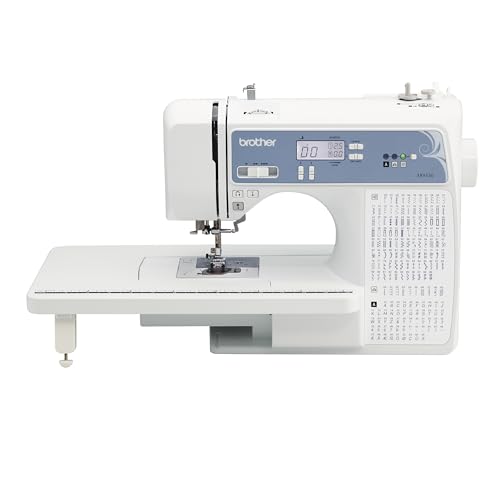


Amazon boxes cover only the specifically verified listings above. Manufacturer and dealer options without a verified ASIN are discussed separately. Bundle contents, condition and availability need checking in the current offer.
Computerized sewing is not the same as embroidery
Electronic stitch selection and stored lettering can exist on a sewing-only machine. Imported-design embroidery requires the appropriate machine category, embroidery unit, field and file support. The two should not be conflated in a purchase decision.
If your goal is ordinary sewing, compare workflow aids on a sewing machine. If it is a logo transferred from your computer, compare actual embroidery capability. A computer connection or a large decorative-stitch menu is not enough to establish that the machine performs the desired design operation.
Compare the relevant equipment categories using the sewing machine buying guide.
Try the controls at the points that cause difficulty
Sew a curve, stop at a mark, pivot, and resume. These steps show whether speed limiting, needle positioning and accessible controls suit you on a model that actually has them. Features vary, so check each shortlisted machine rather than attributing every electronic convenience to the entire category.
Use the screen yourself. Select a utility stitch, change an allowed setting, then return to the basic seam. If navigation requires repeated help, allow for instruction time or compare another interface. A display is valuable when it makes your work understandable, not merely when it looks modern.
For related sewing preparation and problem-solving, see the sewing techniques and troubleshooting.
Lettering and memory require a real sample
Sewn letters can be useful for a label or modest decoration. Test them on the intended stabilized fabric and evaluate spacing, size and appearance. They are not a substitute for every embroidery font or a digitized business logo.
If a model stores pattern combinations, ask how a saved sequence is recalled and edited. This matters more than knowing memory exists in the specification. A convenient demonstration should include recovering from a mistake rather than only completing an ideal sequence once.
Explore accessory categories in our sewing machine parts and accessories; use the exact manufacturer manual for compatibility and maintenance.
Thread cutting and buttonholes affect repeated work
An automatic cutter or one-step buttonhole can be useful when a project repeats those operations. Demonstrate the function with your thread, fabric and preparation. Do not infer a tested time saving from the presence of a button alone.
For clothing, compare multiple sample buttonholes after pressing. For quilting, compare accurate stops and restarts. The most useful electronic feature depends on the task. A sewist who mainly makes long straight seams may value different controls from someone who spends most of a project on fine details.
Maintenance and support should remain model specific
An electronic interface does not determine whether the owner should oil the machine. Follow the exact manual. Some domestic models specify no user oiling, while other categories require defined lubrication. Do not turn one machine’s instruction into a universal rule.
Compare the service route, accessory compatibility and availability of usable manuals. For your Windows desktop, ordinary computerized sewing may not require a computer at all. Software requirements become relevant only for functions that actually use a transfer or design program.
Five advantages and two limitations
Advantages
- Useful controls can improve deliberate sewing workflows.
- Clear displays can make settings easier to inspect.
- Stored sewing patterns can support repeated suitable decoration.
- Model-specific features allow comparisons beyond stitch count.
- Sewing-only and combination categories can be evaluated separately.
Limitations
- Electronic sewing controls do not establish embroidery-file capability.
- A complex interface or unused feature set can add cost without benefit.
Check the exact listing and documentation
Brother CS7000X: No products found.
Brother XR9550: Check Brother XR9550 listing
Brother SQ9285: Manufacturer information for Brother SQ9285
bernette 38: No products found.
Janome New Home 2030DC: Manufacturer information for Janome New Home 2030DC
Brother SE700: Check Brother SE700 listing
Brother SE2000: Check Brother SE2000 listing
Frequently asked questions
Does computerized mean the machine needs a PC?
Not for ordinary sewing on many models. Check only the specific functions that use software or transfer.
Can every computerized machine embroider a logo?
No. Imported-design hoop embroidery requires the correct machine category and file support.
Is more memory always useful?
Only if you use the stored functions. Demonstrate saving and recalling the sequence you need.
Should I oil it because it has electronic controls?
Use the exact manual. Control type does not establish a universal lubrication instruction.
What should I test before upgrading?
Your difficult starts, pivots, buttonholes and navigation. Compare the actual operations rather than the feature list alone.
Related Practical Textile guides
Explore sewing, embroidery, dyeing, printing and other fabric topics at Practical Textile.
Sources and research method
Manufacturer pages, product documentation and exact listing identities were checked on 2026-10-13. Feature-based recommendations are editorial judgments; they are not measured performance results. Availability, software requirements, packages and lifecycle can change.
- https://www.brother-usa.com/p/sewing-embroidery/SQ9285?Condition=New
- https://www.bernette.com/en-US/models/bernette-38
- https://www.janome.com/product/janome-new-home-2030dc/
- https://www.brother-usa.com/p/sewing-embroidery/CS7000X
- https://www.brother-usa.com/p/sewing-embroidery/XR9550
- https://www.brother-usa.com/p/sewing-embroidery/SE700
- https://www.brother-usa.com/p/sewing-embroidery/SE2000

