

Choose a heavy duty sewing machine around the actual seam stack, feeding needs, and frequency of work. A domestic Heavy Duty model may suit household projects, but industrial unison feed is a different category. Test the thick junction before accepting a material-capacity claim. Use a real project sample when comparing controls, access and suitable materials. Its purpose is to support an informed comparison of suitable equipment, not promise universal results.
How this guide helps you choose
A seam-based comparison that separates household Heavy Duty branding from industrial heavy-material equipment.
Options organized by use
| Option | Reason to compare | Practical selection note |
|---|---|---|
| Singer 4411 | Small utility menu | Consider when a four-step buttonhole is acceptable and basic mechanical sewing is the priority. |
| Singer 4423 | One-step buttonhole convenience | Compare for repeated garment openings and its threader rather than assuming the number proves more power. |
| Singer 4432 | Broader stitch selection | Useful when the additional patterns have a specific role in your projects. |
| Singer 4452 | Extra attachment package | Inspect the walking foot, nonstick foot and leveling accessory as distinct tools. |
| Singer 8832 | Warehouse special edition | Evaluate the exact warehouse package; Singer identifies it as a special edition of 4432. |
| Brother ST371HD | Brother household comparison | Test it as a domestic machine on the intended heavy seam, not as industrial equipment. |
| Juki DNU-1541 | Industrial unison-feed category | A separate purchase path for repeated suitable heavy layered seams, with station and service requirements. |
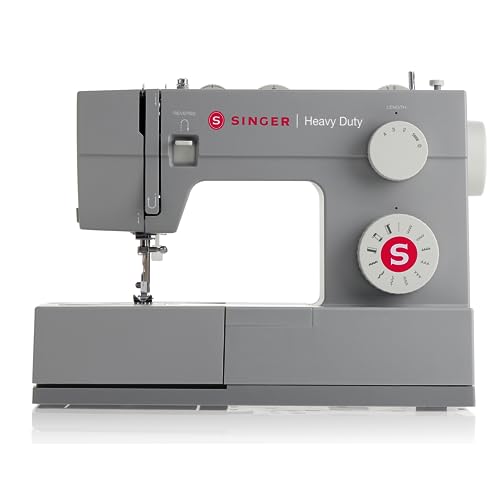
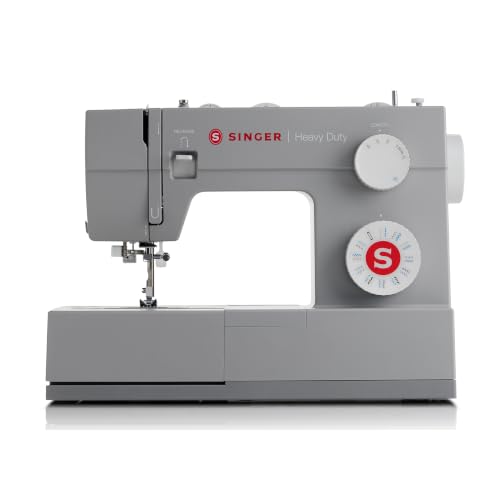
Amazon boxes cover only the specifically verified listings above. Manufacturer and dealer options without a verified ASIN are discussed separately. Bundle contents, condition and availability need checking in the current offer.
The hardest seam is the right test
A material name is not a thickness specification. Thin canvas, folded denim, webbing, coated fabric, and upholstery stacks present different feeding and needle demands. Take a sample containing the junction that caused difficulty on your current machine.
Watch the start, the raised portion, and the return to a flat seam. Check for skipped stitches, deflection, or a sudden change in stitch length. Stop if the motor stalls or the work has to be pulled through. A machine that performs on two flat layers has not demonstrated suitability for every project using that material.
Compare the relevant equipment categories using the sewing machine buying guide.
A walking-foot attachment is not an industrial feed system
A domestic attachment can be useful for coordinating layers in compatible operations. It has its own installation and operating restrictions. An industrial unison-feed machine is designed around a different feeding arrangement, with corresponding needle, thread, station, and maintenance requirements.
If your workload is occasional home décor, an appropriate domestic machine may be enough. If it is repeated heavy layered seams for orders, compare the industrial category seriously. The dividing question is the complete seam and production workflow, not a marketing adjective.
For related sewing preparation and problem-solving, see the sewing techniques and troubleshooting.
Singer Heavy Duty models differ in useful ways
The 4411, 4423, 4432, and 4452 should be compared by exact stitches, buttonhole operation, and supplied kit. Singer’s stitch-application numbers describe techniques rather than an equal number of separate built-in patterns. Read the chart before comparing totals with another brand.
The 8832 is a warehouse edition requiring its own package checks. A larger-looking model number or a different color does not establish industrial capacity. A better accessory package matters only when it addresses a real feeding or construction need.
Explore accessory categories in our sewing machine parts and accessories; use the exact manufacturer manual for compatibility and maintenance.
Needles, thread, and access matter with the machine
Choose the needle system and size from the exact manual and the material/thread combination. For industrial equipment, a household needle with a similar size marking is not automatically compatible. Ask the supplier to demonstrate your intended setup.
Also check seam access. A flat panel may sew well while the final seam in a partly assembled bag is awkward to reach. Plan the construction order and, where needed, evaluate another bed configuration. Better piercing alone does not solve every access or handling problem.
Compare complete ownership costs
For a domestic machine, include the feet, support surface, needles and service you actually need. For an industrial station, include motor, table, controls, electrical setup, delivery, assembly and maintenance. A head-only listing is not comparable with a ready-to-sew package.
Do not buy a complicated station solely to avoid one occasional household repair. Equally, do not expect a portable domestic machine to deliver every industrial operation because it is inexpensive. Choose the category that fits the repeated workload and the practical support available to you.
Five advantages and two limitations
Advantages
- Actual seam samples reveal meaningful capacity limits.
- Pressure and accessory choices can improve suitable household workflows.
- Industrial feeding offers a distinct comparison for layered production.
- Exact model identification clarifies buttonholes and kits.
- Complete-cost comparisons reduce misleading bargains.
Limitations
- Heavy Duty is not a universal or industrial performance guarantee.
- The wrong needle, feed category or seam access can defeat an otherwise suitable machine.
Check the exact listing and documentation
Singer 4411: Check Singer 4411 listing
Singer 4423: Check Singer 4423 listing
Singer 4432: Check Singer 4432 listing
Singer 4452: No products found.
Singer 8832: Manufacturer information for Singer 8832
Brother ST371HD: Manufacturer information for Brother ST371HD
Juki DNU-1541: Manufacturer information for Juki DNU-1541
Frequently asked questions
What is the best heavy duty sewing machine?
There is no universal winner. Match the seam stack, feed system, needle/thread setup, workload and support before comparing models.
Can a Singer Heavy Duty replace an industrial walking-foot machine?
Do not assume that. A domestic attachment and industrial unison feed are different systems.
Does a stronger motor guarantee better results?
No. Feeding, control, needle suitability, stitch formation and seam access also matter.
Which Singer model has the useful extra kit?
The 4452’s reviewed manufacturer package lists additional attachments. Check the exact current seller’s contents.
Is a heavy duty Brother industrial equipment?
A household model such as ST371HD remains a domestic category. Evaluate an industrial machine separately for repeated heavy production.
Related Practical Textile guides
Explore sewing, embroidery, dyeing, printing and other fabric topics at Practical Textile.
Sources and research method
Manufacturer pages, product documentation and exact listing identities were checked on 2026-10-13. Feature-based recommendations are editorial judgments; they are not measured performance results. Availability, software requirements, packages and lifecycle can change.
- https://www.singer.com/products/singer-heavy-duty-4411-sewing-machine
- https://www.singer.com/products/singer-heavy-duty-4452-sewing-machine
- https://help.singer.com/en-US/heavy-duty-8832-2376758
- https://www.brother-usa.com/p/sewing/ST371HD
- https://www.juki.co.jp/industrial_e/products_e/lether_e/flatbed_e/detail.php?cd=DNU-1541_E
- https://www.singer.com/products/singer-4423-heavy-duty-sewing-machine
- https://www.singer.com/products/singer-heavy-duty-4432-sewing-machine
- https://www.singer.com/products/singer-heavy-duty-8832-black-sewing-machine

